
South Korea puts AI and robotics to work on farms
Dutch greenhouse software and research partnerships support smarter growing
South Korea is applying artificial intelligence and robotics to agriculture as labor shortages and limited farmland put pressure on growers. Dutch greenhouse software, crop technology and research expertise are finding partners in a country with strong capabilities in electronics and advanced manufacturing. Recent business and research initiatives show where the two countries can develop and test solutions together, from autonomous greenhouse management to crop monitoring.
South Korea is seeking to become a global powerhouse. Whoever wanders the streets of Seoul does not have to look far for innovations. AI services, cashless payments, delivery robots and automated stores are already familiar parts of daily life. Agriculture is also moving toward more sustainable, technology-intensive production. During an official visit to South Korea in May 2026, Dutch Minister for Food Security, Fisheries and Horticulture Silvio Erkens saw the country’s investments in smart farming, AI, automation and data-driven production.
This visit was not accompanied by a business delegation. A separate Dutch horticulture mission in February 2026 involved 25 companies, including technology provider Priva. From 26 to 30 October 2026, a mission on alternative proteins brought 12 Dutch organizations to South Korea. One horticulture follow-up currently under development concerns a greenhouse project using waste heat from a steel plant. Partnerships arising from the protein mission are still being explored.
South Korea’s rapid industrial growth also helps explain its agricultural ambitions. Rapid urbanization and rising incomes drew workers away from farms, while limited arable land and an aging rural population increased pressure on food production. The country is now applying its experience and strong capability in electronics, robotics and manufacturing to smart greenhouses, autonomous machinery, AI crop monitoring, vertical farming, and data-based production. Labor shortages, climate change, and limited resources are adding urgency.
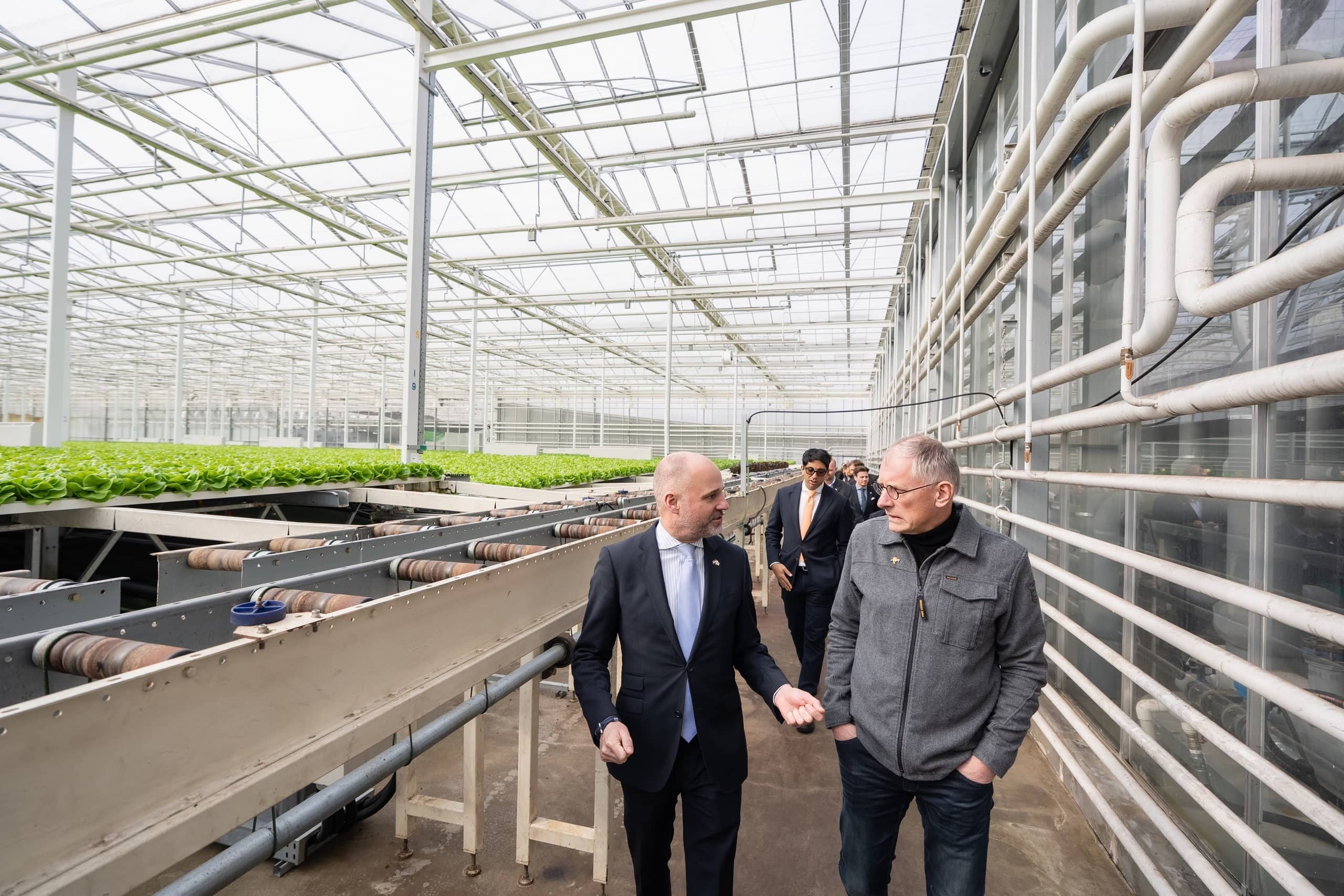
NL trade mission visit to Essence farm in Icheon, South Korea: Asia's largest leafy greens greenhouse, powered by Dutch technology
Dutch greenhouse know-how meets Korean manufacturing
The two countries bring different strengths. Dutch small and midsize companies specialize in practical technologies for sustainable agriculture, including precision farming, greenhouse climate control and food processing. South Korean companies can contribute electronics, robotics, large-scale manufacturing, and access to a demanding domestic market. Cooperation also extends to alternative proteins, where Dutch expertise in ingredients and production processes meets Korean food technology. Existing links, including Korean food research in Wageningen, provide a basis for further partnerships.
‘South Korea excels in food-waste recycling, while Dutch companies bring expertise in circular production and turning waste into useful materials’
Food-waste recovery is another possible area for cooperation. South Korea has extensive food-waste collection and recycling systems, while Dutch companies have expertise in circular production and turning waste into useful materials. Korean industrial groups often have more capital and manufacturing capacity than smaller Dutch technology companies. A concrete example of cooperation is SK Networks’ strategic investment of $2 million in 2023 in Dutch greenhouse AI company Source.ag. Such investments can help promising agricultural technologies reach a commercial scale.
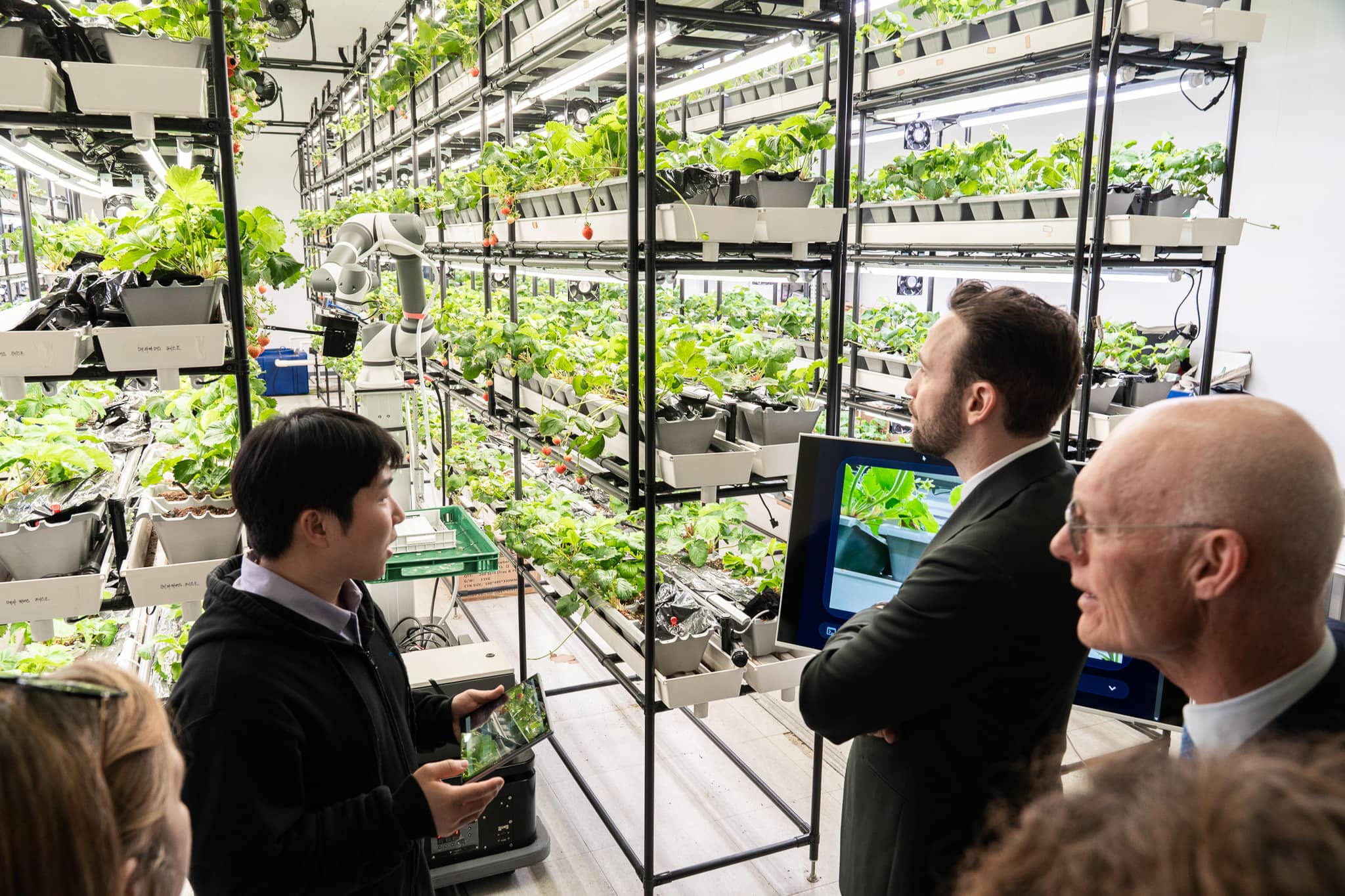
Dutch Minister’s Visit to Metafarmers: Demonstration of AI strawberry-harvesting robot
AI climate control and harvesting robots reach farms
Dutch greenhouse technology is already being used in South Korea. Blue Radix supplies autonomous greenhouse climate software through a subscription model. One of its Korean users is SP Agri, which operates a high-tech strawberry greenhouse in Seosan. There, Blue Radix software works alongside Priva climate controls to manage temperature, humidity and energy use with fewer routine interventions. Such combinations of equipment and software are bringing autonomous greenhouse production closer.
Korean technology companies are developing their own tools. Daedong is working on autonomous tractors and agricultural robots, including AI-based systems for unmanned field operations. Other startups are developing AI tools for pig farms and harvesting robots. M3sen offers a real-time AI management platform for livestock farmers, while Metafarmers develops robots for harvesting soft fruit and vegetables. During the May 2026 ministerial visit, the Dutch delegation saw its computer-vision and robotic-gripper technology.

Korean food businesses such as CJ and Samyang have established a presence around Wageningen, linking industrial expertise with Dutch agricultural research. CJ has an R&D center there, offering a concrete connection in food biotechnology.
The World Horti Center in the Netherlands has also attracted substantial interest from South Korean horticulture: South Korea is its largest international visitor group. Opened in 2023, World Horti Center Korea was the center’s first permanent overseas branch; the other is in China.
‘Korean food businesses have established a presence around Wageningen, linking industrial expertise with Dutch agricultural research.’
Research partnerships test crops and robotics
Research institutions are building ties as well. Since 2025, South Korean organizations have been able to participate in Pillar II of Horizon Europe on nearly the same terms as European partners. The program offers a route to joint research on food, agriculture, climate, and digital technology.
South Korean researchers joined the fourth edition (2024–2025) of Wageningen University & Research’s Autonomous Greenhouse Challenge. Participating teams included researchers from Korea University of Technology and Education and Seoul National University, alongside agricultural technology businesses. They tested algorithms for autonomous dwarf-tomato cultivation, weighing planting density against pest risks, and exploring early pest detection and AI-led crop decisions. The challenge demonstrated that much of a growing cycle can be managed autonomously, although pest management still requires attention.
The Netherlands Plant Eco-phenotyping Centre (NPEC) also works with Korean partners. Its ongoing projects cover digital phenotyping and digital breeding solutions. After a Seed Money Project, NPEC is exploring broader AI-based cooperation with the Korea Institute of Science and Technology (KIST) and Daedong, while separate work is funded by South Korea’s Rural Development Administration (RDA).
The Netherlands Agricultural Network (LAN) team at the Dutch Embassy in Seoul organized the horticulture and alternative-protein missions and helps connect Dutch companies and researchers with Korean partners. In 2027, the team plans to organize a networking event and a scoping mission on AI applications in horticulture. Following the October 2026 protein mission, the team also intends to support scientific cooperation, business matchmaking and R&D partnerships in precision fermentation, microalgae, and cell cultivation.
More information
Would you like to know more about autonomous greenhouses, agricultural robotics or Dutch-Korean research partnerships? You can go to the country page of South Korea on this website. You can also send an email to the LAN team at the Dutch Embassy in Seoul: seo-lvvn@minbuza.nl.