
Field trials and data cooperation shape a Dutch-Belgian smart farming agenda
Local validation and lower costs can accelerate adoption of smart farming techniques
Belgium and the Netherlands face many of the same agricultural pressures: an aging farming population, climate change, high land prices, the energy transition, and the need to produce more sustainably. Yet many Belgian farmers are cautious about digitalization and robotization. Through market studies, missions, field trials and trade fair visits, the Netherlands Agricultural Network (LAN) team at the Dutch Embassy in Brussels connects Dutch technology developers with Belgian researchers and farmers and supports Dutch companies entering the Belgian market.
Belgium has several research organizations working on agricultural innovation. The Flanders Research Institute for Agriculture, Fisheries and Food (ILVO) works on agricultural data platforms and precision farming; Inagro on robotics; the Flemish Institute for Technological Research (VITO) on remote sensing; and the Walloon Agricultural Research Centre (CRA-W) on robotics, artificial intelligence and precision farming. The institutes conduct trials and disseminate results. Together with Belgium's highly educated farmers, they provide opportunities for Dutch developers to test technologies under local conditions.
Belgium has several research organizations working on agricultural innovation
Multi-year program on smart farming in open-field agriculture
The LAN team in Brussels launched a multi-year program to support Dutch smart farming companies entering the Belgian market. Market studies in Flanders and Wallonia were followed by an incoming mission to the Netherlands in June 2024, an innovation mission to Belgium in December 2025 and a visit with Dutch agritech companies to the Libramont agricultural fair in July 2026. The LAN team plans to attend Agribex in 2027 and is preparing further activities around Libramont.
The LAN team's market studies found that Belgian farmers use smart farming techniques to a limited extent. A recurring response was: ‘Nice, but not for me.’ Many Flemish farmers want new machinery to be independently tested under local conditions before buying it.
Dutch company Odd.bot is having its weeding robot tested by Inagro as part of the Interreg Flanders–Netherlands Smart Farming & Food Processing project. The trials can help the company adapt its machine to Belgian conditions and provide farmers with independent evidence of its performance. Comparable Interreg projects involve technologies from Dutch companies Fieldworkers and Trabotyx.
Other barriers include uncertainty about returns and time savings, high investment costs, data ownership and privacy concerns, limited interoperability and technical know-how, and relatively small plots.
According to the LAN team's 2024 market studies, farmers already use technologies such as differential GPS (DGPS), real-time kinematic GPS (GPS-RTK), field maps, and site-specific applications for crop protection, fertilization, and irrigation. Management of information systems, satellite imagery, crop sensors, drones, mechanical weeders, laser weeding machines, and soil scanners are less widespread. Agricultural contractors use GPS applications more frequently than individual farmers. The studies identify precision crop-protection applications as a promising area for growth.
‘Local field trials can make the difference between an interesting technology and one farmers are willing to adopt’
Lower costs and better guidance can drive adoption
During the June 2024 incoming mission to the Netherlands, Belgian participants visited the Agri Innovation Center at Aeres University of Applied Sciences, the Farm of the Future, ERF Landmanagement and Pixelfarming Robotics. At a Dutch-Flemish-Walloon trilogue, participants discussed barriers to wider adoption and possible solutions.
Participants identified subsidies, tailored policies, tax incentives, and good infrastructure as conditions that could support investment. Developers also need to consult farmers and adapt innovations to their requirements. Leasing arrangements and cooperatives could lower investment costs, while practical examples and advice from a technology coach could help farmers with less experience of digital tools. Participants also called for cooperation among farmers, retailers, educational institutions, policymakers, and consumers.
The mission laid the groundwork for possible cooperation between the Netherlands, Flanders and Wallonia on a Code of Conduct for Data Use in Agrifood. In July 2025, the LAN team and five Dutch smart farming companies, including Fieldworkers, Rapagra and Odd.bot, participated in the Walloon organic-sector event Journée interprofessionnelle du Bio. The companies demonstrated technologies to the region's organic farming sector. According to the LAN team, participation helped raise the profile of Dutch smart farming suppliers in Belgium.
Belgian participants visit ERF Landmanagement
Agribex shows how cooperatives can lower barriers
The December 2025 innovation mission brought Dutch companies and research institutes, including TNO, Aeres University of Applied Sciences and Odd.bot, into contact with partners in Flanders and Wallonia. Flemish research offered remote-sensing techniques capable of gathering information through cloud cover, while Walloon drone applications showed possibilities for sowing new crops into standing fields. The Walloon organic sector was also identified as a potential market for Dutch smart farming technologies.
At the Agribex fair in Brussels, Dutch participants saw how Belgian cooperatives Unigrow and Ingro as well as farmers' organization Boerenbond support smart farming through financial incentives, loans, training and joint purchasing. These arrangements are particularly relevant where high upfront costs discourage investment.
Dutch participants in the innovation mission in 2025 meet Dutch Minister of Agriculture, Fisheries, Food Security and Nature Femke Wiersma and several Belgian stakeholders at the Agribex trade fair.
WALLeSmart puts data ownership on the agenda
The use of farm data was another topic during the mission. A Flemish farming pioneer put it this way: ‘You have only worked hard once you have looked at your data, not when you have spent hours on the tractor.’ In Wallonia, the WALLeSmart platform, an initiative of the Walloon Region associated with Digital Wallonia, brings together farmers' data from different applications. It addresses data ownership and privacy and aims to reduce administrative work for farmers.
Discussions now focus on the possibility of forming a Benelux frontrunner group within the Common European Agricultural Data Space (CEADS). Dutch participants in the innovation mission supported closer cooperation on agricultural data. At the request of ILVO and BO Akkerbouw, the LAN team is organizing a meeting in November 2026 at the Dutch ambassador's residence in Luxembourg. ILVO, BO Akkerbouw, Wallonia's WalDigiFarm and prospective Luxembourg partners are to explore whether agricultural data platforms in the Netherlands, Flanders, Wallonia, and Luxembourg can be connected. No agreement on a shared platform has yet been reached.
‘Data ownership and privacy are becoming just as important to smart farming as the technology itself’
Libramont tests the route to the Walloon market
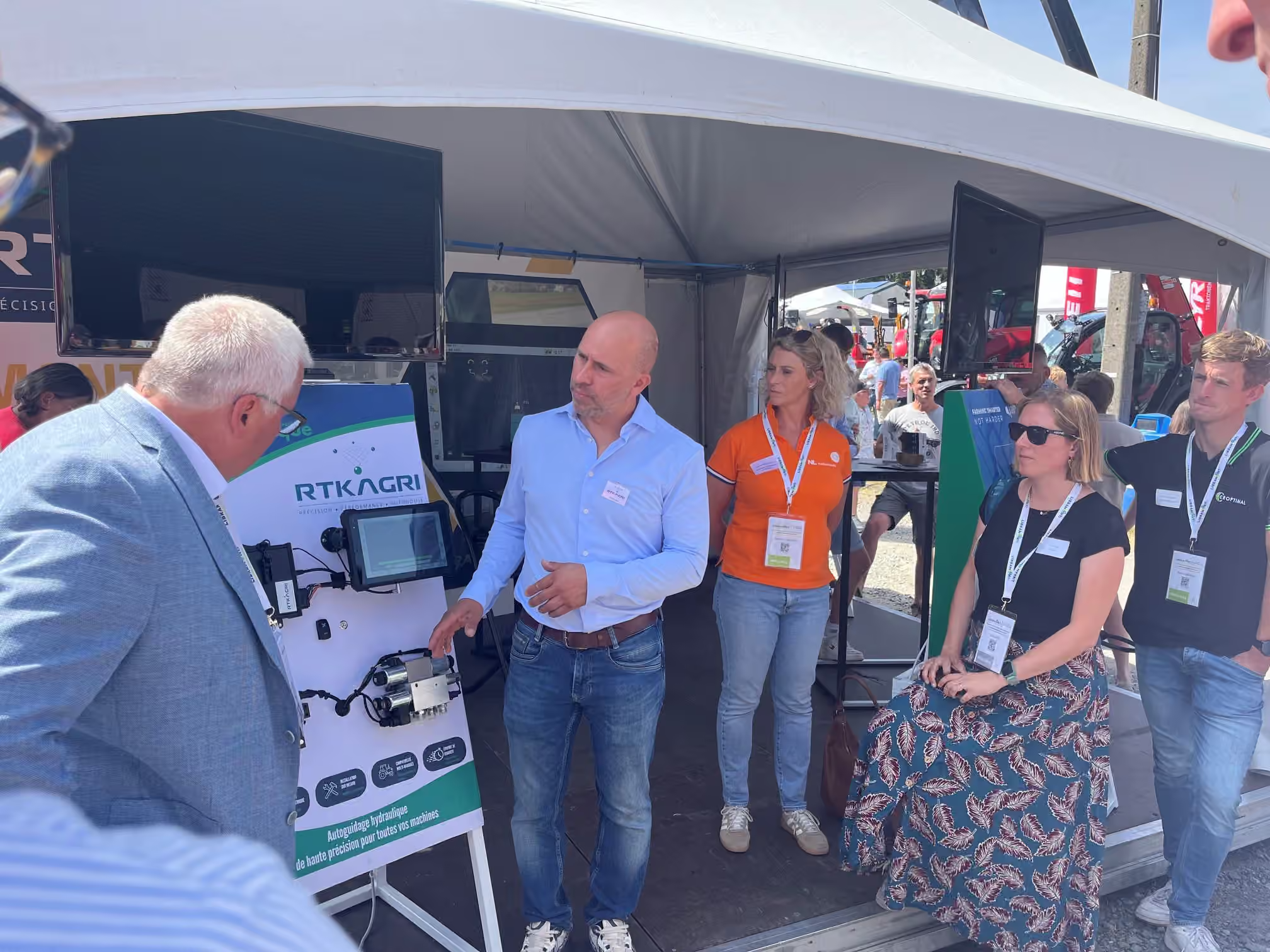
On 24 July 2026, the LAN team visited the Libramont agricultural fair with nine Dutch smart farming companies, including Fieldworkers, Flikweert Vision and the start-up Nivavi. The visit focused on contacts with Walloon farmers and potential customers and generated new contacts and market insights. For 2027, the LAN team intends to support Dutch companies participating in Scale it Agro, a side event for AgTech start-ups featuring workshops, pitch sessions, meetings with investors and a technology testing zone.
The LAN team's market studies suggest that climate change, sustainability requirements, and a new generation of farmers will encourage further digitalization and robotization in the coming years. Belgian food companies are also experimenting with digital tools. Ardo works on digital agronomy through MIMOSA+, while Colruyt Group has tested an autonomous electric tractor and has also used soil-moisture monitoring at its organic farm.
Reception of Dutch participants by the organizers of the Libramont fair
A fast lane could speed up innovation
Smart farming technologies can also help farmers meet national and European environmental requirements, including those arising from the Nitrates Directive and the Water Framework Directive. In April 2024, Flemish Agriculture Minister Jo Brouns visited the Dutch company Lely to examine its emissions-reduction technology, including the Lely Sphere system.
The Flemish nitrogen decree, published in February 2024, includes a ‘fast lane’ for innovations that have already been validated abroad, allowing them to be assessed more quickly for use in Flanders. After completion of the technical procedures, Lely Sphere was recognized on the Flemish ammonia emissions (AER) list in July 2025. According to the LAN team, Flemish dairy farmers can consequently apply for grants covering up to 80% of its installation costs under the Flemish Agricultural Investment Fund (VLIF).
Researchers at Wageningen University & Research, the Netherlands Organisation for Applied Scientific Research (TNO), ILVO, and VITO have developed joint measurement standards for assessing source-oriented and end-of-pipe emissions-reduction techniques, including air scrubbers. The standards were submitted to Dutch Minister Van Essen of Agriculture, Fisheries, Food Security and Nature in April 2026 and are being evaluated by the Flemish government. If validated, the standards could also be used in Flanders.
More information
If you would like to know more about Dutch-Belgian cooperation on smart farming, including field trials, data cooperation and market opportunities, visit the country page of Belgium or contact the LAN team at the Dutch Embassy in Brussels: bru-lvvn@minbuza.nl.