
On 29 April 2026, a workshop titled “Unlocking Value in Aquaculture: Business Models and Partnerships from Vietnam–Netherlands Cooperation,” was held in Ho Chi Minh city, brought together nearly 100 representatives from government agencies, businesses, research institutions, and aquaculture communities from both Vietnam and the Netherlands to explore how to unlock value in Vietnam’s aquaculture sector for sustainable development.
The workshop is held within VinaFIS Expo 2026 – Vietnam's first international exhibition on fisheries science and technology, organized by the Vietnam Fisheries Society (Vinafis) and the Ministry of Agriculture and Environment (MAE).
A true partnership
“Our collaboration is not just about sharing knowledge from the Netherlands to Vietnam; it's a two-way street,” Ms. Raïssa Marteaux, Consul General of the Kingdom of the Netherlands stressed in her opening speech at the workshop. “We are here to learn as much as we are here to share. Through various projects, Dutch businesses work closely with Vietnamese partners, learning from their local insights and farming experience to better adapt Dutch expertise to the local context.,” Ms. Raïssa Marteaux added.
Ms. Raïssa Marteaux, Consul General of the Kingdom of the Netherlands at the event
New phase of collaboration
Assoc. Prof. Dr. Nguyen Quang Hung, Deputy Director General of the Directorate of Fisheries and Fisheries Surveillance (MAE) meanwhile shared that Vietnam’s aquaculture sector has seen strong growth in recent years, affirming its role as one of the country’s key production industries. During the 2020 – 2025 period, aquaculture farming area remained stable at around 1.3 million hectares, while output increased from approximately 4.7 million metric tons to over 6.1 million metric tons. Export turnover from aquaculture exceeded US$8 billion in 2025, helping position Vietnam among the world’s leading aquatic product exporters.
Cooperation between Vietnam and the Netherlands, built over more than 50 years on trust, and mutual benefits, has continued to deepen with expanded policy dialogue, workshops, and practical cooperation in aquaculture. Several key directions include reorganizing production along the value chain, accelerating the application of science and technology and digital transformation, and promoting sustainable aquaculture.
Shifting toward value-added and efficiency-driven growth
At the workshop, Mr. Ngo The Anh, Director of the Aquaculture Division at the Department of Fisheries and Surveillance shared, Vietnam is the third-largest seafood exporter globally, after China and Norway. Vietnam boasts a 3,260-kilometer coastline and about 1 million square kilometers of marine area, alongside an extensive network of rivers, estuaries, and canals, as well as the Red River and Mekong basins.
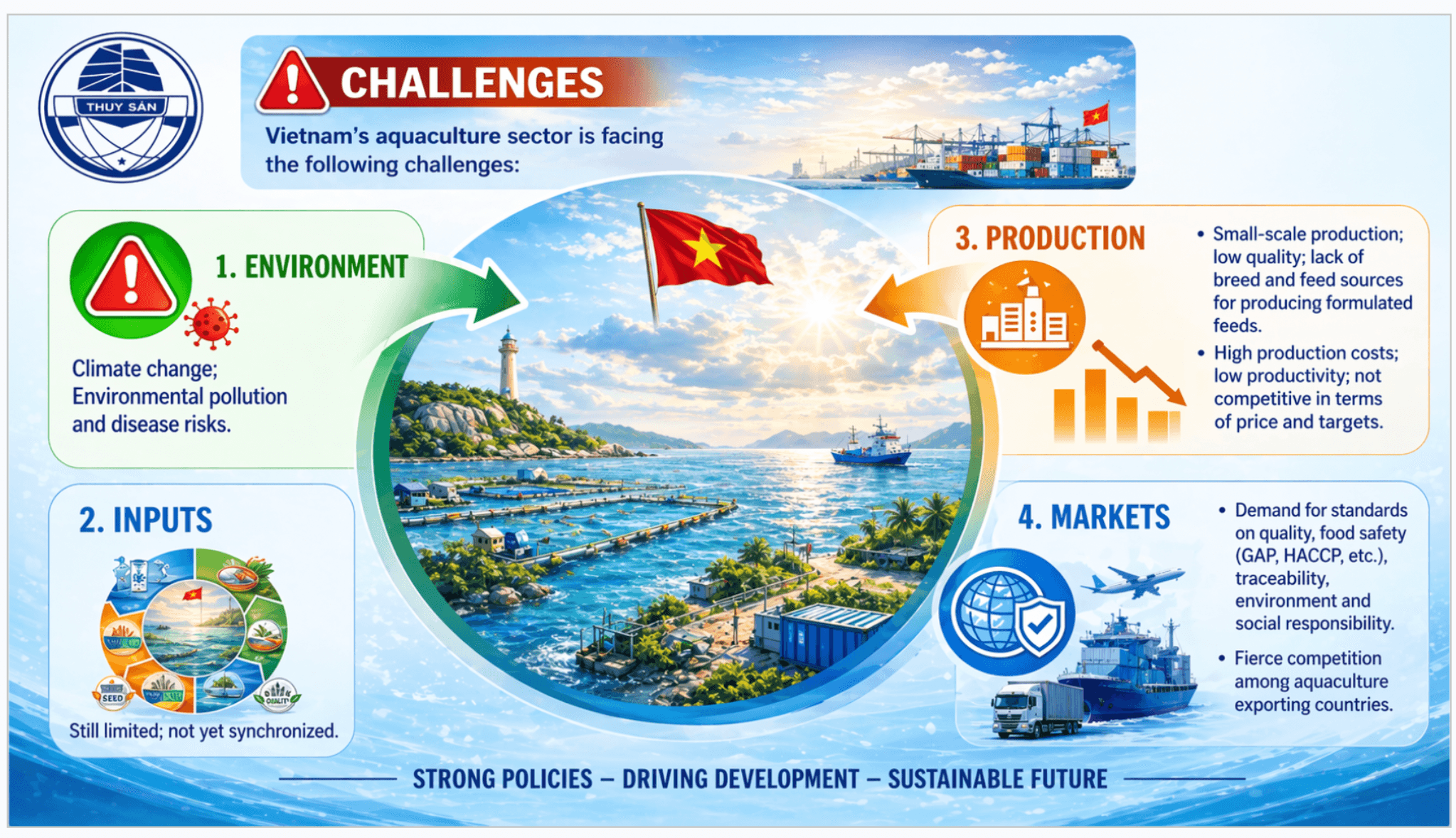
From 2020 – 2025, exports experienced fluctuations, notably a decline in 2023 (USD5.5 billion), but rebounded strongly by 2025, exceeding USD8 billion. Overall, the sector is shifting towards value-added and efficiency-driven growth. Notably, Vietnam’s aquaculture sector is facing multiple challenges. Environmental pressures include climate change, pollution, and disease risks. Input supply remains limited and not yet well synchronized. Production is still largely small-scale and low in quality, with shortages of breed and feed sources for formulated feeds, alongside high production costs, low productivity, and weak price competitiveness.
Meanwhile, export markets are imposing increasingly stringent requirements on quality, food safety standards such as GAP and HACCP, traceability, as well as environmental and social responsibility; while competition among aquaculture-exporting countries continues to intensify.
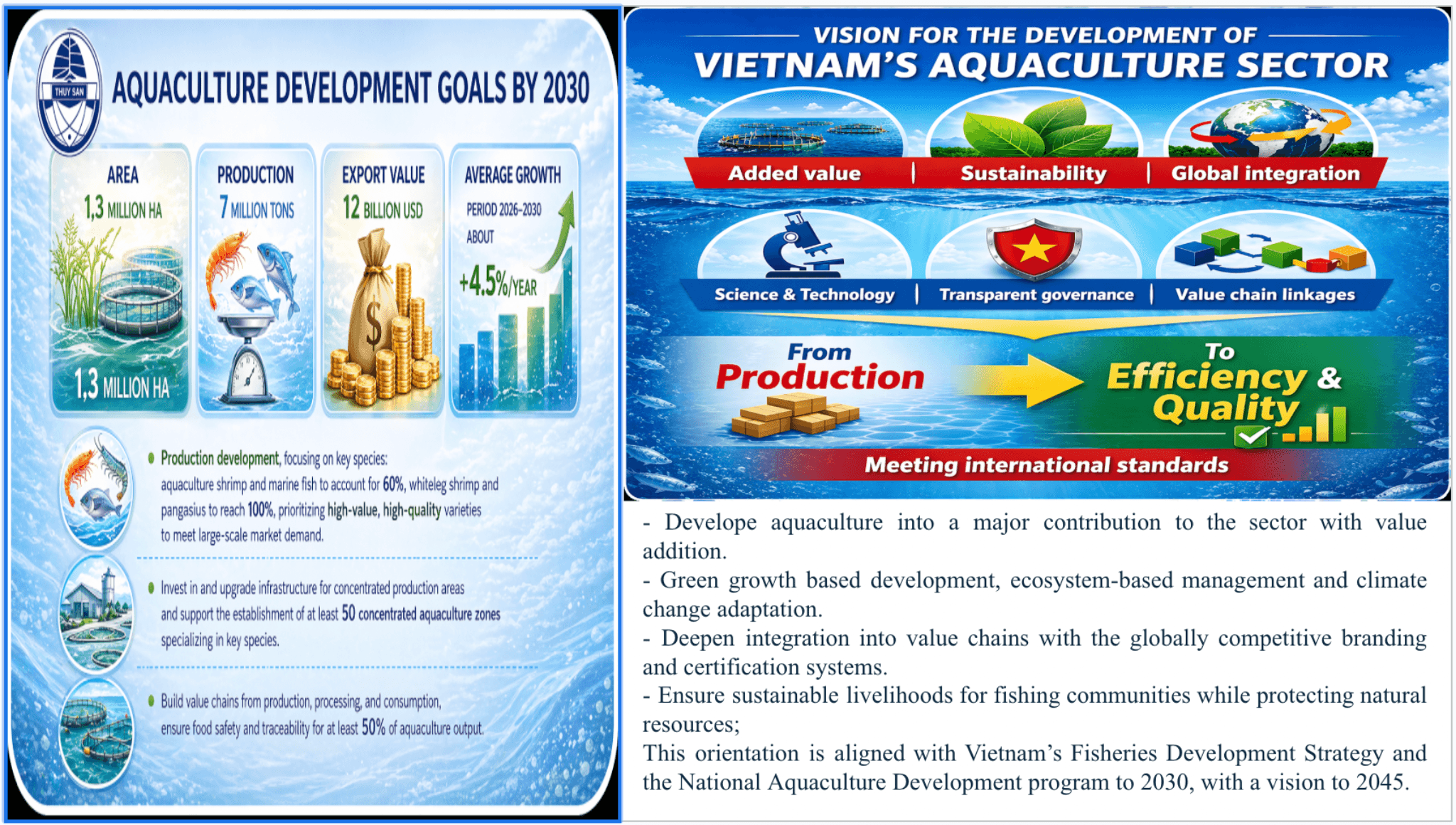
Vietnam’s aquaculture development goals by 2030 include maintaining its farming areas at 1.3 million hectares, achieving a production output of 7 million tons, and reaching an export value of US$12 billion, with an average annual growth rate of about 4.5% during 2026 – 2030 period, The focus will be on added value, sustainability, and global integration, supported by technology, transparent governance, and stronger value chain linkages, shifting from production-driven growth to efficiency and quality while meeting international standards.
Vietnam-Netherlands aquaculture cooperation in practice
One of the workshop’s highlights was a panel discussion themed “Vietnam–Netherlands Aquaculture Cooperation in Practice,” featuring flagship sustainable aquaculture projects in the Mekong Delta under the Combi-Track program.
Moderated by Nguyen Huong Lan, Agricultural Advisor at the Embassy of the Kingdom of the Netherlands in Vietnam, the panel explored how Combi-Track projects are driving change at the farm level; discussed genetics, animal health, and disease prevention as fundamental elements of productivity and resilience; and examined the competitiveness of Vietnam’s aquaculture sector in a changing global market.
During the discussion, Ms. Hien Le from Agriterra, representing the MACIB project (Making Aquaculture Cooperatives in the Mekong Delta Inclusive and Bankable), shared that farmers are generally reluctant to change, especially under current pressures such as high production costs and increasing market demands, and their first concern is usually about cost and who will pay for new practices or technologies. However, she noted that change can be driven by pioneer or risk-taking farmers who are willing to experiment with new approaches, apply new technologies, and run pilot models. These pioneers play a key role in demonstrating practical results, as farmers tend to trust what they see rather than what they hear, making successful examples essential for wider adoption and scaling of new practices.
Mr. Rogier Becker of Larive International, representing the ShrimpTech Vietnam project, identified two key gaps in Vietnam’s shrimp farming sector: weak traceability and transparency, and high production costs driven largely by high mortality rates linked to disease pressure. The main solutions are developing digital systems to improve traceability and transparency in a way that is accessible for both small and mid-sized farmers. He also suggested addressing disease and mortality through a collaborative solution involving better genetics, improved farming technologies, and stronger animal welfare.
Workshop attendees were also shown a documentary movie introducing the Combi-Track project. Launched in 2022, the program was designed to turn shared ambitions into practical, scalable solutions. What makes Combi-Track special is its integrated approach, which mobilizes relevant public and private stakeholders to work together supporting the growth of climate-smart and sustainable aquaculture. It brings together Dutch and Vietnamese stakeholders, from government to business, farmers, and academia, to work out innovations that are not only technically sound, but also economically viable and environmentally responsible.