
Dutch agrifood innovation finds partners in the Western Balkans
Research, precision farming and algae production link Dutch and regional expertise
Dutch companies and research institutions are working with partners in the Western Balkans to develop and test agrifood innovations. From climate-smart agriculture and precision farming in Serbia to algae production in Albania, the collaborations combine Dutch expertise with local knowledge, large-scale production facilities and favorable growing conditions. The Netherlands Agricultural Network (LAN) team at the Dutch Embassy in Belgrade connects Dutch businesses and research institutes with partners in the Western Balkans through trade missions, studies, visits and other events.
The Western Balkans rarely make the shortlist when Dutch agrifood companies look for innovation partners. Yet research institutions and businesses across the region offer opportunities to test technologies and develop new products through international collaboration. None of these are one-way exports of Dutch know-how. Each is a working partnership that draws on knowledge and resources from both sides.
The LAN team at the Dutch Embassy in Belgrade, which covers all six Western Balkan countries (Serbia, North Macedonia, Albania, Bosnia and Herzegovina, Montenegro, and Kosovo), has spent years building and maintaining relationships between Dutch and regional partners. Three projects illustrate cooperation in research, commercial farming, and the development of new ingredients.
‘Research institutions and businesses across the Western Balkans offer to test technologies and develop products through international collaboration'
BioSense connects research with climate-smart farming
In the Serbian city of Novi Sad, BioSense Institute (a Serbian public research institute) has grown in less than a decade from a university research group into a 7,000 m² campus where around 170 scientists work on artificial intelligence, robotics, satellite data and precision agriculture.
Wageningen University & Research, a Dutch public research university, has been a key partner in this work from the start. Together, the two institutions entered the ANTARES project in Horizon 2020's Teaming for Excellence call, an EU scheme that pairs promising research institutes with a leading European university. Wageningen took the role of BioSense's official 'advanced partner'. ANTARES came first out of around 200 proposals and was the only winner from outside the EU. The project received €28 million in funding, with €14 million from the EU and the rest from the Serbian government and a European Investment Bank loan. That funding helped build BioSense's current campus in Novi Sad.
The partnership continues through the Farming with Climate Initiative, three linked Horizon Europe projects in which both Wageningen and BioSense play central roles. Climate Smart Research uses 29 research stations across Europe to test climate-smart farming practices, tools and decision-support systems. Climate Farm Demo demonstrates these approaches on around 1,500 farms in 28 countries, with BioSense helping to coordinate the network and its demonstration events. Climate Smart Advisors trains advisers to share the results with farmers. The experiences of farmers and advisers feed back into research, linking science and practice.
For Dutch AgTech companies, BioSense offers a place to test and validate new solutions under real farming conditions. As a European Digital Innovation Hub, it runs Living Labs that test new technologies directly in the field, and connects Serbian farmers, entrepreneurs and researchers with market-ready digital solutions. Its research capacity is supported by long-term European partnerships.
Beeld: © BioSense Institute
Researchers at BioSense Institute in Novi Sad working with advanced laboratory equipment
‘Within the region, Serbia combines digital-agriculture research with some of the largest commercial farming operations’
MK Group tests Dutch precision technology at scale
In the Vojvodina region, MK Group (a private Serbian agribusiness group) offers large-scale commercial conditions for testing agricultural technology. As one of the Western Balkans' largest agribusinesses, it cultivates close to 9,900 hectares. 70% of it is irrigated through PIK Bečej, its farming company. PIK Bečej produces more than 200,000 metric tons of field and vegetable crops annually. That scale is valuable to Dutch technology suppliers looking to demonstrate new sensors and digital farm-management systems under commercial conditions. By comparison, Dutch farms had an average of 37 hectares of agricultural land in 2025.
MK Group has already put Dutch precision technology to work through the DHI program, a Dutch government scheme that co-funds technology demonstrations abroad. The Dutch agri-data company Dacom, now part of CropX, installed soil sensors and weather stations on irrigated plots at MK Group's PIK Bečej farm. They collect weather and soil data, and Dacom's software turns it into advice on when and how much to irrigate. The same system can also help warn of fungi and crop diseases. The system is designed to support more targeted irrigation and avoid unnecessary water use.
BioSense and MK Group illustrate two stages of an innovation process: research and development, followed by large-scale commercial validation. Both can offer opportunities for Dutch AgTech companies exploring the wider region.
Beeld: © MK Group
Checking data from a Dacom sensor station in an irrigated field at MK Group's PIK Bečej farm
Algae Biotech Albania combines production with Dutch research
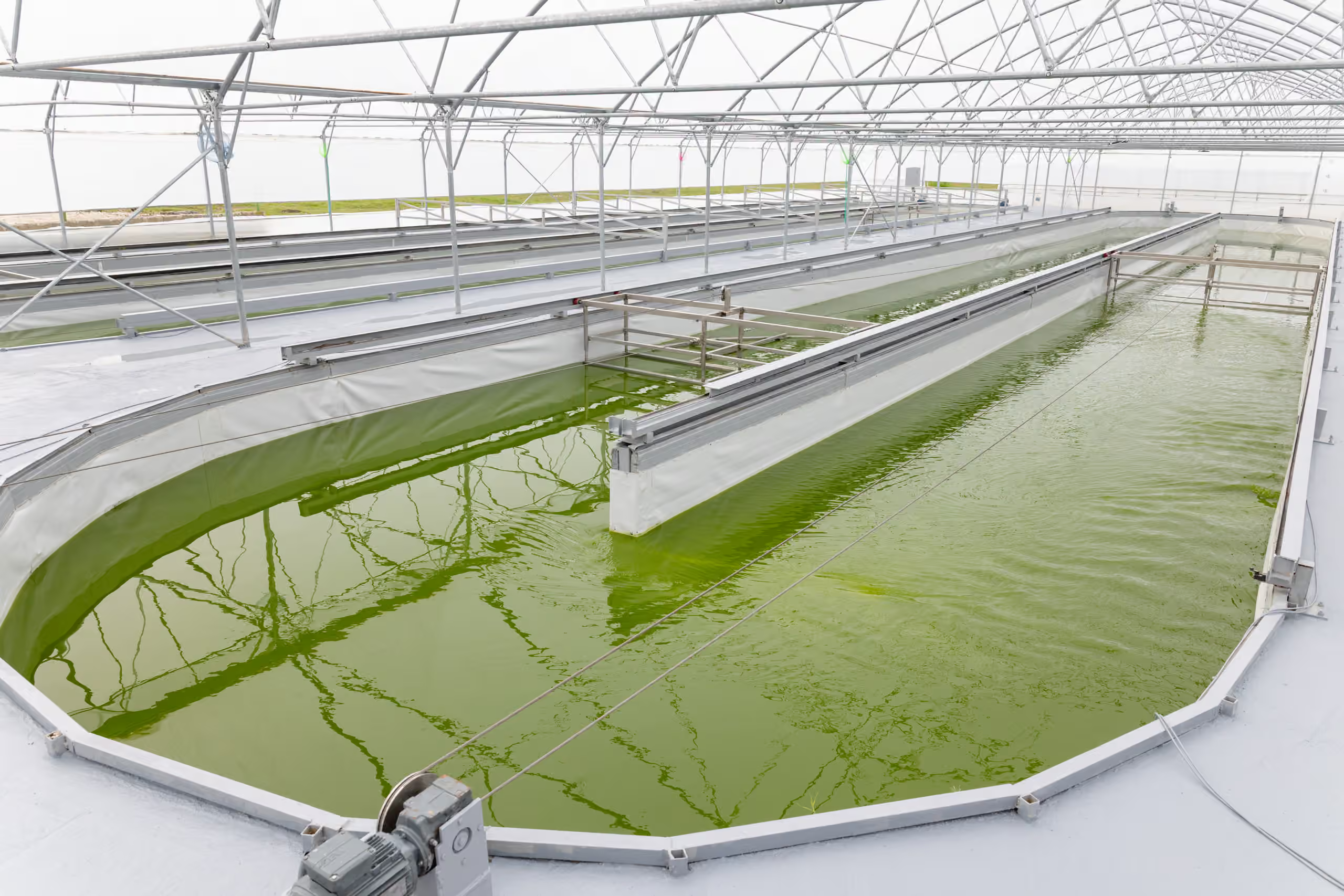
Several hundred kilometers to the south, in Tirana, Algae Biotech Albania (ABA), a private Albanian algae producer, cultivates microalgae. It grows spirulina and chlorella using its own patented strains. Production runs on a hybrid system: open ponds combined with photobioreactors, chosen to balance cost against quality. Established about three years ago, ABA has been operating steadily for over two years and is now scaling up together with local farmers in a cooperative structure.
ABA already supplies premium-grade algae ingredients to customers across Europe and is now developing algae-based biostimulants and biopesticides: plant-care products made from sustainable, natural raw materials. Alongside new ingredients, this work also concerns applications for resilient crops. Albania's near year-round sunshine helps keep production costs low, under conditions that are difficult to replicate in Dutch greenhouses.
ABA also has strong Dutch links. Its commercial arm, Allgae Solutions, is led from the Netherlands and handles product development, sales and marketing for European customers. Its research and development are carried out together with ACRRES, Wageningen University & Research's applied research centre for green raw materials, where microalgae are being turned into plant biostimulants and biopesticides. ABA also works with Viride, a private German algae producer growing algae in large open seawater ponds in Morocco. A similar project in Albania is in preparation.
The partnership combines an Albanian production base with Dutch research, sales through a Dutch commercial partner, and links to a wider European algae network. For Dutch agrifood investors and biostimulant producers, it offers lower-cost, sun-rich production capacity alongside Wageningen research expertise.
Agricultural counselor Michiel van Erkel giving a speech at the Orange Pavilion at the Novi Sad Agricultural Fair 2026
Opportunities for Dutch agrifood companies
The three partnerships cover different stages of agrifood innovation: research, large-scale commercial testing, and the development of new ingredients and plant-care products. Within the region, Serbia combines digital-agriculture research with some of the largest commercial farming operations.
The LAN team connects Dutch businesses and research institutes with partners in the Western Balkans through trade missions, study visits and other events. It has brought Dutch companies and knowledge institutes into contact with BioSense and helped with the DHI demonstration at PIK Bečej, where Dacom installed irrigation technology.
The team also helped organize a workshop at LoginEKO, a Lighthouse Farm in Serbia working with Wageningen University & Research, and organizes the Dutch Orange Pavilion at the Novi Sad Agricultural Fair. Its current priorities are regenerative agriculture and protected cultivation. Dutch companies interested in the region are welcome to contact the team.
More information
Would you like to know more about climate-smart agriculture, precision farming, and algae-based products in the region? Visit the country pages for the Western Balkans and Serbia, or email the LAN team at the Dutch Embassy in Belgrade: bel-lvvn@minbuza.nl.