
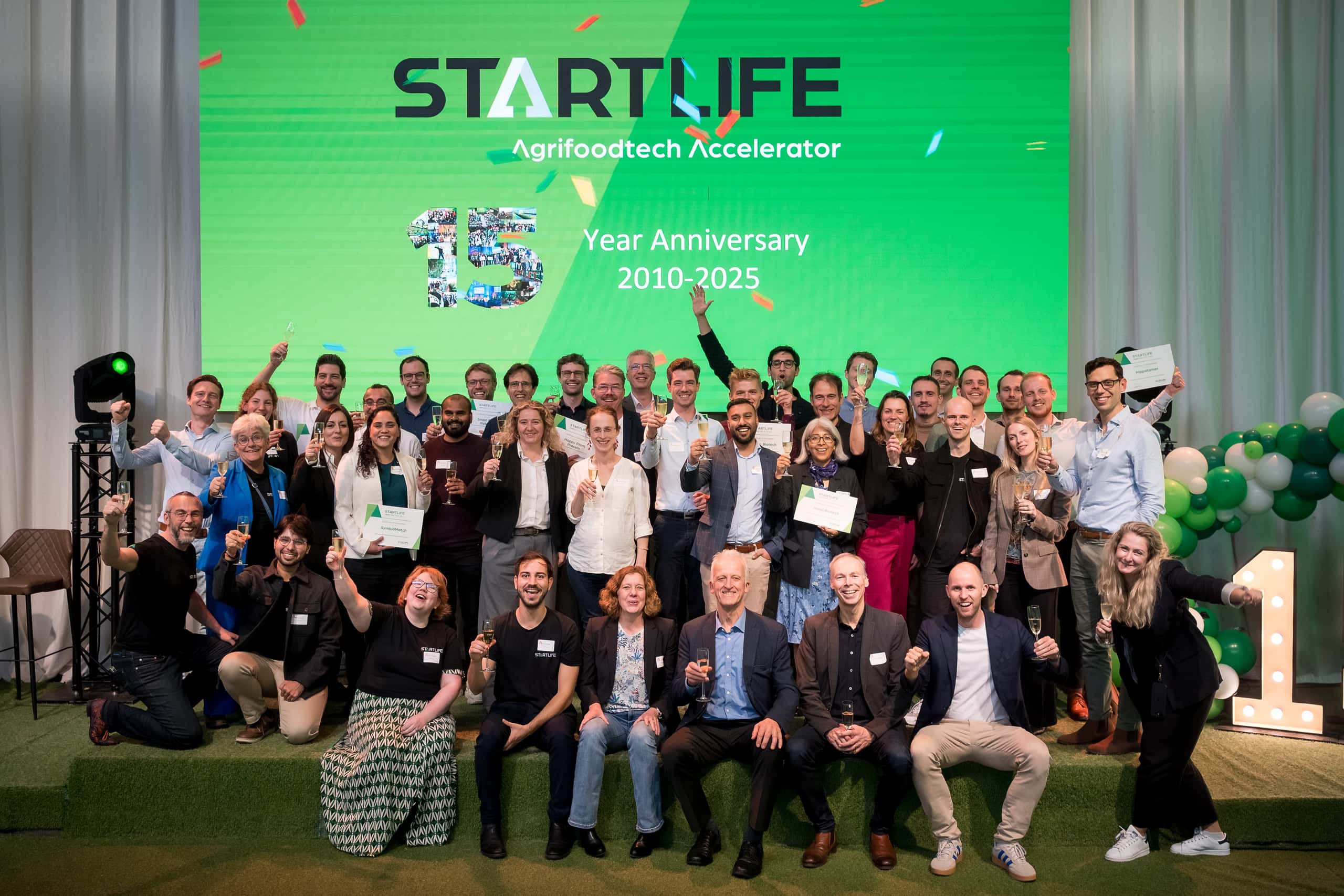
StartLife and Source.ag push for better conditions to scale
Strong ecosystem, patient capital
Though concentrated within a relatively small area, the Netherlands has all the ingredients for successful agrifood innovation: leading growers, technology companies, knowledge institutions and international networks. But developing an innovation is one thing; turning it into a successful international business is another. Rien Kamman is CEO and co-founder of Source.ag, an Amsterdam-based AgTech company developing AI software for greenhouse growers. Nicola Harrison is Managing Director of StartLife, a Wageningen-based agrifood innovation platform and startup accelerator. They discuss what makes the Dutch ecosystem strong, why agrifood companies need time to grow and how international networks can help them expand.
Rien Kamman and Nicola Harrison
Rien Kamman knows both the technology world and horticulture. Before founding Source.ag, he worked in data science and developed AI software for large companies. He and his co-founder wanted to use that expertise in an industry where technology could have a positive impact. ‘We knew we wanted to do something with food and agriculture, but we did not know exactly what. So, we spent about a year talking to probably 200 growers, from potato and dairy farmers to greenhouse growers. We asked them: what frustrates you that nobody has solved yet?’
Those conversations eventually led them to high-tech horticulture. ‘Growers told us that predicting yields was still incredibly difficult. Others were growing from one greenhouse to ten or even 30 and asked how they could standardize their operations when skilled growers are scarce.’
Source.ag now develops AI software for greenhouse growers. ‘We collect data from different sources, such as climate computers, sensors and packing systems, and build AI applications on top of that. These can predict yields, help determine the right growing strategy and even autonomously control greenhouse equipment.’ The company is active in around 25 countries.
Everything is close by
For Kamman, the Netherlands remains an exceptional place to develop this type of technology. ‘Honestly, I think it may be the premier place in the world. This is probably one of the densest areas where all parts of the value chain are present and where all those parts are world-class.’
That is particularly visible in horticulture, he says. ‘The world’s leading seed breeders are here, the leading greenhouse builders are here, the leading equipment providers are here, and some of the best growers are here. I can get in a car and within an hour be at all those places. That is a tremendous competitive advantage.’
For a young technology company, that proximity matters. ‘You need to have something that others do not have. That can be a dataset, access to the market, intellectual property, or technology. Starting an agritech company in the Netherlands gives you an enormous ability to work with people around you and keep improving your product.’
Talent is another advantage. ‘There is a lot of Dutch talent, but also a lot of international talent. We are based in Amsterdam for a reason. The growers are not there, but the AI talent is.’
Growers can gain real-time operational insights and improve decision-making with a centralized, intuitive platform
The world looks to the Netherlands
Nicola Harrison recognizes what Kamman says. She moved from the United Kingdom to the Netherlands in 2025 to lead StartLife. The organization began as a Wageningen University & Research (WUR) program for local spinouts and startups but later expanded to support AgriFoodTech companies from across the Netherlands and, eventually, from around the world.
Harrison agrees: ‘For high-tech horticulture, the world looks to the Netherlands to see what is happening here, what the innovations are and what companies are doing. Internationally, the reputation is number one.’ What surprised her was the contrast with the way the sector is viewed inside the Netherlands. ‘Nationally, it is not that well known that this is a sector that leads the world. That was a big shock to me.’
WUR illustrates why the Dutch ecosystem works, Harrison says. ‘You have the students, the scientific knowledge, and the academics, but there are also many companies on campus that want to work with researchers and innovate. When you combine that with support from regions and government, through funding, coaching, and mentoring, you create an ecosystem where companies can grow and access the market.’
'Combining scientific knowledge with companies, funding, coaching and mentoring creates an ecosystem where companies can grow'
Innovation takes time
AgTech is particularly difficult to finance because agriculture moves much more slowly than venture capital expects. ‘Consumers may think in days or weeks, but growers and farmers think in years,’ Kamman says. ‘The clock speed is years, while venture capital expects weeks and months.’ Source.ag experienced this itself: although the company raised substantial funding, much of it came from outside Europe, particularly the United States, because later-stage investment was harder to find closer to home.
That creates a paradox. Agriculture is a huge market, and innovation is essential for climate, food security and healthy food, but its slower pace can make it less attractive to investors. Kamman stresses that this does not limit the potential of agrifood companies. ‘If you build something that works, it can become very big and very durable.’ Growers can become loyal customers, he says, but reaching that point takes years.
Harrison sees the same mismatch from the perspective of startups. ‘The funding cycles simply do not fit agrifood. Some food-tech companies may fit more easily into traditional investment models, but on the agricultural and horticultural side it is much more difficult.’
That calls for a different type of investment. ‘I think we need more patient funding. We need to think differently and more creatively about where that funding comes from.’
What government can do
Both see a role for the Dutch government in creating better conditions for agrifood innovation. Harrison points to the rules startups face as they begin to grow. ‘The regulations around recruitment, for example, are quite difficult for them. I think there is an opportunity to look at employment conditions for small businesses, SMEs, and startups, so they are not as restrictive.’
Kamman also believes governments should remove barriers rather than simply provide more subsidies. He points to Europe's fragmented capital markets as another example. ‘Different national rules complicate fundraising across borders. A single European capital market would make this considerably easier, he argues, and the Dutch government should push for greater integration.’
For Harrison, government policy also needs to look beyond the immediate challenges facing startups. ‘Both the Dutch government and Europe more broadly need to take food security more seriously. We need to be building our own resilience within the country and within Europe.’
‘Everywhere we go, we say: we can help you with your water management; why do we not embrace agriculture in the same way?’
A strong home market
Reducing those barriers also matters because AgTech companies need a strong domestic sector in which they can develop, test, and improve their technology. Kamman: ‘If you want high-tech companies that can export around the world and bring economic value back to the Netherlands, you also have to foster the industry on which those companies are built.’
‘If there is no healthy greenhouse industry here, it becomes much more difficult for me to build a global AI company from the Netherlands. In these real-world industries, you need a healthy farming and growing community because otherwise there is nothing to build innovation with.’
The 'Plant Balance Factor (PBF)' metric compares the photosynthetic output of your plant with its consumption for growth and fruit development (available for tomatoes and peppers)
Connected to the world
A strong domestic sector also gives Dutch companies and knowledge organizations something to build on internationally. Both Harrison and Kamman have experience with the Netherlands Agricultural Network (LAN), which helps connect the Dutch agrifood sector with partners and markets abroad. Harrison first worked with the network in the UK. ‘I worked with the Dutch Embassy in London and the LAN team there. We organized several UK-Dutch events and delegations together.’
Since moving to the Netherlands, she has seen how extensive that network is. ‘Everywhere I have been globally where agriculture is important, the Dutch Ministry of Agriculture, Fisheries, Food Security and Nature has a representative at the Embassy there. They reach out to connect with you when they know you are coming. I am super impressed by that because I have never experienced it from any other country. I think building strong linkages through this sector approach is smart to do.’
Kamman has also worked with the network through trade missions and contacts with Dutch embassies abroad. ‘As a startup, you cannot expect them to be your sales force or to help you grow. That is not their job. But I think they can help with the positioning, with how you are being seen in countries. That has always been quite valuable.’
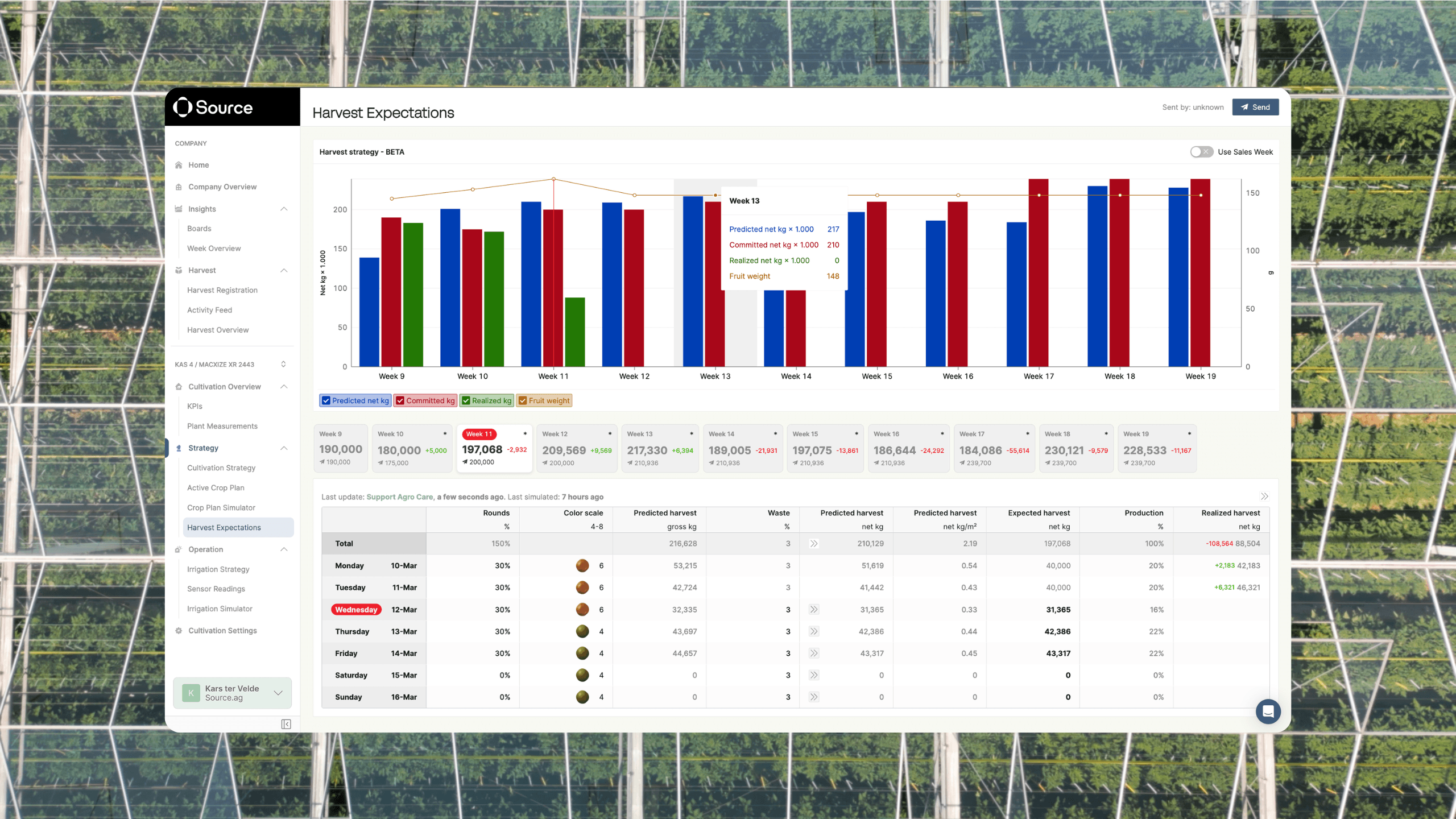
AI-driven harvest forecasts up to 8 weeks ahead. With this tool, sales can commit earlier and growers can act sooner. (Available for tomatoes and peppers)
More pride in Dutch agriculture
For Kamman, international positioning is not only about having the right network. It is also about being clearer and more confident about what the Netherlands has to offer. ‘For some reason, we are very proud of our water management. Everywhere we go, we say: we can help you with your water management. And that is great. But why do we not embrace agriculture in the same way?’
He believes the Netherlands could present its agricultural expertise more strongly abroad. ‘I think people should call us if they want climate-resilient, locally resilient, and healthy food production. That is what we are good at. If we are prouder of that, I think that would help a lot.’