
Lely’s long-term investment and international cooperation in dairy farming
Innovations take patience and persistence
Dutch family-owned company Lely develops robots, automated systems, and digital tools for dairy farmers around the world. CEO André van Troost explains how the company turns challenges on the farm into new technology, how Lely looks ahead to dairy farming in 2035.
Beeld: Lely
André van Troost, CEO at Lely
Lely deliberately does not start by asking farmers whether they would buy a new idea, Van Troost explains. ‘If you ask that question too early, you risk rejection before an idea has had a chance to develop. Thirty years ago, nobody was asking us for a milking robot. If we had relied purely on market research, it might never have been built.’
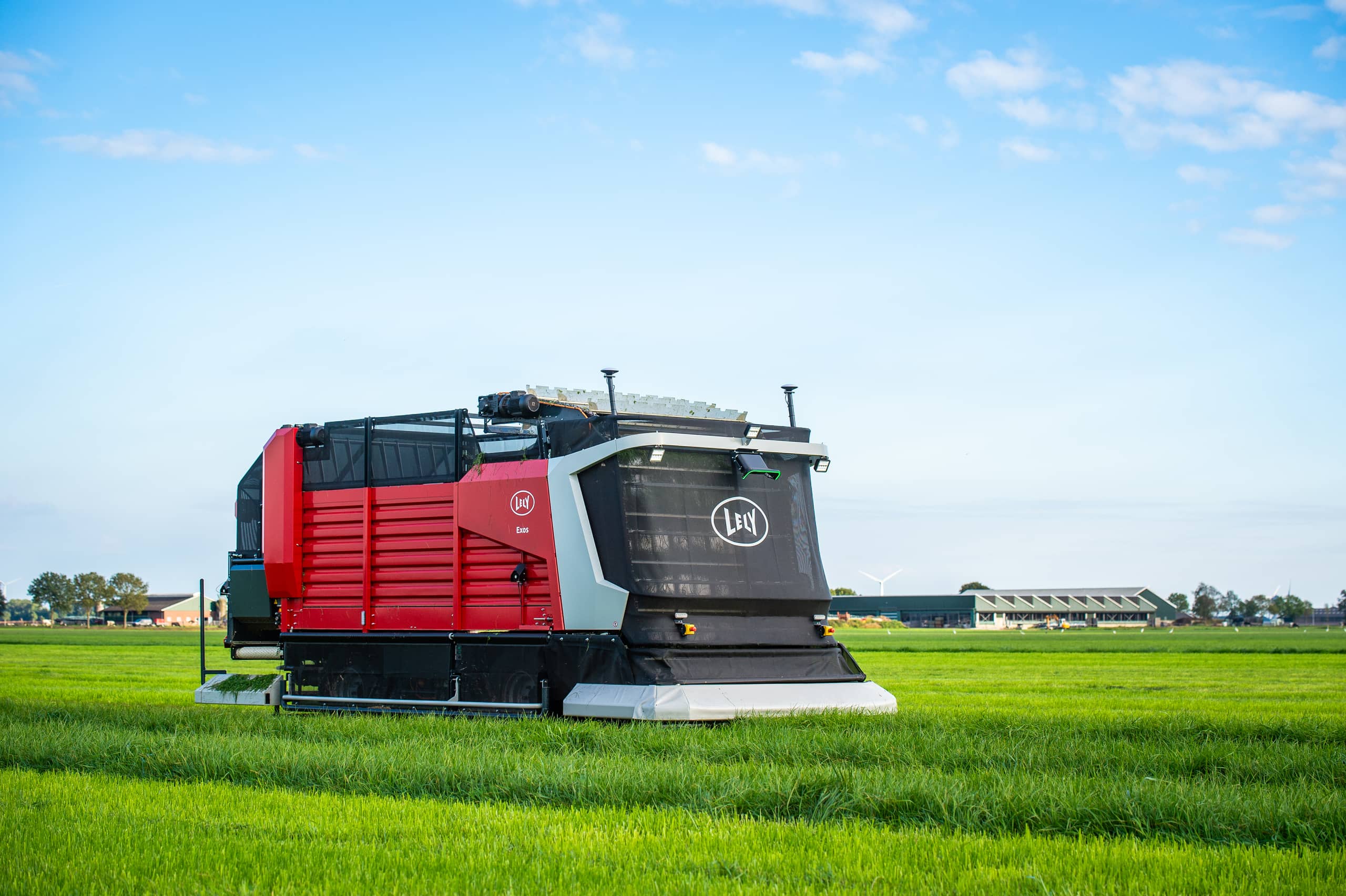
He distinguishes innovation from improvements to existing technology. ‘We reserve innovation for something genuinely new. Improving an existing milking robot is important, of course, but for us innovation means introducing a way of working that was not there before. That was the case with the milking robot, the feeding robot, and, more recently, our solution for autonomous fresh grass harvesting and feeding. Today, our technology also includes systems that can detect when a cow is about to give birth and equipment designed to reduce nitrogen emissions.’
‘Thirty years ago, nobody was asking us for a milking robot. If we had relied purely on market research, it might never have been built’
Animal welfare, emissions, soil, and water quality as drivers
Van Troost describes how those ideas take shape. ‘We have a separate innovation team of around 50 people. About half of them are farmers themselves or come from farming families, so they know the sector from the inside. Their job is to identify (future) challenges that could be automated and explore whether technology can offer a solution.’
Animal welfare, emissions, soil, and water quality are important drivers of that work. ‘We need to think a long way ahead. Bringing completely new technology to the market can take five to ten years. So, we are not only looking at what farmers need today. We are asking what will matter to them several years from now. For Lely, that includes the farmer’s license to produce: the economic, environmental, and societal conditions that determine whether dairy farming has a future.’
Lely’s Farm of the Future 2035 vision guides its development work. ‘We work around five main themes. Animal welfare is one. Sustainability is another, including emissions, water quality, and biodiversity. We also look at the farmer’s economic position, the relationship between farmers and consumers, and the future development of the dairy sector itself.’
That approach also leaves room for failure. ‘The first step is to prove that an idea works in practice. The commercial question comes later. And not every idea succeeds. If you want to innovate, you must accept that some projects will fail. We invest around 9% of our revenue in research and development, which gives us room to take those risks.’
The company also collaborates with start-ups. ‘We have our own start-up activities within Lely and work closely with around ten start-ups, while our wider network includes more than 20.’ In December 2025, for example, Lely announced an investment in a two-year pilot by Dutch scale-up Grassa. Its technology extracts protein from grass while returning the fiber to farmers as cattle feed. Together, the companies are exploring whether this could provide farmers with an additional source of income.
Beeld: © Lely
Lely Exos - autonomous harvesting
Connecting technology and AI to support animal health
These technologies can also provide important information. Data helps Lely connect technology with, for example, animal health and welfare. ‘Lely’s Horizon management platform combines information from our robots with data on individual cows. When a cow enters a milking robot, she can be weighed. We can analyze the somatic cell count in her milk, while a sensor on her collar records her eating behavior. Taken together, these data can help indicate whether an animal may be developing a health problem.’
He sees a practical role for AI. ‘We have been working with it for much longer than the current AI debate might suggest. For us, the important step is moving from collecting information to predicting what happens next and advising the farmer on what to do.’
‘Horizon can use data from the robots to identify an animal that needs attention and help the farmer decide what action to take. The Lely Zeta AI calving monitor is another example. Instead of simply showing that a cow is pregnant, the system can warn the farmer that the birth is approaching and that it is time to go to the barn. In the past, a farmer might have had to get out of bed several times during the night to check whether a cow was about to calve. Now technology can help predict when that moment is approaching. That predictive element is where AI becomes useful.’
‘Innovation often moves faster than laws and regulations’
Adoption around the world
Van Troost sees several reasons why more farmers are adopting automation. ‘Labor is one of the main reasons. A farm that relies heavily on manual work must first find the people to do it, and that is becoming increasingly difficult. Physical workload matters too. If you spend hours every day standing in a milking parlor, you feel it in your knees and shoulders.’
In Europe, automation has moved beyond early adopters, he says. Elsewhere, adoption is at an earlier stage. ‘We estimate that around 90% of dairy farming worldwide has not yet been automated or robotized. That is one reason why we remain focused on dairy farming rather than moving into completely different agricultural sectors. There is still enormous potential within this sector alone.’
Grazing herd
Different markets, different requirements
Lely operates in more than 50 countries. How does the company adapt its technology to different farming systems and markets? ‘A cow gives us a good starting point. A Holstein Friesian in China is essentially the same animal as a Holstein Friesian in the Netherlands. The farming system around her, however, may be completely different.’
‘In the Netherlands, we mainly work with family farms of perhaps 100 or 200 cows. Elsewhere, we encounter farms with 5,000, 10,000 or even 15,000 cows. The individual cow is not the problem. Scale is. The larger the farm becomes, the more the technology must be able to handle.’
New markets are assessed by Lely’s expansion team. ‘Mexico is a recent example. Before entering a country, our expansion team looks at how many dairy cows there are, where farms are concentrated and whether we can meet local regulations and service requirements. Only then do we decide whether it makes sense to establish ourselves there.’
‘We look at the dairy population, but also at where the farms are. They cannot be spread too thinly across a huge country because service is essential. If something goes wrong with a robot, we need to be able to get someone to the farm quickly – ideally within two hours.’
‘Labor costs also matter. As a rule of thumb, 60 to 90 cows per robot are needed for profitable milking. In a country where ten employees cost the same as one robot, the economics of automation are obviously very different. And every country has its own rules. Import regulations vary and components that are permitted in one market may require a different approach in another. International expansion adds a lot of regulatory complexity.’
Making connections through the LAN
Lely also draws on the Netherlands Agricultural Network (LAN). ‘We learn from Dutch agrifood companies that already operate locally, and we use the LAN to gather information and make contacts. We have also hosted agricultural counselors from many countries at Lely and shown them what we are developing. Those relationships become valuable later, when we explore opportunities in their markets.’
In Kazakhstan, for example. Lely was one of six Dutch companies participating in the Jana Dala agricultural exhibition in 2025. Its representative presented robotic dairy farming and, together with the Dutch ambassador, met the owner of dairy farm Rodina to discuss possible cooperation. The LAN team in Astana used the exhibition to Lely connect with local farmers, businesses, and networks.
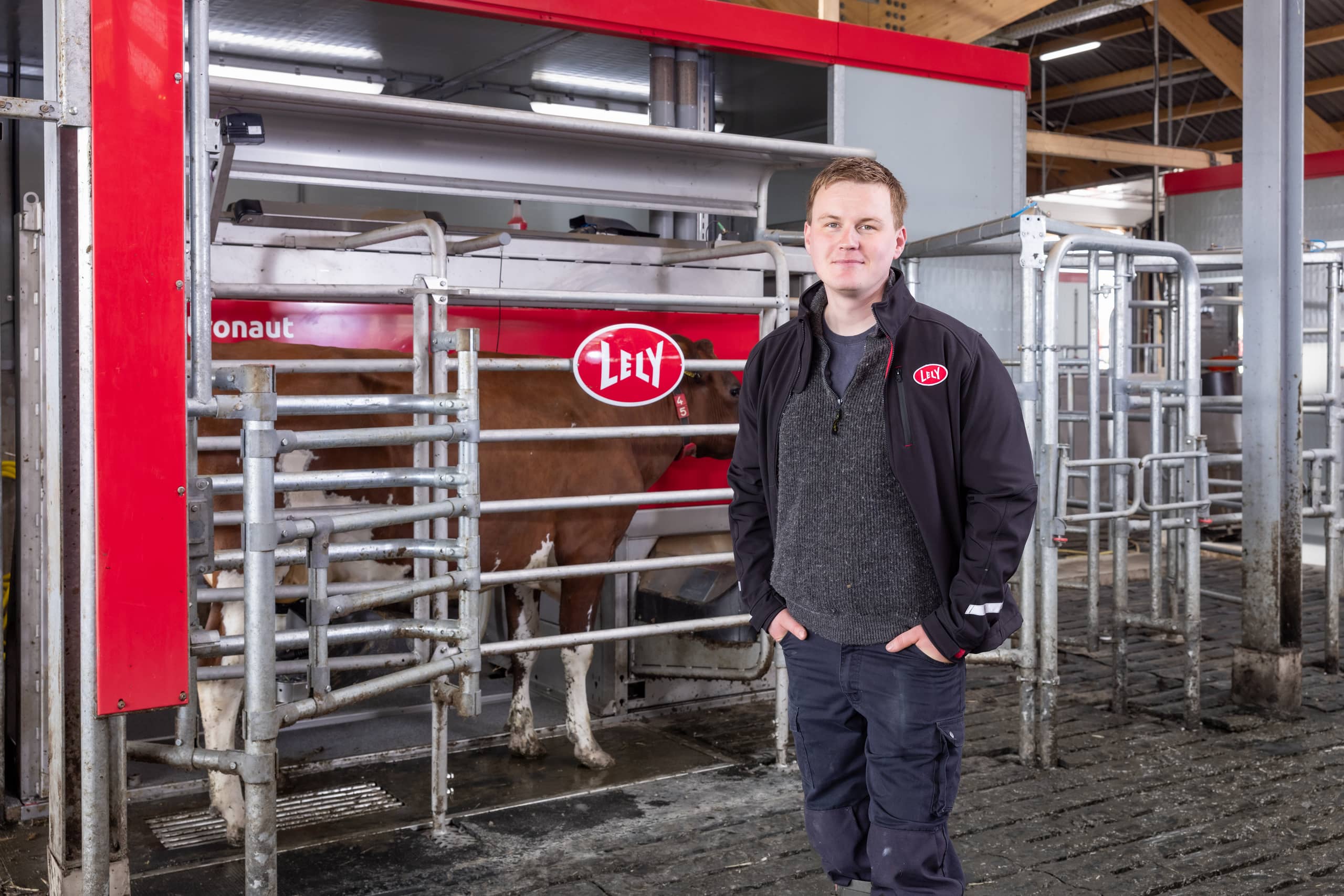
Lely Astronaut A5 Next - automated milking
Looking ahead to 2035
‘In the Netherlands, you sometimes get the impression that dairy is a sector in decline. Globally, that is not the case. Dairy is still growing by around 1 to 2% a year. So, for us the question is not whether dairy has a future, but what kind of dairy farming will be viable in the future.’
He sees differences in how markets approach sustainability. ‘The further you move away from the Netherlands, the less dominant it tends to be in the debate today. That is understandable, though. The Netherlands is small and densely populated, so issues such as nitrogen emissions and pressure on the environment are particularly visible here. But I expect those questions to become more important elsewhere as well. If technology can reduce methane, nitrogen or the wider environmental footprint of a farm, there is a real opportunity.’
A difficult environment for innovation in the Netherlands
At home, however, he finds the climate for innovation difficult at times. ‘We understand that the Netherlands is a small country and that difficult choices must be made. We believe that innovation can help solve the challenges we face. At the same time, innovation often moves faster than laws and regulations. These need to be adapted, but the necessary procedures can take a long time. This makes it more difficult to introduce new technologies than we would like.’
Looking ahead to smarter farming
For Van Troost, preparing for 2035 also means making better use of data. ‘Technology will play an important role in that. Farmers already have an enormous amount of data coming at them. The next step is not simply collecting more of it but turning it into something useful: predicting what is likely to happen and helping farmers decide what action to take. That is where data and AI can make automation increasingly intelligent.’
Details of future products remain confidential. ‘As for the products we are working on next, I cannot tell you anything. We still have a few secrets.’