
Chinese AgTech cooperation with the Netherlands shifts toward system integration
Bringing opportunities and economic security risks
The Netherlands Agricultural Network (LAN) team in China is exploring developments in China's agricultural technology sector. China is investing heavily in the digitalization and intelligent transformation of agriculture. Recent policies increasingly identify artificial intelligence, robots, sensors, and intelligent machinery as tools for modernizing agricultural production, while research institutes and companies are developing applications ranging from smart farm management to agricultural AI and robotics. For Dutch companies, opportunities for cooperation must be weighed against economic security risks, particularly those involving intellectual property and technical know-how.
For Dutch stakeholders the key question is not whether innovation is taking place. It clearly is. The more useful question is how mature these technologies are, where they are being deployed, and whether they can generate reliable commercial returns.
A useful distinction is therefore between technological demonstration and commercial deployment. A robot demonstrated on a showcase farm may be technically impressive without being economically viable. Conversely, a relatively simple technology can achieve large-scale impact when it is supported by an effective service model, infrastructure, and user base. China's agricultural innovation landscape increasingly illustrates both sides of this equation: some technologies have reached significant commercial scale, while others remain in research, pilot or early commercial stages.
From policy ambition to commercial deployment
China's policy direction has become increasingly application oriented. The 2024 National Smart Agriculture Action Plan identified technologies including sensors, intelligent equipment, agricultural robots and large agricultural models, while the 2026 No. 1 Central Document called for wider application of AI and expanded use of drones, the Internet of Things and robots in agriculture. In parallel, China has introduced policies specifically aimed at improving the transition from innovative agricultural machinery to pilot validation and commercial application.
This emphasis on the middle stage between research and commercialization is important. China has substantial research capacity and an increasingly sophisticated system of demonstration and testing. Yet official discussions still identify costs, business models and limited participation by smaller farming operations to adopt advanced technologies as constraints on wider adoption. In particular, the relatively small production scale, limited capacity, and financial resources of many smaller farmers make it difficult for them to participate in the large-scale adoption of AI-driven agricultural solutions.
The challenge is therefore increasingly not whether a technology can work under demonstration conditions, but whether it can deliver reliable performance, an attractive return on investment, and repeatable adoption under commercial farming conditions.
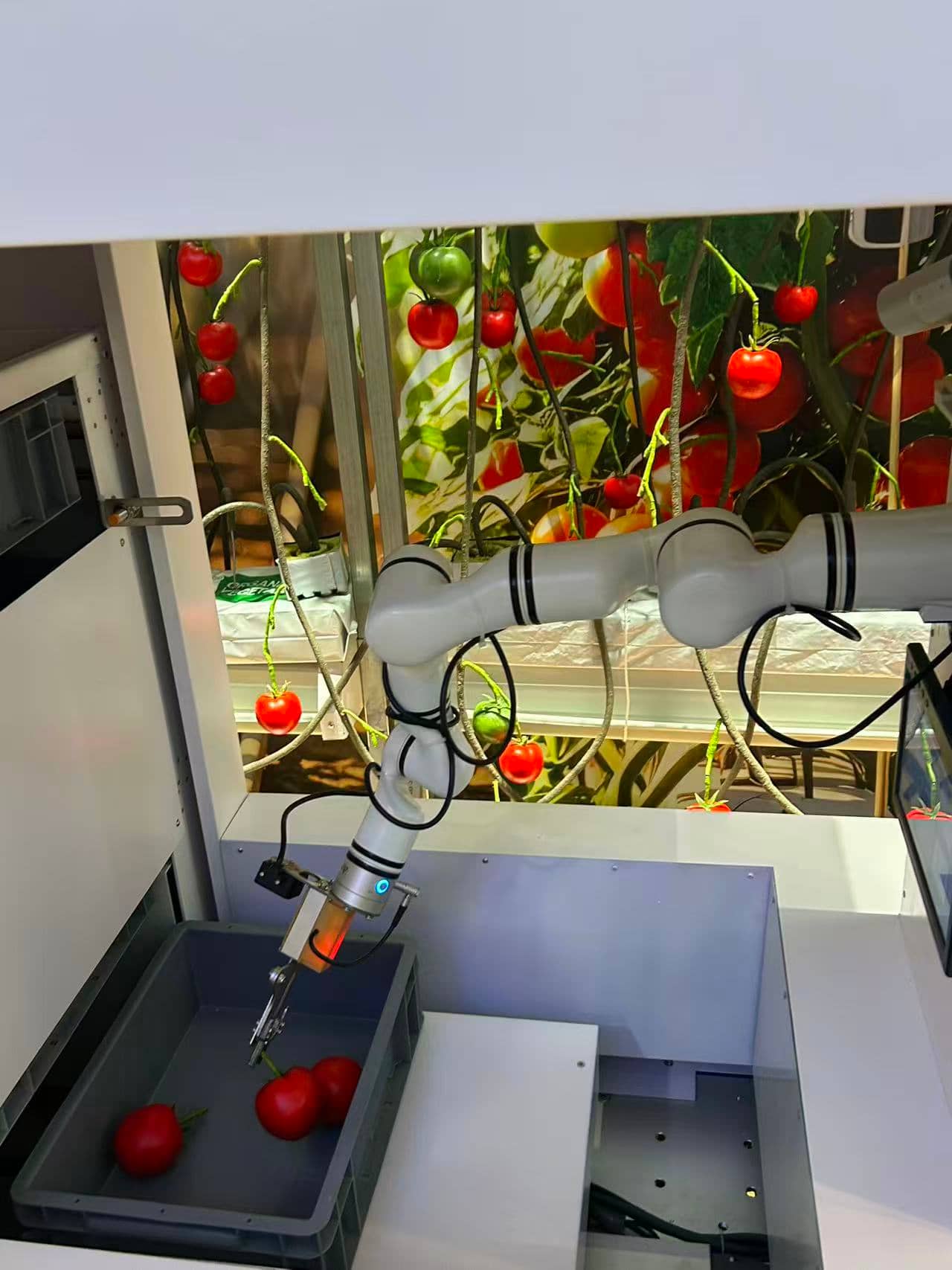
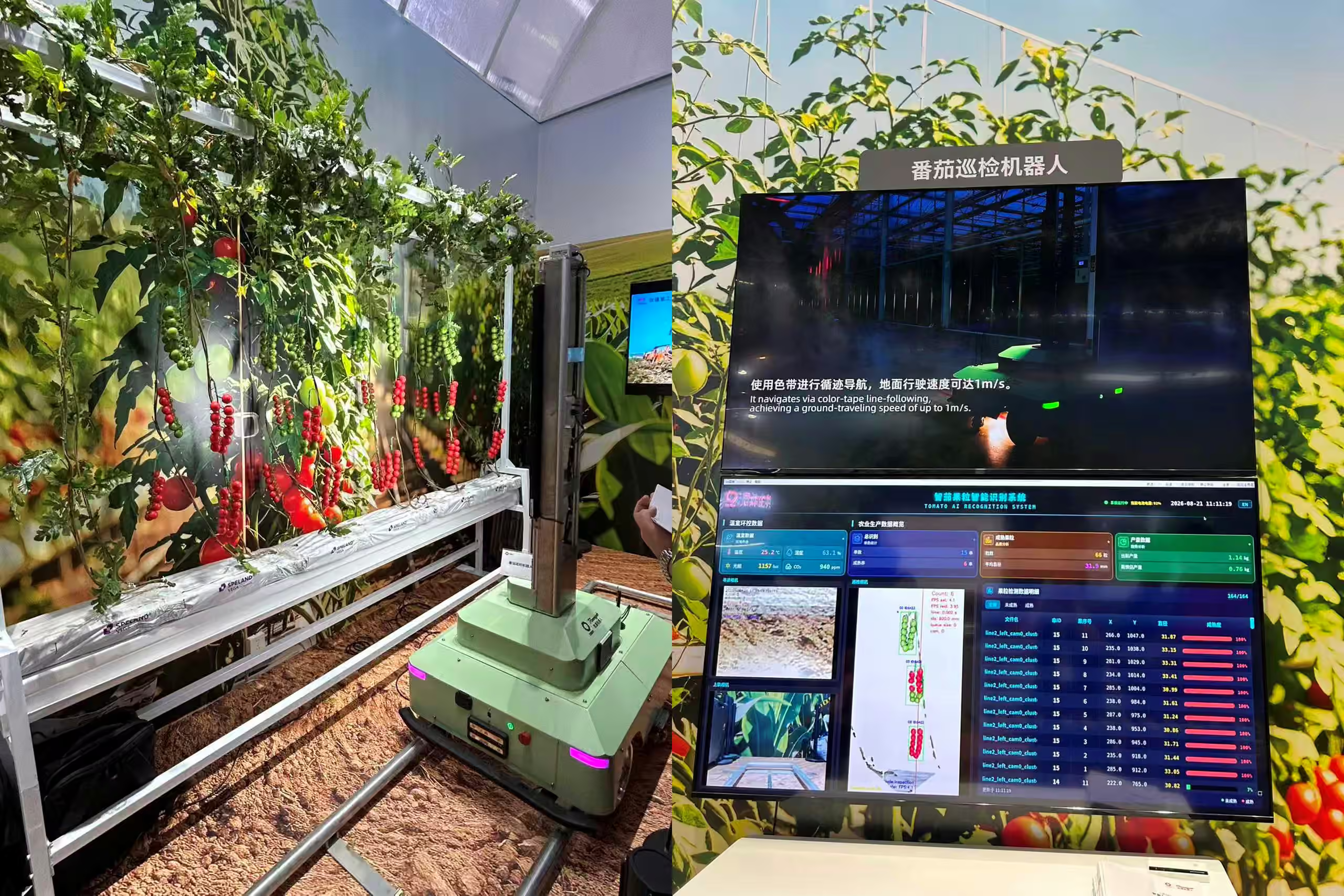
Demonstration prototype of large-fruit tomato harvesting robot by China National Building Material (CNBM) Triumph Robotcs , exhibited at CAAM joint-booth at the 2026 World Robot Conference in Beijing. Note: background is printed poster not real world greenhouse working condition 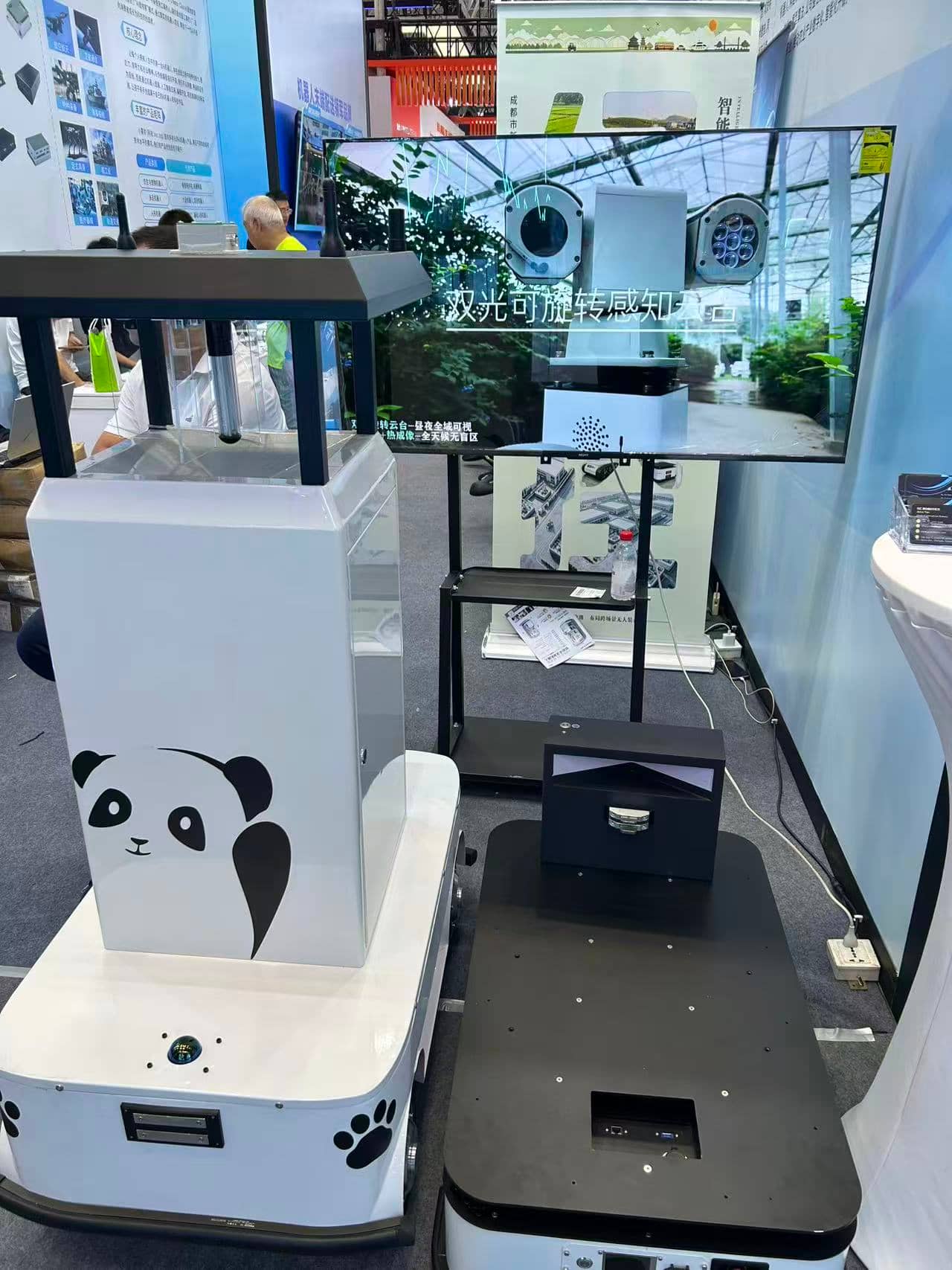
Agricultural-inspection robot prototype by Lukong Agri-tch, Exhibited at CAAM joint-booth. Left: complete unit with panda housing; right: bare mobile chassis, equipped with dual-light rotating sensor gimbal. Demo unit for exhibition purpose only
Precision machinery and robotics mature at different speeds
Auto-steering systems using China's BeiDou satellite navigation system, as well as precision machinery, have achieved substantial deployment. BeiDou-assisted machinery is already used in major production regions including Xinjiang and Northeast China, supporting operations such as planting, fertilization and harvesting. This represents an important step in the practical application of precision agriculture in China: satellite navigation and automated guidance are no longer limited to demonstrations but have become part of routine agricultural operations in major production areas.
The development of these technologies also reflects China's ability to translate digital infrastructure and engineering capabilities into practical agricultural applications. However, the level of maturity varies across technologies. Assisted steering and navigation are considerably more mature than fully autonomous agricultural machinery.
At the same time, Dutch companies retain strong expertise in integrated precision farming, crop-specific cultivation, sensing and control, and the integration of technology with agronomic knowledge. China's progress is therefore better understood as rapid expansion and deployment of precision technologies rather than uniform technological leadership across the entire field. The distinction matters for Dutch suppliers: individual components may increasingly be available from Chinese manufacturers, while value can remain in the integration of technology with crop knowledge and production systems.
‘The real test is whether technology works reliably, delivers a return on investment, and can be widely adopted on commercial farms’
AI and agricultural robotics remain much more uneven. China is developing agricultural foundation models, computer-vision systems and robots for harvesting, pollination and other labor-intensive tasks. At the same time, these developments point to the emergence of a broader domestic technology base for agricultural AI. China's strengths in AI research, computer vision, data processing and engineering are increasingly being applied to agricultural production challenges. The development of crop-specific models and intelligent systems also creates opportunities to connect agricultural data with practical production decisions, potentially supporting more precise and data-driven farm management.
Research on China’s greenhouse sector also points to uneven adoption prospects: sensor and robotic technologies differ substantially in their perceived performance and adoption potential across growers, investors, technology suppliers and policymakers, suggesting that technological availability does not automatically translate into widespread commercial uptake. The pace of development is notable, but many applications remain at research, pilot, or early commercial stages. Agricultural AI models are increasingly specialized around crops, breeding and production data, yet evidence of sustained farmer adoption, willingness to pay, and long-term commercial returns remain limited.
Robotics exposes the deployment gap
Robotics illustrate the same gap particularly clearly. Chinese research teams have developed strawberry- and apple-harvesting robots, while more specialized systems are being tested for crops such as winter jujube. These projects demonstrate growing technical capabilities, but the available evidence does not support describing fruit-harvesting robotics as an established commercial market.
A more advanced research example is GEAIR, developed by Chinese Academy of Sciences researchers, which combines crop engineering with AI-based robotics to facilitate automated cross-pollination. Its significance lies in demonstrating what may be possible when crop characteristics and robotic systems are designed together—not in showing that robotic breeding has already become commercially established.
Beeld: © Lily Zhang
The LQ-PhenoMPI mobile crop phenotyping platform developed by the Information Technology Research Center, Beijing Academy of Agriculture and Forestry Sciences, exhibited at the 33rd China Beijing Seed Industry Conference
The broader lesson is that demonstration, technical capability, and commercial maturity are different things. China is moving quickly through the innovation pipeline, but the distance between a successful demonstration and a reliable, profitable and scalable agricultural business model can still be substantial.
Complementary strengths drive localization
China's technological development should therefore be viewed neither simply as a market for Dutch technology nor solely as a source of competitive pressure. It is increasingly both.
China brings several advantages: a large agricultural production base, rapidly developing AI and engineering capabilities, extensive testing environments and the ability to deploy technologies at scale. Large production systems can generate substantial operational data and provide opportunities to test technologies repeatedly under real production conditions. China's emerging agricultural AI ecosystem similarly benefits from the combination of research capacity, agricultural data and a large potential user base.
The Netherlands has a different but increasingly complementary set of strengths. Dutch companies and research institutions have longstanding expertise in crop science, precision cultivation, controlled-environment agriculture, genetics, resource efficiency and the integration of technologies into commercially viable production systems. In horticulture in particular, the value of technology is closely linked to crop-specific knowledge, cultivation strategies, sensing and control, and the ability to integrate multiple components into a reliable production system.
This complementarity suggests that future cooperation does not have to follow the traditional model of transferring Dutch technology to China. In practice, cooperation is increasingly taking place through knowledge exchange, technical training, adaptation of technologies to local production conditions, and the development of integrated solutions. Dutch horticultural cooperation programs bring together companies and knowledge institutions across the value chain, providing a platform for collaboration with Chinese partners. Chinese capabilities in AI, data, robotics, engineering, and manufacturing can be combined with Dutch expertise in agronomy, crop management, precision cultivation, and commercially proven production systems.
Economic security matters in joint development
Dutch companies considering local production in China, either by establishing their own operations or cooperating with Chinese partners, are advised to carefully assess potential economic security risks. Particular attention should be given to the protection of intellectual property rights and trade secrets. As part of their risk assessment, companies should consider potential challenges relating to intellectual property infringement, unauthorized use or reproduction of proprietary technologies, and the protection of technical knowledge and know-how.
Appropriate due diligence, clear contractual arrangements and effective safeguards are important to ensure secure and mutually beneficial business cooperation. The Netherlands Enterprise Agency RVO and the Dutch Embassy or Consulates General in China can provide guidance on identifying and managing these risks.
‘Cooperation creates opportunities, but Dutch companies must protect their technology and know-how’
Domestic systems raise the benchmark
Dutch companies need to monitor China's domestic innovation more closely. Chinese technology developers are increasingly capable of producing locally adapted and potentially lower-cost alternatives. A 2025–2026 Beijing greenhouse trial, for example, compared three domestically developed control systems with a Dutch system under standardized production conditions. The trial should not be interpreted as evidence that Chinese greenhouse technology has generally overtaken Dutch systems: one location and one production cycle cannot establish that. It does, however, demonstrate that Chinese developers are increasingly capable of benchmarking domestic technologies against established international suppliers under real production conditions.
For Dutch stakeholders, the competitive question is therefore shifting. Differentiation is less likely to come from hardware alone and increasingly from system performance, crop knowledge, reliability, resource efficiency, and the ability to integrate technology into profitable production systems. This creates opportunities for Dutch companies to contribute through system integration, crop-specific solutions, cultivation strategies, and the adaptation of technologies to commercial production requirements in China. Such opportunities should, however, be pursued with due attention to economic security, even when individual hardware components can be sourced locally.
Looking ahead: opportunities for Dutch agri-food
China's agricultural innovation landscape is evolving rapidly, although the level of technological and commercial maturity varies across sectors. For Dutch agri-food stakeholders, the key is to understand where Chinese capabilities are developing, where Dutch expertise can add value, and how the two sides can respond to emerging opportunities while taking economic security considerations into account.
The Netherlands Agricultural Network (LAN) team in China is actively exploring developments in China's agricultural technology sector, identifying innovative Chinese companies, and establishing contacts with relevant industry players. At the same time, it continues to monitor technological and market developments to identify areas of potential interest to Dutch businesses. Looking ahead, the team hopes to further develop these connections and explore the possibility of organizing a Dutch business delegation to China, allowing Dutch companies to gain first-hand insights into China's agricultural innovation ecosystem, meet potential Chinese partners and assess opportunities for future engagement.
More information
This article is a summary of the full report "Agricultural innovation in China: from policy ambition to commercial reality". If you are interested in selected examples of agricultural automation and intelligent farming solutions in China, you can find the overview here.
Would you like to know more about agricultural innovation, smart farming and opportunities for Dutch-Chinese cooperation in China? You can visit the country page of China on this website. You can also send an email to the LAN team at the Dutch Embassy in Beijing: pek-lvvn@minbuza.nl.