
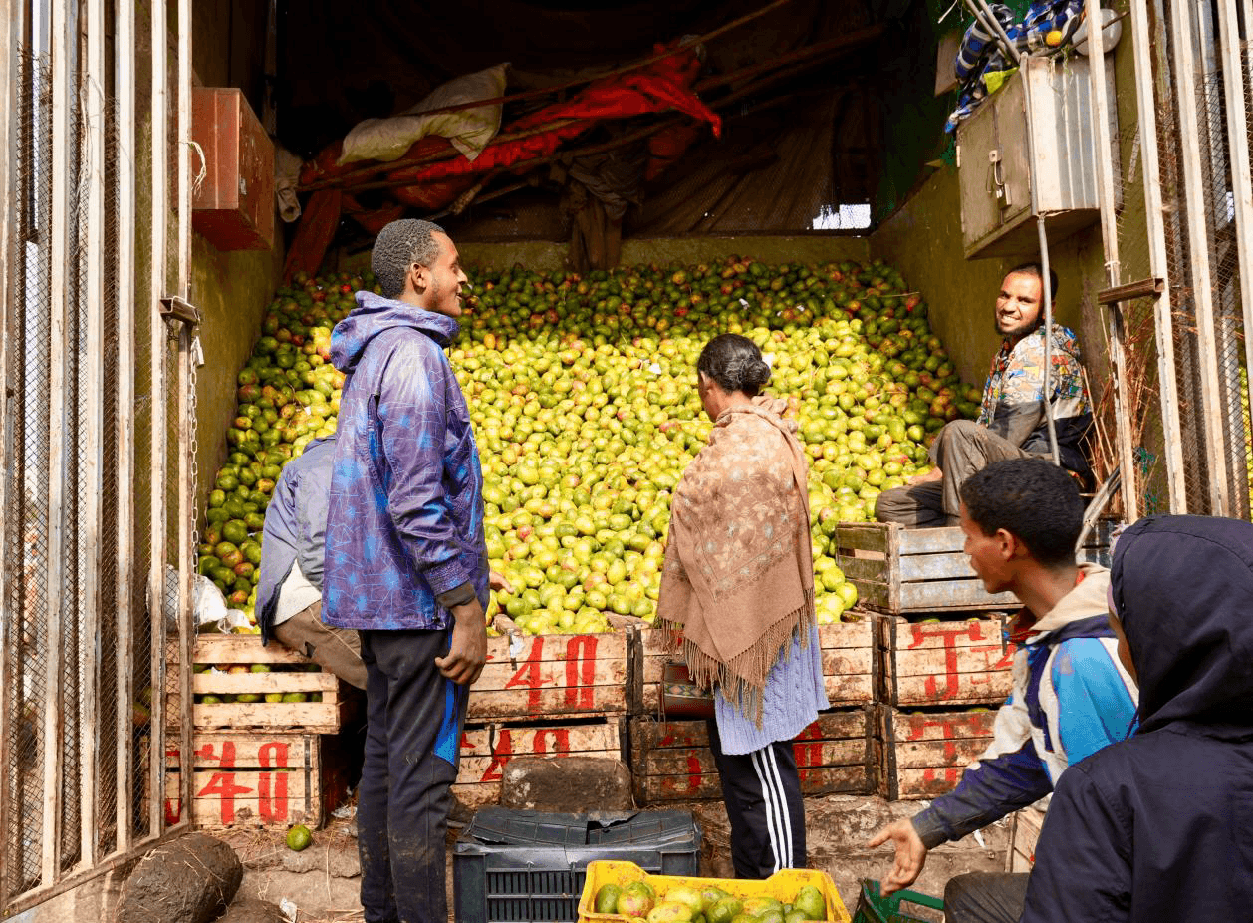
Connecting solutions to reduce food loss in Ethiopia’s horticulture sector
LAN initiatives on cold chains, agrologistics, circularity, and partnership-building
In Ethiopia, around 30% to 50% of the horticultural products are lost between harvest and market. This reduces incomes, wastes resources, undermines food security, and weakens competitiveness. The Netherlands Agricultural Network (LAN) at the Dutch Embassy in Addis Ababa is addressing this by developing a food safety and aggregation-hub, supporting agrologistics companies, collaborating at the All Africa Post-Harvest Loss Congress and more.
Food loss in Ethiopia happens due to factors such as inadequate storage, limited cold chain infrastructure, and inefficient transport and market systems. The agriculture sector is largely smallholder‑based, with most farmers operating on less than two hectares. While larger commercial farms exist, they are limited in number. Smallholders and traders often lack access to proper post‑harvest handling, packaging, and logistics, which makes them particularly vulnerable to losses. This not only reduces the income of farmers and traders but also limits the availability of fresh produce for consumers and increases pressure on natural resources.
An economic analysis estimates that proper post‑harvest management could save volumes of food currently lost, enough to feed over 23 million people. Addressing these challenges is essential for improving food security and strengthening the competitiveness of the horticulture sector.
Cool Port Addis as a catalyst for cold chain development
To address these challenges, the Ethiopian government developed one of the Cool Port Addis (CPA) projects with financial support from the Netherlands throughInvest International.
Since the signing of the agreement between the Ethiopian and Netherlands governments, several steps have been completed, such as preparing and commissioning contracts to hire supervisors, contractors, and technical and equipment design providers.
Three additional contracts are currently in the process of being commissioned to enable the start of the cool port construction. The LAN team in Addis Ababa is actively monitoring the progress and engaging with stakeholders from both sides to help move the process forward. At the same time, the team is also working on related projects in close collaboration with other Embassy departments and implementing partners to improve the supply and quality of products that will pass through the cool port once it is completed.
The aforementioned project is designed to facilitate the export of horticultural crops from Ethiopia in a cooled state to the port of Rotterdam and other market destinations. Located at the largest dry port in the country in Modjo, 70 km southeast of the capital Addis Ababa, CPA is intended to serve as a central hub for cold-chain operations, linking producers, transporters, and exporters. It is designed to provide:
- modern cold storage and handling to reduce spoilage of perishables;
- improved coordination along export corridors;
- better connections to domestic and international markets;
- lower losses during transport and inspections.
By establishing a well-equipped cold-chain hub at a strategic logistics point, CPA is planned to reduce post-harvest losses as well as strengthen the overall efficiency and competitiveness of Ethiopia’s horticultural value chains. In doing so, it creates a foundation for long-term growth, greater investment, and stronger export potential.
Design of Cool Port Addis
Assessing logistics improvements to optimize Cool Port Addis
The LAN team partnered with Wageningen University & Research (WUR) through a feasibility study on local postharvest and cooling infrastructure investments. Its purpose was to analyze Ethiopia’s horticultural value chains, identify key logistics improvements, and guide the effective use of CPA to reduce losses and maintain product quality.
The study suggests focusing on export-oriented crops such as avocado, banana, and mango, and highlights regions with strong potential for initial cold-storage deployment, including Sidama, Southwest Ethiopia and Central Ethiopia, based on production volumes, cooperative structures, and existing cooling facilities. It recommends starting cooling at regional hubs linked to CPA to maintain product quality for European and Middle Eastern markets, while using ambient aggregation hubs near production sites during the first mile for climacteric crops to optimize costs.
The study also emphasizes private-sector management of storage and logistics, capacity building for operators, and early engagement with financiers to enable scalable, market-driven cold-chain solutions that make optimal use of CPA.
The Netherlands can contribute knowledge and expertise to these regional hubs. However, there are also several Dutch companies, such as Pluss Advanced Technologies and Celtic, in the cold logistics sector with technologies that are well suited to the Ethiopian market.
‘By establishing a well-equipped cold-chain hub, Cool Port Addis can reduce post-harvest losses and strengthen overall efficiency and competitiveness’
Implementing the PADEO approach to reduce post-harvest losses
The findings of the WUR study have supported ongoing implementation efforts, including the PADEO approach
in Ethiopia. PADEO stands for Programmatic Approach for Sustainable Economic Development. It is a pilot program used by the Dutch government to apply a systems approach to addressing complex development challenges, with private-sector engagement as a key driver.
This approach has recently been renamed or reframed as the Light Systems Approach to reflect a more practical focus on systems thinking and co-creation with stakeholders, while maintaining the same core intent of driving sustainable, locally-led change. The approach focuses on three leverage points:
- An effective policy and regulatory framework: supporting food safety and reliable operations through pesticide monitoring, local GAP, and market guidelines.
- Innovations and technologies to reduce post-harvest losses: promoting local and Dutch partnerships, LogiTech accelerators, and other tools to reduce spoilage.
- Functioning regional aggregation hubs: improving collection, storage, and market access through capacity building and the strengthening of existing aggregation hubs.
Sourcing and logistics schema recommended by WUR Study
Turning losses into circular opportunities
In addition to reducing losses, there is growing interest in valorizing unavoidable by-products. To support this, the LAN team in Addis Ababa is promoting circular-economy approaches in Ethiopia’s agriculture sector by collaborating with Dutch companies to map food loss and waste across major value chains, including horticulture, livestock, and agro-processing.
A detailed analysis is currently being conducted to identify where losses occur and which waste streams can be converted into value-added products, with a focus on:
-
quantifying the volumes and locations of losses;
-
understanding causes along the value chain;
-
identifying policy gaps;
-
identifying investment-ready circular solutions .
To put this into practice, the LAN team is also supporting a pilot in Ethiopia’s Sidama region, in partnership with Dutch and local companies, to convert avocado residues into cosmetic ingredients for international markets, protein-rich animal feed, biochar to improve soil health. This pilot shows how collaboration among the Embassy, private-sector partners, and local stakeholders can generate new income streams, reduce waste, and provide a model for scaling circular solutions across Ethiopia’s horticulture and agro-processing sectors.
Collaboration among the Embassy, private-sector partners, and local stakeholders can generate new income streams and help scale circular solutions.
Building partnerships through international platforms
Reducing food loss also requires collaboration among governments, businesses, and research institutions. The LAN team serves as a connector, linking Ethiopian stakeholders with Dutch expertise, in areas such as cold chain logistics, post-harvest handling, food processing, and supply chain management. The annually held All Africa Post-Harvest Loss Congress
(AAPHLC) provides an important platform for this cooperation along with other platforms and initiatives, such as knowledge-sharing networks with organizations like WUR. The congress and platforms are used to:
- showcase practical solutions supported by Dutch knowledge and technology;
- connect Dutch companies, researchers, and African partners;
- align Dutch initiatives with African Union and national priorities;
- build partnerships that extend beyond individual projects.
This platform helps give ongoing Dutch initiatives and future opportunities regarding post- harvest loss greater visibility and support. This video of the 4th AAPHLC gives an impression of the event in 2023.
Side event organized by the LAN Team as part of the 4TH AAPHLC
Looking ahead
Reducing food loss offers a major opportunity to strengthen Ethiopia’s horticulture sector while improving resource efficiency and food-system resilience. The LAN team continues to work with partners to support stronger logistics systems, more resilient value chains, and circular solutions for agricultural by-products. They act as both a connector and a catalyst in reducing food loss, especially in horticultural value chains. They also initiate and coordinate analytical work on agrologistics and post-harvest systems to inform policy dialogue and identify practical entry points for implementation.
For Dutch agribusinesses and knowledge institutions, these developments offer significant opportunities for collaboration in a plethora of areas such as cold-chain technology, agrologistics, circular agriculture, value-added product development, innovative post-harvest solutions, market linkages, investment in pilot projects, and the scaling of sustainable practices across Ethiopia’s horticulture sector. Over time, this can help create more sustainable systems that support both food security and market efficiency.
More information
If you would like to know more about Cool Port Addis, food safety and aggregation-hub development, and circular solutions in Ethiopia, you can go the country page of Ethiopia on this website. You can also send an e-mail to the LAN team at the Dutch Embassy in Addis Ababa: add-lvvn@minbuza.nl.