
China and the Netherlands strengthen cooperation to combat food loss
Shared focus on post-harvest management, cold-chain logistics and food supply chain efficiency
In China, food loss occurs on a massive scale during harvesting, post-harvest handling, storage, and distribution. This creates major challenges but also opens opportunities for innovation and international cooperation. With its strong expertise in post-harvest management, cold-chain logistics and efficient food distribution, the Netherlands is well positioned to contribute to practical solutions that can help reduce losses across China’s food supply chain.
As the world’s largest agricultural producer and one of the largest food consumption markets, China faces significant challenges related to food loss and waste – translating directly into lost farmer income, wasted natural resources, and unnecessary greenhouse gas emissions. For a country that feeds nearly one-fifth of the world’s population on less than 9% of the world’s arable land, every percentage point of loss represents a missed opportunity to strengthen food security. National assessments estimate that the country’s food loss and waste rate stand at 22.7%, equivalent to approximately 460 million tons of food annually. Based on 2021 production levels, this represents a substantial misallocation of resources and highlights the importance of improving efficiency across the food supply chain.
By category, vegetables, grains, and fruits account for more than 94% of total losses. Vegetables alone contribute around 270 million tons annually, reflecting both their production scale and the vulnerability of highly perishable products during distribution. Grains and fruits follow, each facing distinct technical and logistical constraints.
Loss during harvesting and post-harvest handling
Across the supply chain, harvesting and post-harvest handling account for 63% of total supply chain losses. This stage represents the primary food loss hotspots caused by technical limitations, such as outdated harvesting equipment and lack of temperature monitoring, as well as infrastructural limitations, such as inadequate cold storage and insufficient drying facilities. Experts estimate that roughly half of existing food losses are technically avoidable. If realized, this would save approximately 230 million tons of food annually, enough to meet the yearly nutritional needs of 190 million people. This number underscores the dual significance of food loss reduction for food security and nutritional security.
‘Experts estimate that half of existing food losses are technically avoidable’
Uneven access to mechanization, storage facilities and post-harvest technologies
In a citrus orchard in Zhejiang Province, farmer Zhou Chungu vividly recalls 2023: ‘’It was a bumper harvest, but farm-gate prices were just over 1 yuan per jin (500 grams). The more we harvested, the more we lost. They were all good oranges, left to rot in the field.’ This case reveals a core dilemma: when market prices fall below harvesting costs, the rational economic decision may be to leave crops unharvested. And behind that decision lies the waste of land, water, fertilizer, and other inputs.
The deeper issue lies in production fragmentation. China has approximately 93 million smallholder farmers, representing 98.1% of all agricultural operators and cultivating around 70% of farmland. On average, each household manages less than 10 mu (0,67 ha) of land. This highly fragmented structure constrains farmers’ ability to invest in mechanization, storage facilities, and post-harvest technologies, which typically require significant upfront capital and economies of scale. As a result, individual farmers are typically unable to afford equipment such as harvesters, drying facilities, or cold storage on their own. Access to information and technical guidance remains uneven, further widening differences in post-harvest practices and outcomes.
Beeld: © Cheng Guangyan et al., Institute of Food and Nutrition Development, MARA, 2022 China Food and Nutrition Development Report
Food loss rate data by food chain stage in China. The loss rates are quantified based on long term large scale field survey.
Beeld: © Cheng Guangyan et al., Institute of Food and Nutrition Development, MARA, 2022 China Food and Nutrition Development Report
Loss rate by category in China. The loss rates are quantified based on long term large scale field survey.
Challenges of fragmentation and limited investment
These structural constraints translate directly into food losses through several mechanisms. First, fragmentation limits operational efficiency: while large, contiguous fields can be harvested efficiently with modern machinery, numerous small and irregular plots are more time-consuming to manage and prone to higher field losses. Second, limited investment capacity leads to inadequate post-harvest handling, with practices such as open-air drying exposing crops to humidity, pests, and contamination. There, gaps in access to timely market and technical information can result in suboptimal harvesting decisions, increasing the risk of quality deterioration and spoilage.
Taken together, the scale of fragmentation means that these inefficiencies accumulate across millions of productions and post-harvest decisions, ultimately contributing to substantial food losses.
Emerging actors in loss reduction
To address fragmentation, farmer cooperatives and producer organizations increasingly act as intermediaries. By aggregating supply, investing in shared storage facilities, and negotiating contracts, they help standardize handling practices and reduce individual risk.
In this context, the Sustainable Development Project for Agricultural Product Circulation is jointly implemented by industry associations and research institutions. The project promotes a practical four-dimensional pathway for loss reduction, focusing on:
- the development of standards (of packaging and handling);
- training of farmers and supply chain actors;
- the introduction of appropriate tools such as standardized crates, and:
- improved coordination across the supply chain.
Together, these elements aim to translate simple, scalable solutions – such as better packaging – into systematic improvements in post-harvest management.
Beeld: © Xizhe Hu
On-site post-harvest operations for kiwifruit in Meixian County, showcasing the sequential steps from harvesting to pre-warehouse logistics.
Cold-chain solutions are no panacea
Over the past decade, China has invested heavily in cold-chain logistics. Cold storage capacity has expanded rapidly, refrigerated truck fleets have grown, and distribution centers increasingly integrate temperature control technologies. Yet, infrastructure expansion does not automatically translate into effective food loss reduction.
According to data from the Ministry of Agriculture and Rural Affairs, loss rates for fresh agricultural products during circulation remain as high as 20% to 30%, far above the internationally recognized benchmark of around 5%. One key factor is the relatively low penetration of cold-chain logistics. The refrigerated transported rate for fruits and vegetables in China remains around 35%, compared to 80-90% in many developed countries.
Operational shortcomings further exacerbate losses: products lack professional cold-chain packaging, some rely on only a few ice packs, and others are wrapped in rudimentary blankets. Frequent handling and open-air transfers break the temperature chain, while some drivers switch off refrigeration units to save costs. Standardized reusable crates remain underused, and industry-wide challenges such as high packaging costs, inadequate product protection, and non-uniform handling processes persist.
‘The cold chain is vulnerable to the weakest link effect’
Transport-related losses in perishable fruit
In Guangdong province – China’s most populous province and a major grain-consuming region – annual grain production is around 13 million tons, while the logistics system must serve a permanent population of 127.8 million. The pressure to reduce logistics-related losses is immense. Even when refrigerated trucks and warehouses are available, loading and unloading may take place outdoors, exposing perishable goods to ambient heat.
A typical case comes from Chinese bayberries (Myrica rubra, also known as Chinese bayberries or Yangmei, are small, highly perishable fruits widely grown and consumed in China) transported from Yunnan to Guangdong, where loss rates may reach 30%. A farm manager recalled instances where products were rejected due to excessive loss during transit and had to be sold at low prices in local markets.
Digital solutions deliver measurable results
Technological innovation is reshaping the landscape. During the Fourteenth Five-Year Plan period, national R&D programs have focused on efficient multimodal grain logistics and cross-regional transport of perishable agricultural products.
Digital solutions are delivering measurable results. AI-driven route optimization and temperature prediction systems have reduced fresh produce loss rates from industry averages of 15% to below 3% in pilot applications. In addition to pilot projects, several digital tools are already being deployed at scale to reduce losses in cold-chain logistics. Internet of Things (IoT)-enabled monitoring systems are increasingly being adopted in commercial operations in cold-chain logistics.
For example, large scale cold-chain parks such as facilities in Shanghai’s Lin-gang Free Trade Zone, where integrated IoT sensors and cloud analytics provide 24/7 temperature and humidity tracking, multi-level alerts, and end-to-end traceability to reduce spoilage in large-scale operations. Such systems have been shown to lower product loss rates by enabling rapid response to temperature deviations and full-chain data visibility.
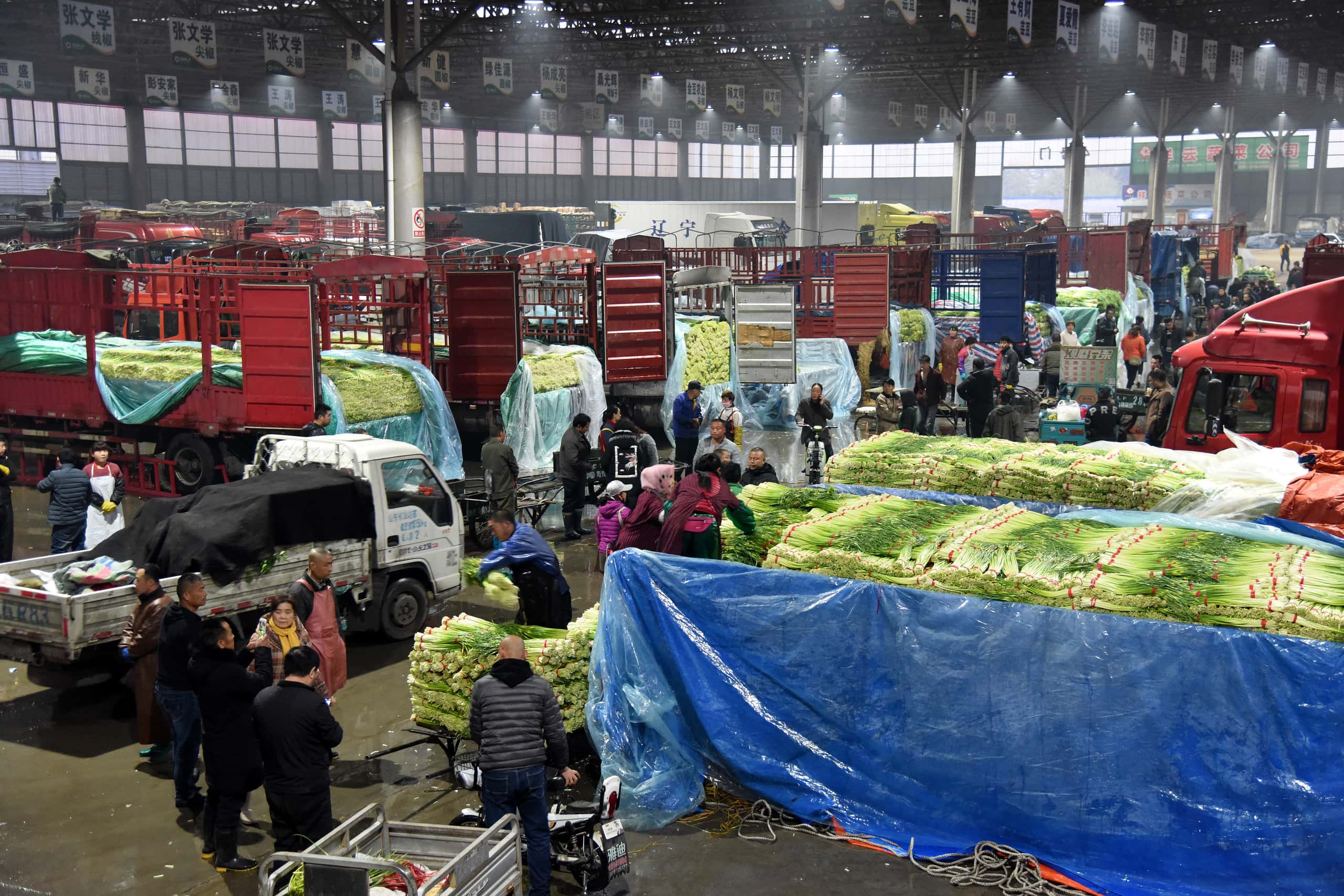
Beeld: © Shouguang Municipal People's Government Official Website (Guangying Shouguang)
Interior and transaction scene of Shouguang Agricultural Products Logistics Park.
China’s broader agricultural modernization agenda
Food loss reduction has been embedded into China’s broader agricultural modernization agenda. The recently published Fifteenth Five-Year Plan (2026-2030) emphasizes stronger integration across production, processing and logistics.
In October 2024, the National Food and Strategic Reserves Administration discussed food security trends and post-harvest loss reduction strategies. Senior officials emphasized that national action plans on grain conservation and anti-food waste have established a comprehensive, nationwide strategy covering the entire supply chain to reduce losses.
Operational results are visible. Between 2022 and 2024, mechanical harvesting loss rates declined significantly: wheat from 3% to 0.93%, rice from 4% to 1.76%, and maize from 5% to 2.06%. Since 2021, more than 25 million tons of grain losses have been prevented – enough to feed 130 million people for one year.
Storage losses among farmers have fallen from 8% a decade ago to 3%. Losses in state granaries are controlled below 1%. Transport losses have fallen to 0.8%, and processing losses to 0.8%.
Dutch expertise in minimizing losses
The experience of the Netherlands offers valuable entry points. In horticulture, the Netherlands has developed advanced post-harvest management and cold-chain solutions that directly improve product quality and reduce losses during storage and transport. For example:
-
Optical sorting technologies can remove damaged or substandard produce at an early stage;
-
Precision temperature control and controlled-atmosphere storage help extend shelf life for fruits and vegetables;
-
Digital monitoring systems enable real-time tracking of temperature and storage conditions.
Dutch companies specializing in controlled-atmosphere storage, particularly for preserving fruits and potatoes, have already implemented projects in China. Controlled-atmosphere storage containers have also been deployed along the China-Europe Railway Express, supporting long-distance temperature-sensitive transport along the way.
Beyond post-harvest technologies, Dutch plant breeders have also contributed to reducing losses at the source by introducing and developing varieties of crops better suited to China’s diverse climatic conditions, with improved transport tolerance and reduced susceptibility to deterioration. These practical applications demonstrate that technological cooperation in cold-chain logistics has moved beyond dialogue into concrete operations.
Cooperation can extend beyond infrastructure. Efficient food distribution systems also play a crucial role in reducing losses across the value chain. The Dutch fruit and vegetable auction system, for example, is widely recognized for its transparent pricing, demand aggregation, and rapid turnover mechanisms that help align supply with market demand and reduce overproduction and spoilage. Such system-level experience may offer inspiration for improving efficiency in China’s large and diverse market environment.
Sino-Dutch cooperation in cold-chain logistics
For the Netherlands Agricultural Network (LAN) team at the Dutch Embassy in Beijing, food loss is positioned to support broader goals such as food security, supply chain efficiency, and sustainability. By promoting Dutch expertise in post-harvest management, cold-chain logistics, and supply chain organization, the LAN team aims to facilitate knowledge exchange, foster public–private partnerships and create opportunities for Dutch businesses and knowledge institutions to engage with China’s evolving agrifood sector.
In this context, the LAN team at the Dutch Embassy in Beijing operates the Sino-Dutch cold-chain network. This network brings together representatives from more than 150 Dutch and Chinese companies. Dialogue sessions focus on topics such as regulatory frameworks for cold-chain logistics, the integration of post-harvest expertise into broader sectoral activities and exploring opportunities for collaboration.
Furthermore, yearly recurring horticulture roadshows in China have consistently included Dutch companies active in cold-chain logistics, embedding these topics within broader agricultural cooperation. In 2024, the LAN team organized a seminar focused on cold-chain logistics at the Netherlands Pavilion during the Asia Fruit Logistica expo. In 2025, during the horticulture technology masterclass in Kunming, a Dutch expert, Dr. LIU Zhen, from Wageningen University & Research specializing in post-harvest management was invited to lecture on preservation technologies and key operational practices, such as temperature and humidity control, handling and grading techniques, and packaging methods to maintain product quality and extend shelf life, particularly for perishable horticultural products.
Future plans and opportunities for cooperation
Looking ahead, the LAN team will continue to integrate food loss across its broader agrifood activities, rather than addressing it as a standalone theme. In this context, it is exploring a value-driven Dutch Cuisine approach, which combines zero food loss and waste principles with healthy diets, the use of local produce, and creative, inspirational food concepts.
In addition, China is expected to further prioritize food loss reduction as part of its broader agricultural modernization and food security agenda. This will likely translate into increased investments in cold-chain infrastructure, creating demand for advanced technologies, services, and expertise.
For Dutch businesses and knowledge institutions, this creates opportunities in areas such as cold-chain equipment, digital monitoring solutions, post-harvest technologies, and supply chain optimization. The LAN team will continue to support these efforts by facilitating matchmaking, organizing knowledge exchange activities, and providing market insights to help Dutch stakeholders engage with relevant Chinese partners.
More information
Would you like to know more about food loss reduction, cold-chain logistics and post-harvest cooperation in China? You can visit the country page of China on this website. Are you interested to join the Sino-Dutch cold-chain network? You can also send an e-mail to the LAN team at the Dutch Embassy in Beijing: pek-lvvn@minbuza.nl.