
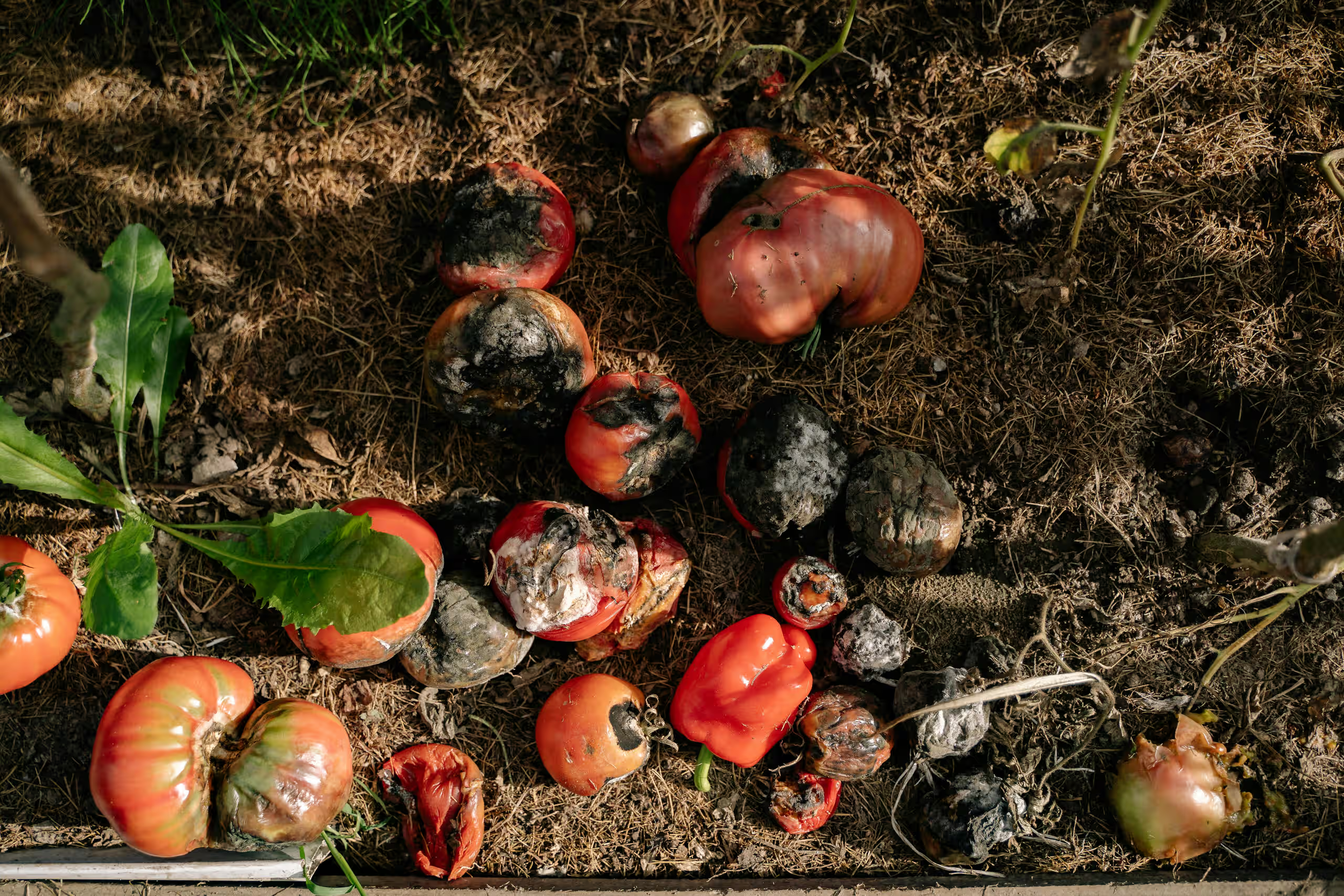
Food loss in Brazil’s horticulture chains
An opportunity for food security, climate and innovation
A significant share of the fruit and vegetables produced in Brazil never reaches consumers. Being one of the world’s largest agricultural producers, improving farming practices and post-harvest efficiency is therefore a major opportunity. Losses occur along the entire chain, from farm handling to transport and retail, reducing food availability and generating unnecessary environmental impacts.
According to research conducted by the Brazilian agricultural research corporation Empresa Brasileira de Pesquisa Agropecuária (Embrapa), post-harvest losses in Brazil can reach around 30% for fruit and about 35% for vegetables, depending on the product and supply chain. Reducing these losses could increase food availability without expanding agricultural production.
A systemic challenge across the food chain
Food loss is often discussed as if it occurs at a single stage of the supply chain. However, researchers emphasize that it is a systemic issue that connects decisions made by farmers, logistics providers, retailers, food services, and consumers. Losses can vary greatly according to seasons, produce type, regions, technology level as well as transportation distance and type of transport.
Gustavo Porpino de Araujo
In an interview with the Netherlands Agricultural Network (LAN) team in Brazil, Embrapa researcher Dr. Gustavo Porpino de Araujo, noted that the waste observed in households or supermarkets is frequently linked to inefficiencies earlier in the chain. Problems such as inadequate pest management, harvesting practices or post-harvest handling at farm level can shorten the shelf life of fruit and vegetables before they even reach retail shelves.
At the same time, retail practices also influence what happens on farms. Strict aesthetic standards demanded by supermarkets, often reflecting consumer preferences for visually perfect produce, may cause farmers to discard products that are perfectly edible but slightly irregular in shape or size (read more in Food losses and waste: how Brazil is facing this global challenge). When producers lack processing options or alternative markets for these products, field losses increase, or the produce is diverted to lower-value uses such as cattle feed or composting.
Brazil’s geography: logistics and climate vulnerability
In Brazil, production areas are often located far from major urban markets such as São Paulo, Rio de Janeiro and Brasília. Fresh produce may travel hundreds or even thousands of kilometers before reaching consumers. During this journey, highly perishable fruit and vegetables face several risks: mechanical damage during harvesting and transport, unsuitable packaging, long trucking times and exposure to a cold chain that is often irregular and outside ideal temperatures.
In tropical and subtropical climates, these factors accelerate natural biological processes such as respiration and water loss, which shortens shelf life, and increases the risk of deterioration. As a result, cold-chain infrastructure plays a critical role in preserving product quality. However, temperature-controlled logistics are not yet consistently available across all regions and supply chains as Brazil are still largely truck-based. A 2018 study, carried out in the state of Maranhão (one of the hottest states in Brazil), found a post-harvest loss of 18.4% in tomatoes – the highest among any of the fruit and vegetables analyzed.
Beeld: © Alf de Wit
Blueberry harvest at 35°C in Ibicoara, Chapada Diamantina, Bahia State
‘Fresh produce may travel hundreds or even thousands of kilometers before reaching consumers.’

Dr. Fabiana F. C. Sasaki
Innovation in post-harvest technology
Research conducted by Embrapa and its partners has highlighted several promising solutions. Dr. Fabiana F. C. Sasaki, from the Embrapa unit specialized in Cassava & Fruits, explained the LAN team that, alongside further advances in cold-chain logistics, Brazil could benefit from greater focus on:
-
improved packaging systems designed to reduce mechanical damage during transport;
-
vacuum-cooling technologies that rapidly remove heat from freshly harvested produce;
-
post-harvest treatments such as UV-C radiation, edible coatings, and controlled-atmosphere use;
-
sensor-based monitoring systems that track temperature and quality throughout the supply chain;
-
digital logistics platforms and artificial intelligence tools to improve demand forecasting and transport planning;
-
traceability systems and sensors for ethylene, temperature, and humidity.
At this very moment, for example, Brazilian researchers from UFRJ and Embrapa are developing a pesticide-free biological coating agent that inhibits fungal growth, significantly extending the shelf life of fruits and vegetables. Derived from a bacterium found in an oil well, the product is expected to have potential for industrial application within a few years.
Although available for implementation in high-end Brazilian markets, the aforementioned solutions are far from common within horticultural supply chains. In general, the level of technology adopted is low due to various factors, ranging from a lack of technical expertise to limited access to investment opportunities. This is characterized by high capital costs that are inaccessible to small and medium-sized producers. National and state-level infrastructure issues, as well as a lack of market appreciation for superior quality, are also significant contributing factors, among others. The technology exists; however, the problem lies in adoption, not innovation.
Nevertheless, there are a few initiatives underway. A concrete example is the Embrapa-led post-harvest workstation, which focuses on training farmers and introducing simple handling and packaging technologies to reduce losses in fruits and vegetables along the supply chain. Next to fundamental and applied research in universities and Embrapa units, these initiatives serve the sector despite the difficulties mentioned above.
Beeld: © Alf de Wit
Bahia State Food Supply Center (CEASA), Salvador-BA
These innovations can significantly extend shelf life and improve supply-chain efficiency, particularly when combined with better management practices.
There is also room for added value through industrialization, making horticultural products more stable and commercially viable through dehydration, biorefineries, fermentation, functional foods, and related applications.
Dr. Sasaki also pointed to the promising field of edible coatings based on microorganisms and other bio-inputs, building on Brazil’s strong position in biocontrol research and technology. In her interview with the LAN team, she added that Brazil could benefit from partnerships with countries such as the Netherlands. Knowledge developed for temperate fruit, for instance, could be further adapted to Brazil’s tropical setting through joint research between teams in both countries.
Public food programs as part of the solution
Brazil has large public food programs that play an important role in reducing food loss while strengthening food security. The country operates one of the world’s largest school feeding programs through the Programa Nacional de Alimentacao Escolar (PNAE), which provides daily meals to tens of millions of students in public schools. The program requires that at least 30% of food purchased for school meals comes from family farmers, creating an important market for small-scale producers.
Public procurement initiatives such as PNAE and the ‘Programa de Aquisição de Alimentos’ (PAA) – that purchases food directly from family farmers to distribute to vulnerable groups and supply government networks (schools, hospitals)- can help prevent food loss by providing stable demand for products that might otherwise struggle to find markets.
In addition, Brazil has developed an expanding network of food banks and social food retail initiatives in cities such as Curitiba. These initiatives redistribute surplus food, provide training on food use, and sometimes process fruit and vegetables that would otherwise be discarded.
Some cities have also begun experimenting with circular approaches. In Recife, for example, programs have been implemented to collect surplus produce from street markets, redistribute edible food through public food banks, and convert the remaining organic waste into compost for community gardens.
‘Brazil has large public food programs that also play an important role in reducing food loss while strengthening food security’
Opportunities for Dutch knowledge institutes and companies
Concrete developments are already underway in the cooperation between the Netherlands and Brazil. Recently, a workshop, which is part of the Orange Dialogues series, was organized in Holambra by the LAN team. This city constitutes a major Dutch hub in Brazil—the result of the immigration of Dutch farmers—and today serves as the country's most important horticultural center, hosting a wide range of national and international companies and service providers in the sector, as well as trade fairs and events. During this workshop, participants contributed to LAN's sector report (currently under preparation) and discussed the possibility of establishing a branch of the World Horti Center in Brazil—a potential future home for many Dutch horticultural companies and knowledge institutes in the country.
Furthermore, with the Netherlands’ globally recognized expertise in efficient farming practices, post-harvest technology, agrilogistics and horticultural supply chains, both in companies and in universities and other knowledge institutes, potential areas of cooperation include:
-
precision agriculture: sensors, robotics and imaging;
-
cold-chain infrastructure and sustainable refrigeration;
-
smart logistics and digital supply-chain management;
-
improved packaging technologies;
-
circular solutions for food residues and organic waste;
-
bio-inputs and coatings for better produce shelf life.
Ensuring that more fruit and vegetables successfully travel from farm to plate is not only an economic challenge; it is a key step toward building more sustainable and resilient food systems.
More information
Would you like to know more about Brazil’s initiatives and research on food loss and other current topics? You can visit the country page of Brazil on this website, or contact the LAN team at the Dutch Embassy in Brasilia via bra-lvvn@minbuza.nl.
Do you want to read more about food loss in Brazil? You can visit: