
From precision fermentation and microalgae to cultivated meat, the race to build the next generation of proteins is fundamentally global. To accelerate this transition, the agricultural team of the Dutch embassy in South Korea and RVO(the Netherlands Enterprise Agency) recently welcomed a delegation of Dutch agrifood innovators for an intensive five-day mission across Korea’s evolving food innovation landscape. Read on to discover the key takeaways from our visits, the complementary strengths of our two ecosystems, and what comes next for Dutch–Korean protein collaboration.
Beeld: © SEO-LVVN
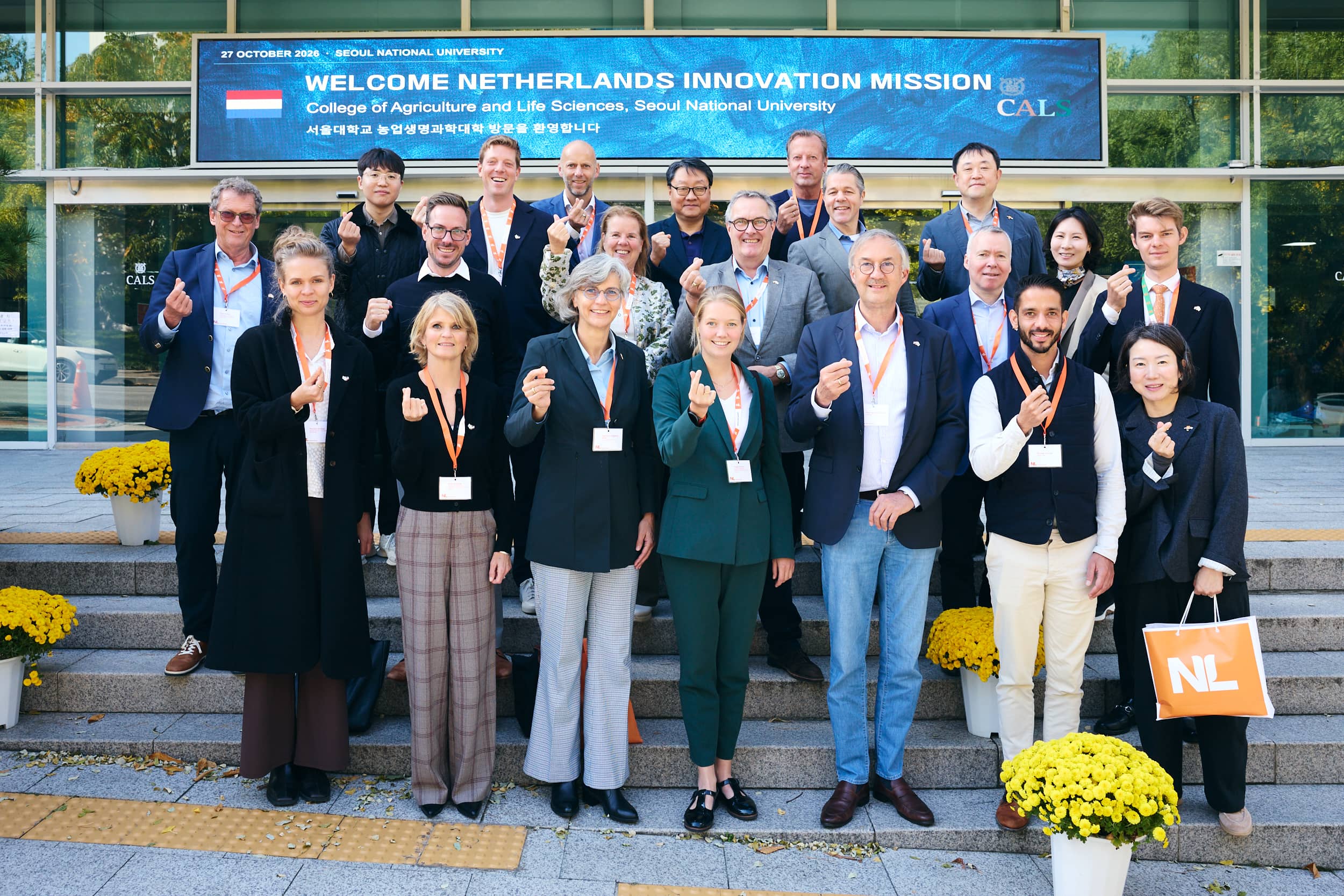
Innovation Mission visit to Seoul National University
Why international innovation missions matter
International cooperation can accelerate food-system innovation by connecting countries, companies and knowledge institutions that bring complementary expertise, technologies and market access to the table. It allows innovators to learn from different approaches, share the risks and costs of developing new technologies, and address common challenges that cannot easily be solved within national borders. In this way, international innovation cooperation can help bridge the gap between research, technological development and commercial application, contributing to the transition towards more resilient and sustainable food systems.
This is one of the central concepts guiding the work of the Netherlands Agricultural Network abroad. Innovation missions are an important instrument in translating this ambition into concrete partnerships, bringing together companies, knowledge institutions and policymakers to explore opportunities for collaboration.
Five days inside Korea’s alternative protein ecosystem
From 26 to 30 October, the agricultural team of the Dutch embassy in South Korea, together with RVO, welcomed a Dutch delegation specializing in alternative and next-generation proteins for a five-day programme in South Korea. The delegation brought together representatives from the Dutch Ministry of Agriculture, Fisheries, Food Security and Nature and RVO, alongside Dutch innovators, companies and knowledge institutions, including Studio Fava, Biotech Booster, Brig Bio, HAS green academy, Wageningen University & Research (WUR), Delft University of Technology (TU Delft), Protix, Protinext, InnovationQuarter, Nourish Ingredients and the Cellular Agriculture Netherlands Network.
The programme offered a broad overview of Korea's rapidly developing food innovation ecosystem, with visits and exchanges involving a diverse range of Korean stakeholders. These included Pulmuone, Pensées, Daesang, CJ CheilJedang, Seoul National University, Korea National Food Cluster, the Ministry of Food and Drug Safety (MFDS) and The Good Food Institute.
Complementary strengths in a rapidly evolving sector
The visits highlighted the considerable ambition in South Korea to develop and scale up innovation in next-generation proteins. Korean companies and research institutions are actively exploring new technologies, products and business models, while also looking at how these innovations can be translated into commercially viable applications.
The company visits offered interesting insights into the different approaches being pursued in Korea. Pensées is addressing some of the key technological bottlenecks in cultivated meat production, developing its own bioreactors, food-grade cell-culture media and 3D bioprinting technologies to improve scalability and reduce production costs. CJ CheilJedang is exploring the potential of mycoprotein, as a source of nutritious and functional ingredients, with applications in meat alternatives. Meanwhile, Daesang Corporation is building on its longstanding expertise in industrial fermentation, extending its activities towards emerging protein technologies, including microalgae-based ingredients and cultivated meat. Together, these examples illustrate how Korean companies are approaching the protein transition from different angles, combining established food-production capabilities with new biotechnological solutions.
For the Dutch delegation, the programme provided valuable insights into the Korean market and its innovation landscape, as well as an opportunity to identify areas where Dutch and Korean expertise could complement one another.
The Dutch participants represented a broad spectrum of technologies and approaches, ranging from cultivated cell-based products and precision fermentation to insect proteins and microalgae. Importantly, the delegation also reflected the strength of the Dutch ecosystem: a close connection between scientific research, technological development, entrepreneurship and commercial application.
Bringing these different perspectives together is particularly relevant in a sector where technological progress, regulatory developments, consumer acceptance and the ability to scale production will all play an important role in determining future success.
From knowledge exchange to concrete cooperation
The mission was not only about presenting Dutch expertise or gaining a better understanding of developments in Korea. Equally important was identifying shared challenges and opportunities, and exploring how cooperation between the two countries could help address them.
Potential areas for further engagement include business development, scientific and technological cooperation, regulatory dialogue and exchanges between companies, researchers and other ecosystem stakeholders. Building connections across these different domains can help accelerate innovation and create opportunities for both Dutch and Korean partners.
In the coming period, the embassy, RVO and the delegation members will follow up on the contacts and opportunities identified during the mission, with the aim of translating the initial exchanges into concrete partnerships and further visits.
International cooperation will not, on its own, deliver the transition towards more resilient and sustainable food systems. But by connecting complementary expertise, facilitating access to new markets and bringing innovators together, it can help accelerate the development and adoption of the solutions needed.
We look forward to continuing the dialogue with our Korean and Dutch partners.
More information & contact
For questions regarding this innovation mission or future bilateral cooperation in next-generation proteins, please contact the agricultural team at the Dutch embassy in South Korea via SEO-LVVN@minbuza.nl.