
From 26th to 29th October, the Singapore International Agri-Food Week (SIAW) held its latest edition at the Suntec Singapore Convention & Exhibition Centre. The week retained its focus on strengthening climate resilience across the Asia-Pacific's agri-food systems, and it was anchored by the Asia Pacific Agri-Food Innovation Summit.
SIAW has increasingly become a reference point in the region for public–private collaboration on sustainable and innovative agri-food solutions. For the Netherlands, Singapore is not only an important regional hub, but also a frontrunner in foodtech and agritech innovation. This creates two-way opportunities: Dutch organizations can contribute to Singapore’s ambitions, while at the same time drawing lessons from Singapore’s innovation journey to strengthen the Dutch agri-food ecosystem.
The 2026 Innovation Summit program mirrored the evolution of the agri-food sector and the increasing need to combine technological innovation with viable business models and supportive regulation. For the foodtech sector, there were discussions and showcases around novel food ingredients, food waste valorization, and functional foods. As for the agritech sector, the focus was on biologicals, crop genetics, automation on farms, and smarter supply-chain traceability. Throughout the week, many of the questions revolved around how innovation, policy and finance could work together to move these technologies from discovery and research to commercialization and adoption. This resonates strongly with Dutch practice, where close cooperation between government, research institutes and businesses is essential to accelerate the transition to more sustainable and resilient agri-food systems, and was therefore a good platform to highlight (the benefits of) our famous Dutch diamond approach.
Putting the Dutch Diamond in the spotlight
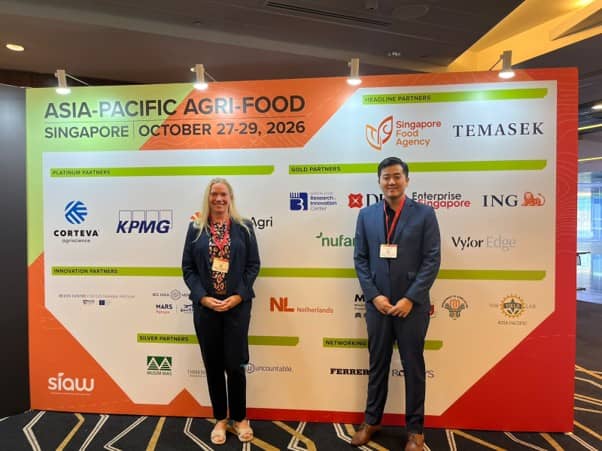
Agricultural Counsellor, Ester Kruk, and Agricultural Advisor, Lucas Jiang, at the Innovation Summit
The LAN Network in Singapore played an active role during the SIAW as an Innovation Partner at the Innovation Summit. We hosted a seminar session on 27 October, titled "Scaling agri-food tech innovation: Translating insights from the Dutch ecosystem to APAC", involving panellists from Oost NL, Wageningen University & Research, Hudson River Biotechnology, and SPECTRUM Scaling. With this diverse group of speakers from across the Dutch agri-food ecosystem, we were able to tap into their lived experiences to understand different angles of the Dutch Diamond’s collaborative approach.
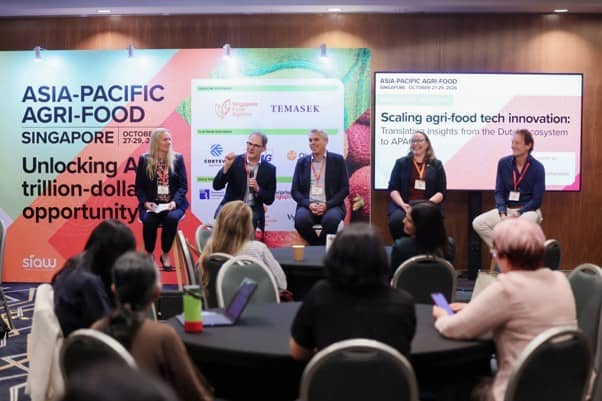
Our insightful panel discussion moderated by Agricultural Counsellor Ester Kruk
Professor Leo Marcelis of Wageningen University & Research and Ferdinand Los of Hudson River Biotechnology shared in particular about the exchange of knowledge and expertise between universities and companies in the horticulture industry. Susan van Boxtel of OostNL and Ferry Kamp of SPECTRUM Scaling highlighted the cohesive and supportive agrifood tech ecosystem of the Netherlands, which was conducive for international companies establishing in the Netherlands. The panellists mentioned similarities between the Netherlands and Singapore as well, such as both being small open countries with high-trust environments and import-dependent economies, which facilitates the translation of learning points from the Netherlands to Singapore. During the QnA segment of the panel, there was lively back-and-forth between the attendees and the panellists. One of the attendees even mentioned that, being from a commercial and regulatory background, he “could listen to this (discussion) all day” and that the Dutch agri-food ecosystem shows how you can “do so much with so little” in a small, highly urbanized country. This observation echoed the central takeaway from the session: that close collaboration between government, knowledge institutions, companies and investors – the Dutch Diamond approach – is crucial to unlock innovation and translate it into concrete, scalable solutions for sustainable food systems.
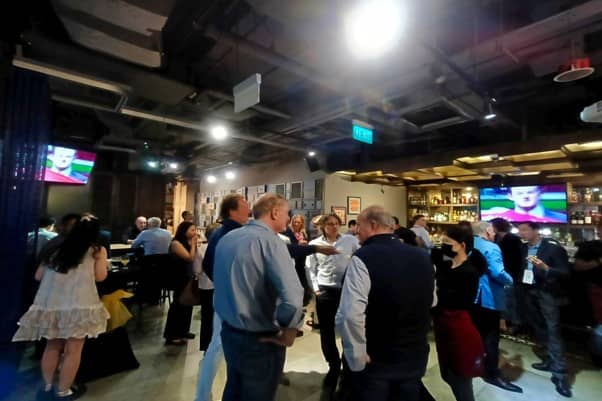
To end off a fruitful day, the LAN network organized a round of networking drinks near the SIAW venue, bringing together Dutch and Singaporean agri-food communities from different types of organizations and industries. The atmosphere was abuzz with conversations about partnerships and possibilities for collaboration. Throughout the night, Dutch and Singaporean organizations connected with complementary stakeholders.
Beeld: © LVVN Singapore
A packed event during the SIAW Networking Drinks
Several of these conversations are now being followed up, with discussions on joint R&D, testbeds and market entry strategies. With respect to market entry, the interest is 2-way, with Dutch companies keen to explore the region and Singaporean companies interested to expand in the Netherlands. As for joint R&D and testbedding, there is exploration on larger-scale trials in a commercial setting for joint R&D research between the Netherlands and Singapore.
Singapore's food security strategy in motion
This edition of SIAW also offered a first opportunity to hear about the latest developments in Singapore’s food security strategy. Under the Research, Innovation and Enterprise Plan 2030 (RIE2030), S$138 million will be committed to the next phase of the Singapore Food R&D Program.
The focus of this R&D program is to strengthen Singapore’s food resilience and accelerate the development commercialization of agri-solutions with real-world impact, with a focus on 5 areas, namely aquaculture, agriculture, future foods, food safety, and food supply resilience. In the aquaculture sector, the research focus is on fish health and farming systems, whereas for the agriculture sector, there is strong focus on resource-efficient and precise farming as well as seed genetics. In the area of future foods, the aim is to improve nutritional qualities and efficiency in its production, and for food safety, research will be done to better assess and manage emerging food safety hazards. Last but not least, in the new domain of food supply resilience, capabilities in food supply forecasting and management will be built up.
This offers opportunities for Dutch knowledge institutions and companies with the expertise in the above technologies to work with Singaporean organizations and tap into the funding initiative. At the same time, Singapore’s integrated approach to food security – combining long-term R&D funding, clear strategic focus areas and strong public–private collaboration – provides useful reference points for the Netherlands as it continues to strengthen its own agri-food innovation agenda.
Rounding off a fruitful week
Overall it was a week with a lot of new leads for potential collaborations between the Dutch and Singaporean agri-food communities and we hope that these conversations will mark the start of future collaborations. Looking ahead, we see opportunities not only for Dutch actors to contribute to Singapore’s ambitions, but also to use Singapore’s innovation experience to inform and accelerate transitions in the Dutch agri-food sector. These mutual learning opportunities – ranging from high-tech horticulture and seed breeding to AI-driven farm management, circular agrifood solutions and new regional production models – will be further explored in our forthcoming article in AgroSpecial on agri-food innovation, so keep an eye out for this publication.
For questions on partnering with Singapore on sustainable food production, our Agricultural Advisor Lucas Jiang can be reached at sin-lvvn@minbuza.nl.