
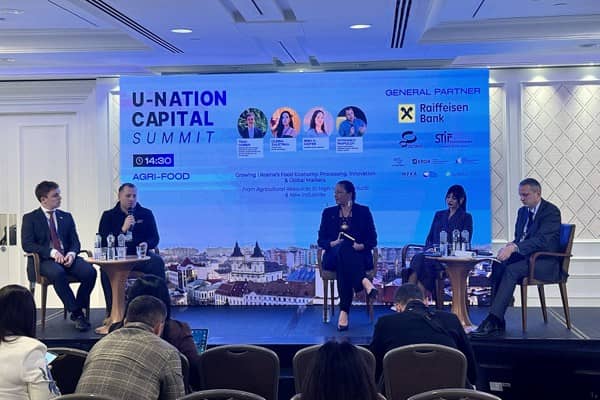
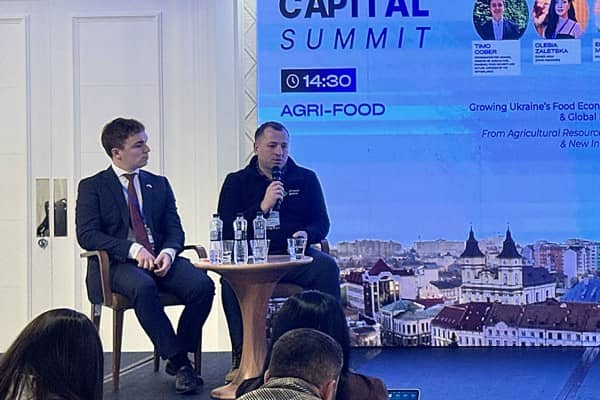
On 27 October 2026, Timo Cober, Coordinator for Ukraine at the Ministry of Agriculture, Fisheries, Food Security and Nature (LVVN), spoke on the agri-food panel of the U-Nation Capital Summit in Kyiv. He explained how Dutch partnerships help Ukrainian producers move beyond raw commodity exports towards processing and higher-value food products.
Beeld: © #UAgroNL
The U-Nation Capital Summit brought together diplomats, investors, development finance institutions and Ukrainian businesses to discuss Ukraine’s recovery and international economic cooperation. The summit was organised by U-Nation, with Raiffeisen Bank as general partner. Its sector sessions covered recovery investment, construction and smart cities, energy, manufacturing and logistics, and agri-food.
The agri-food session, “Growing Ukraine’s Food Economy: Processing, Innovation & Global Markets”, focused on turning Ukraine’s agricultural resources into high-value products and new industries. Panellists included Mykhailo Riapolov, Senior Agricultural Manager at Prosper Global, Olesia Zaletska, owner of MUKA (Ivano-Frankivsk), and Erin K. McFee, founder of the Corioli Institute.
Creating value in the country of origin
Timo Cober explained that the Netherlands has always been a trading country, especially in agricultural products. For a long time, this trade relied largely on importing raw commodities and re-exporting them within Europe and beyond. In recent years, the Dutch approach has shifted towards supporting value addition where products are grown.
He added that the Netherlands is also shifting from exporting products to exporting knowledge and expertise. The innovative Dutch agri-food sector, from greenhouse horticulture and plant breeding to dairy, poultry and food processing technology, enables Dutch companies and knowledge institutions to help build value chains in partner countries such as Ukraine.
Ukraine is a clear example of this approach. The Netherlands is one of the main destinations for Ukrainian agri-food exports, and Dutch partners are connecting Dutch business and investment with Ukrainian companies to strengthen their processing capacity. Examples include a USD 13 million Dutch concessional loan, part of a USD 40 million IFC financing package, for the construction of Ukraine’s first soy protein concentrate plant by Astarta. FMO, the Dutch entrepreneurial development bank, invested USD 25 million in Kernel’s pre-export facility, which finances the purchase of sunflower seeds, rapeseed and soybeans from Ukrainian farmers for processing into oil and meal.
Knowledge transfer is equally visible in smaller sectors. In October 2026, the Zeelandia Baking Center opened in the Kyiv region under the UPF-funded Bake4Ukraine project, together with Zeelandia Ukraine and the Perspectiva 21.3 Foundation. In its first year, the centre aims to train at least 250 people from small and medium-sized bakeries and start-ups, and to award up to 15 grants to small bakery owners.
Restoring broken value chains
russia’s attacks on Ukraine’s logistics and storage infrastructure have disrupted agri-food value chains. Timo Cober noted that restoring these chains matters for Ukraine and also for its trading partners, including the Netherlands. Under the Ukraine Partnership Facility (UPF), a grain transshipment terminal is being built in the Danube Delta. The Netherlands is also a donor to the World Bank’s crisis response fund for Ukraine, through which Ukrainian farmers receive working capital and temporary storage capacity.
In the potato sector, the first UPF project, the climate-smart potato demo centre in the Kyiv and Chernihiv regions (2023–2025), created production and storage infrastructure for seed potatoes and organised knowledge transfer. In the poultry sector, Dutch knowledge, machinery and companies are already active in Ukraine.
Horticulture and berries
Horticulture, a sector in which the Netherlands has strong expertise, is a growing area of cooperation. The UPF-funded SmartHarvest Ukraine project, implemented by Delphy with Ukrainian partners, is developing greenhouse innovation hubs with demonstration greenhouses and training centres in the Khmelnytskyi and Lviv regions.
In the berry sector, the UPF project “Rebuilding Ukraine’s Soft Fruit Sector”, led by the Dutch Ukrainian Berry Industry Cluster (DUBIC), supports regenerative strawberry and blueberry production in western and central Ukraine. Dutch partner SonderJansen helps bring the frozen berries to international markets. Knowledge exchange in these projects takes place mostly in person, and online when travel is not possible.
“Local value production is very important for us as a trading partner, especially now that exporting has become more difficult,” Timo Cober said.
Beeld: © #UAgroNL
Next step: UPF4
Several of these projects are financed through UPF, which RVO implements on behalf of the Ministry of Foreign Affairs. Timo Cober highlighted the fourth round, UPF4, as the next opportunity for Dutch-Ukrainian partnerships in agri-food. Eligible projects include rebuilding storage, cooling and irrigation facilities, restoring demined agricultural land and improving food supply. Dutch companies and organisations considering an application must submit the mandatory quick scan by 3 December 2026.
The agricultural team of the Netherlands Embassy in Kyiv will continue to connect Dutch and Ukrainian partners working on processing, logistics and horticulture.