
On 28 October 2026, Carolien Spaans, Agricultural Counsellor at the Netherlands Embassy in Kyiv, and Timo Cober, Coordinator for Ukraine at the Ministry of Agriculture, Fisheries, Food Security and Nature (LVVN), gave an online guest lecture at the National University of Life and Environmental Sciences of Ukraine (NULES). They discussed the future of the Common Agricultural Policy (CAP), Ukraine’s EU accession negotiations and the Dutch position on both.
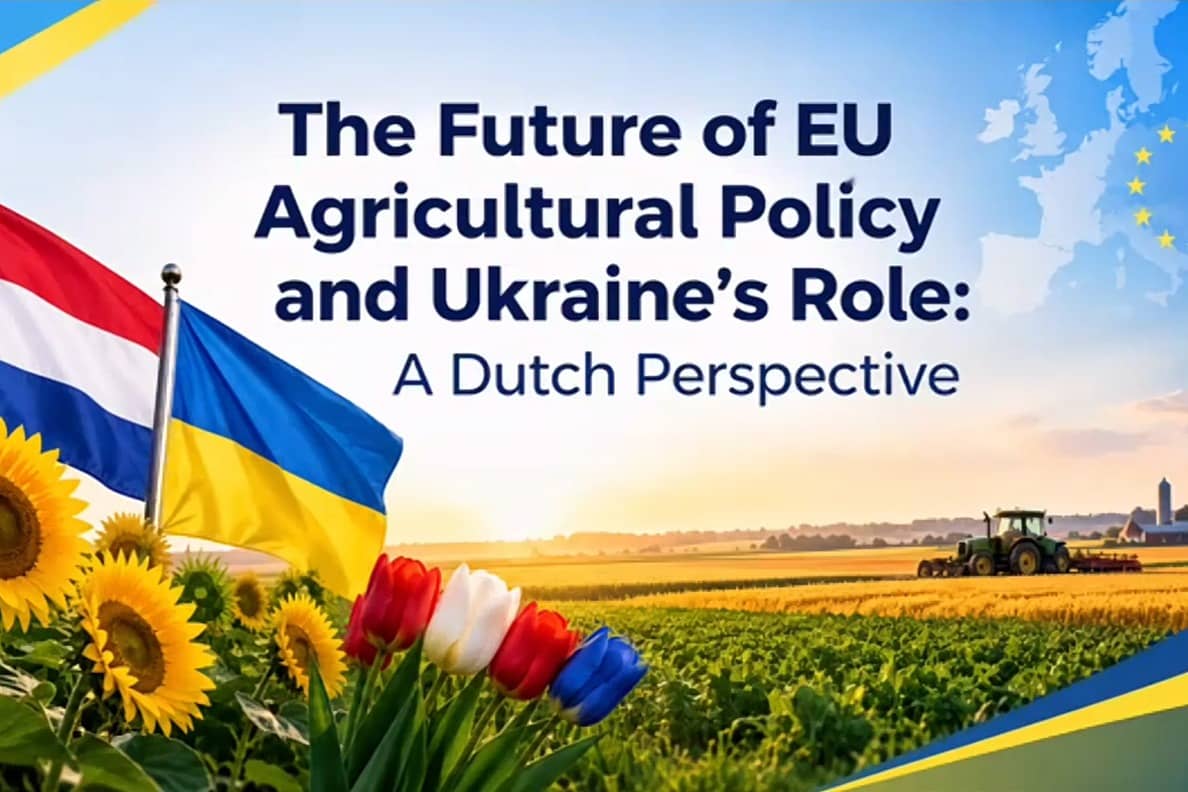
Beeld: © NUBiP
The open lecture was organised by the NULES Center for European Agrarian Policy and Diplomacy and the Department of International Relations and Social Sciences, within the Erasmus+ Jean Monnet project “EU-Ukraine Negotiating Diplomacy in the Agrarian Sphere” (EUNDAS). Students and lecturers from universities and research institutions across Ukraine joined, including from Lviv, Kharkiv, Dnipro, Ternopil and Mykolaiv. The session was moderated by Bohdan Hrushetskyi, head of the Center and coordinator of the project.
Two farmers, one policy
To make the policy debate tangible, the speakers followed two fictional farmers: Jan, a young dairy farmer in the Netherlands, and Natalia, a grain farmer in Ukraine. Jan receives direct payments per hectare under Pillar 1 of the CAP and can earn additional income under Pillar 2, for example for managing nature on his farm. Natalia receives none of this support, yet she competes with farmers who do. The current CAP (2021–2027) amounts to EUR 386.6 billion, around one third of the EU budget.
The lecture opened with statements for the audience, such as “The CAP is more about politics than about farming” and “Big farms should get less support than smaller farms”. They led to an active discussion in the chat.
Dutch priorities for the next CAP
Carolien Spaans explained how member states build their positions in the negotiations on the next CAP. The Netherlands is among the countries that pay most and favour a careful budget. Within the CAP, it wants to shift support from payments per hectare towards rewarding farmers for biodiversity, water quality and higher animal welfare. Countries such as Denmark and Austria are natural allies in these negotiations.
Merit-based accession and a level playing field
On enlargement, Spaans explained that the Netherlands supports a merit-based approach: progress depends on whether Ukraine actually meets the requirements, and the Netherlands assesses this closely. Agriculture falls mainly under Cluster 5, with chapters 11, 12 and 13 covering agriculture and rural development, food safety, veterinary and phytosanitary policy, and fisheries. Other member states look at accession more politically, focusing on what it means for their own farmers, as Ukraine would add around 24 million hectares of sown land to the EU.
The Dutch farmers’ organisation LTO has publicly supported Ukraine’s EU membership. It points to the geopolitical value of a larger EU and to the benefits that previous enlargements brought to the Dutch agricultural sector, which exports around 80% of its production. At the same time, the Dutch government and sector insist on a level playing field. Under the revised EU-Ukraine trade agreement, Ukraine is to apply the same animal welfare and crop protection standards as the EU from 2028.
Let farmers talk to farmers
Asked what Ukraine can do to move the process forward, Spaans stressed direct dialogue between Ukrainian and EU farmers’ organisations. In many EU countries, the image of Ukrainian agriculture is limited to large, efficient agroholdings, while the role of smaller farms in regional food security remains largely unseen. She also advised Ukrainian associations to agree on one joint position before engaging with Brussels.
She named two main challenges for the coming years. The first is institutional capacity, for example staffing a paying agency: the Dutch agency employs about 2,000 people, while Ukraine is considering around 300. The second is implementation on the farm, as many Ukrainian farmers are not yet aware of the EU animal welfare requirements that already apply.
Food security and Dutch support
Responding to a student question, Spaans explained how russia’s war against Ukraine has changed the EU’s view of food security. Since the end of July, hardly any grain has been exported from Ukraine’s Black Sea ports, and russia deliberately targets alternative export routes. Combined with rising input prices and instability around the Strait of Hormuz, this has made food security a topic at every level, from the FAO to the United Nations.
The speakers also presented Dutch support to Ukraine. Since the start of the full-scale invasion, the Netherlands has provided around EUR 5 billion in non-military support, largely via international financial institutions such as the World Bank, EBRD and IFC. Through the World Bank, for example, farmers receive working capital and temporary storage. Bilateral cooperation covers the implementation of EU animal welfare standards, a three-year cooperation between the Dutch and Ukrainian food safety authorities, and projects under the Ukraine Partnership Facility (UPF). These include the climate-smart potato demo centre, a transshipment terminal in the Danube Delta and demonstration greenhouses in the Khmelnytskyi and Lviv regions. Smaller initiatives support biodiversity, craft producers and young people interested in agriculture.
Carolien Spaans and Timo Cober closed with their personal career paths into agricultural diplomacy. NULES and the Dutch agricultural team agreed to continue the dialogue with an in-person session at the university, possibly in spring 2027.