
With climate change threatening cocoa production in Côte d'Ivoire, an ambitious roadmap has been approved to position organic compost as a benchmark agricultural input. This initiative, led by the Dutch Embassy in Cote d'Ivoire, the Netherlands Enterprise Agency (RVO), i4Policy and Akvo Foundation, aims to radically transform agricultural practices in the world's leading cocoa-producing nation.
A sector under climate pressure
Cote d'Ivoire, which supplies around 40% of the world's cocoa and provides a livelihood for nearly 5 million people, faces major structural challenges. For the 2024/2025 season, production is estimated at between 1.75 and 1.8 million tonees, a significant drop fro the 2.3 million tonnes produced in 2022/2023. This decline is manly due to unfavourable climatic conditions: excessive rainfall promoting witches broom disease and swollen shoot desease, followed by severe droughts and Harmattan winds.
Experts warn that climate change has already added around 40 days per year with temperatures exceeding 30 degrees Celsius, the optimal treshold for coca cultivation. In this context, soil regeneration through organic compost is no longer an option, but a strategic necessity.
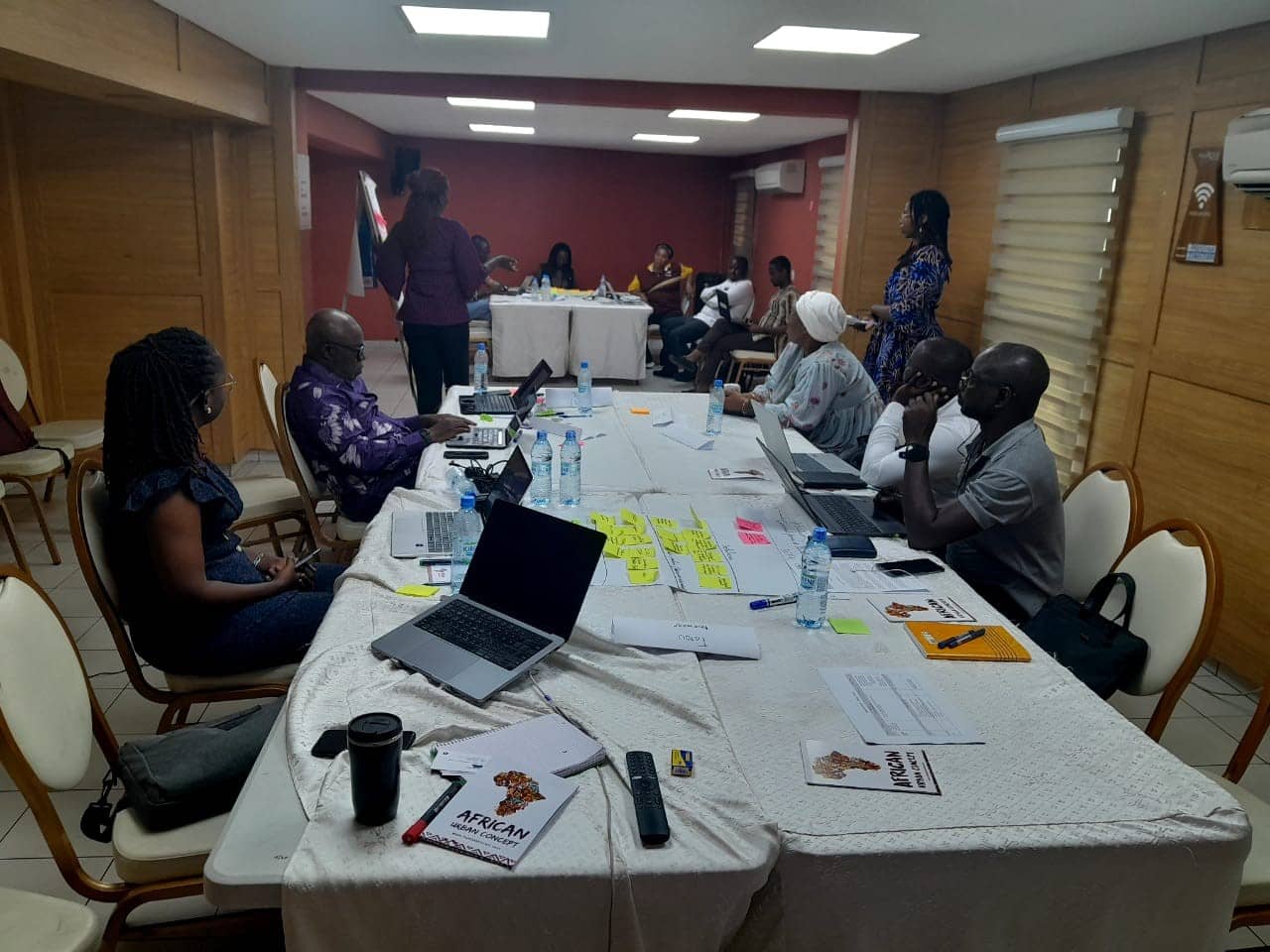
Consultation workshop, Abidjan, November 2025
From research to action: a unique participatory approach
Between October 2025 and January 2026, an in-depth study was conducted using the ADDIS (Agenda Setting, Drafting, Decision-making, Implementation, Sense-making) methodology promoted by i4Policy. More than 39 stakeholders were mapped, eight ten of which were interviewed in depth: public institutions (DSEPA, ANADER), research centres (CNRA, CIFOR-ICRAF), international NGOs (Rainforest Alliance, IFDC), the private sector (LONO, ECOM, BioSave) and agricultural cooperatives (CADESA).
Two participatory workshops were then held to refine the roadmap. The first, organised on 20 November 2025, brought together 12 experts to discuss four structural challenges: (i) Production, Quality and Standardisation; (ii) Adoption, training and awareness-raising. (iii) Funding and business models; (iv) Distribution, logistics and access to inputs. The second, held on 22 January 2026, validated the final version of the five-year action plan.
Four major obstacles
The study reveals that while the agronomic benefits of compost are widely recognised, its adoption remains marginal, estimated at between 1 and 5% of cocoa farmers. Four structural obstacles have been identified:
- Institutional and regulatory vacuum. The absence of a specific legal framework for organic amendments creates "regulatory invisibility". Unlike mineral fertilisers, which benefit from direct national subsidies, compost has no official status or dedicated budget line.
- The absence of quality standards. Without national certification, any product can be marketed under the name "compost", creating significant variability in quality that erodes farmers' confidence. Workshop participants unanimously called for the creation of a "National Quality Label" in collaboration with the DSEPA, CNRA, LANADA and CODINORM.
- Economic constraints. Compost requires massive volumes – up to 3 tonnes per hectare – generating prohibitive transport and spreading costs. Added to this is the lack of suitable financial products. Farmers favour subsidised mineral fertilisers that offer immediate results, whereas the benefits of compost are cumulative over the long term.
- Logistical and technical obstacles. the isolation of certain production areas makes compost production a financial constraint. In addition, existing training modules are often too generic and unsuited to local soil conditions.
Plenary session to validate the roadmap
An ambitious vision: 35% adoption in 5 years
The validated roadmap sets an ambitious goal: to make organic compost an accessible input for at least 35% of Ivorian cocoa farmers by 2030, contributing to a 25% increase in average productivity and profound soil regeneration.
The roll-out will take place in three progressive phases:
Phase 1 (years 1-2): preparation and experimentation
- Establishment of a multi-stakeholder steering committee led by the Ministry of Agriculture, the Coffee and Cocoa Council and the Interprofessional Agricultural Organisation (OIA) of the coffee and cocoa sector;
- Identification of reference farms in the areas of Daloa, Soubré, Abengourou, Man, Meagui, Bouaflé, Sassandra, Yamoussoukro and Duékoué to generate scientific data;
- Development of a "Cocoa Compost" Quality Label with validation by the CNRA, DSEPA and LANADA;
- Design of multilingual training kits adapted to local realities.
Phase 2 (years 3-4): structuring and scaling up
- Deployment of 50 village composting units at the cooperative level to solve the logistical challenge of the "last kilometre";
- Implementation of innovative financing mechanisms: guarantee funds, cash advances (20-30%), exploration of carbon credits;
- Formal integration of compost into certification systems (Rainforest Alliance, UTZ, Fairtrade);
- Deployment of a Management Information System (MIS) platform to monitor the real impact on 20,000 trained and equipped farmers.
Phase 3 (year 5): institutionalisation
- Creation of a national stakeholder platform and finalisation of a National Master Plan;
- Drafting of a bill on soil fertility and health to give compost the same political weight as mineral fertilizers;
- Establishment of a smart subsidy system linked to results, in collaboration with FIRCA, the Coffee and Cocoa Council and the Interprofessional Agricultural Organization (OIA) of the coffee and cocoa sector;
- Expansion of the network to 200 operational composting units.
Ambitious but realistic success indicators
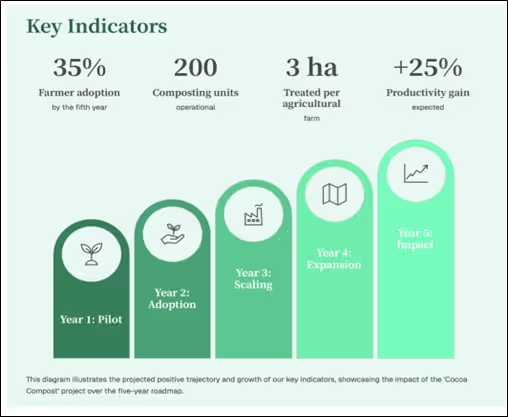
Four key indicators
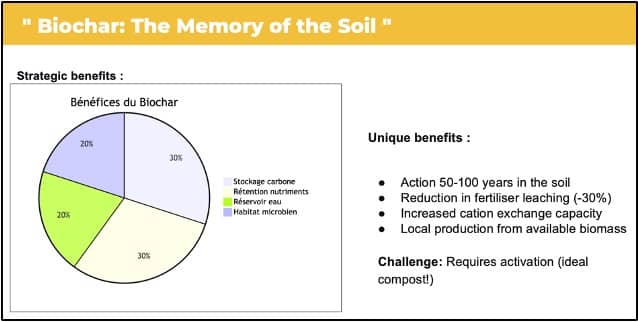
Benefits of Biochar
Biochar: strategic innovation for carbon credits
A distinguishing feature of this roadmap is the integration of biochar – charcoal obtained by pyrolysis of biomass (particularly cocoa bean shells). Unlike standard compost, biochar sequesters carbon for centuries, opening the door to carbon credit markets
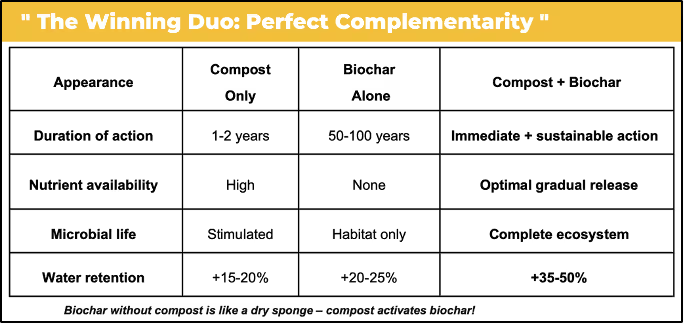
Compost activates biochar
This innovation could provide the direct financial incentive needed to offset the initial costs of the organic transition. However, during the validation workshop, participants emphasised that carbon credits should be considered as "complementary medium-term opportunities" rather than a prerequisite for launching the project, given their technical complexity
Beyond agronomy
Beyond soil regeneration, this initiative aims to achieve four major social and environmental impacts:
- Financial inclusion for women
- Enhanced climate resilience
- Job creation for young people
- Improved agricultural incomes
A replicable model for West Africa
This Ivorian initiative could serve as a model for other cocoa-producing countries in West Africa facing the same challenges of soil degradation and climate adaptation. Ghana, the world's second largest producer, is closely monitoring this systemic approach combining scientific research, multi-stakeholder mobilisation and innovative financial mechanisms.
The originality of this roadmap lies in its progressive, measurable and adaptive nature, with clearly assigned responsibilities. As the Directorate of Plant Health and Protection (DSEPA) emphasised during the validation workshop, "it is no longer a question of transforming compost into a simple technical option, but into a truly viable economic solution for all actors in the sector".
About the study
This roadmap is the result of collaboration between the Dutch Embassy in Côte d'Ivoire, the Netherlands Enterprise Agency (RVO), the Innovation for Policy Foundation (i4Policy) and Akvo foundation. The participatory study took place from October 2025 to January 2026, involving desk research, ecosystem mapping, interviews with eight key stakeholders, focus groups and a national validation workshop.
More information:
Interested in learning more or getting involved? Please contact us for more information at abi-lvvn@minbuza.nl.
Author: Rabdo Abdoulaye, Akvo
This article is part of the bilateral cooperation between the Netherlands and Côte d'Ivoire to promote sustainable agriculture that is resilient to climate change.