
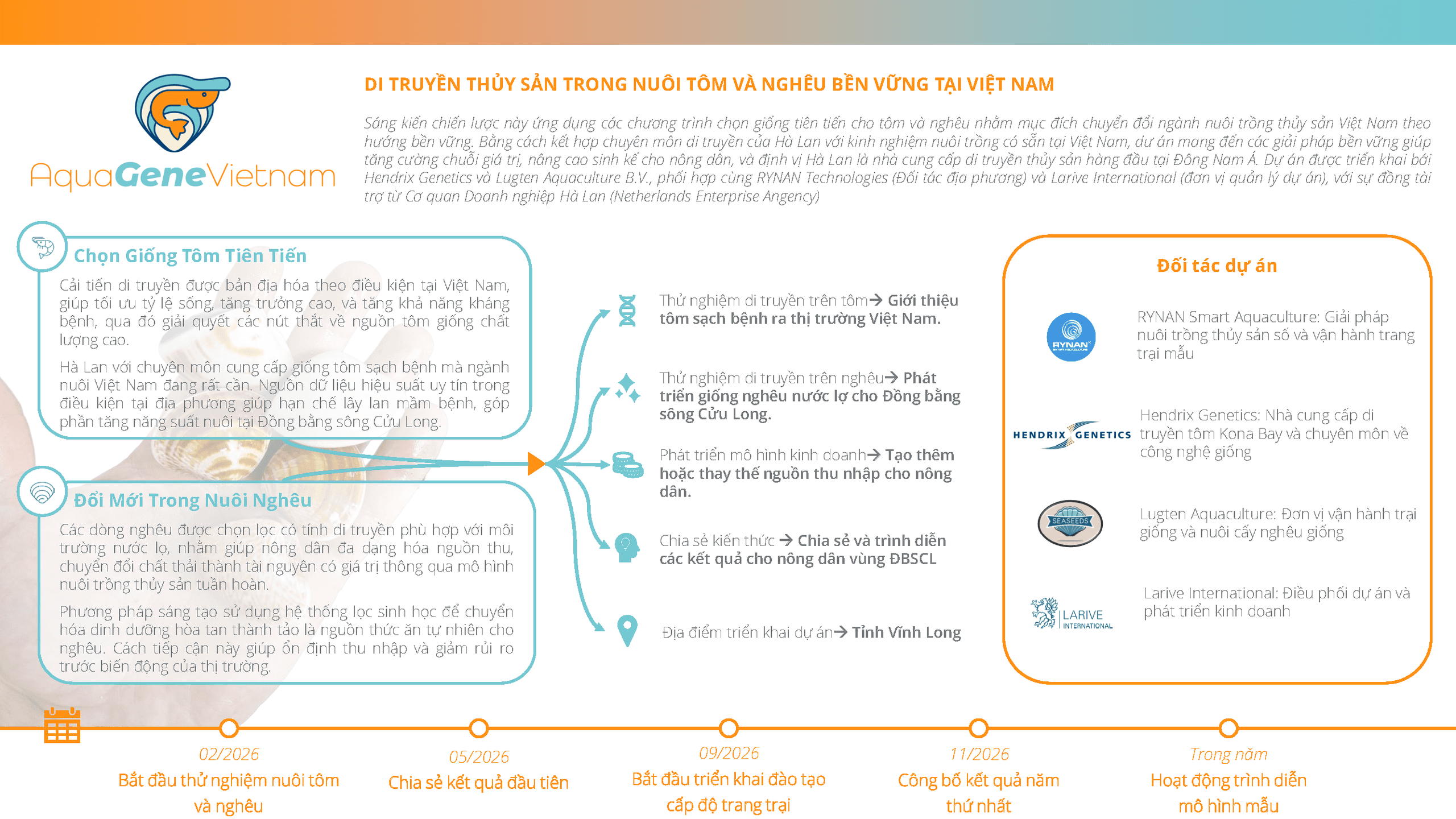
During the Combi-track mission Sustainable Aquaculture in the Mekong Delta in November 2025, partners from the Netherlands and Vietnam officially launched the AquaGene Vietnam Program. This project brings modern breeding and genetics into the Vietnamese aquaculture for shrimp and clams, helping farmers produce more reliably, reduces disease losses and creates new sources of income. AquaGene Vietnam combines Dutch expertise in breeding with Vietnamese know-how in farming and local conditions. It is a two-year collaboration between Hendrix Genetics B.V., Lugten Aquaculture B.V., RYNAN Smart Aquaculture JSC, and Larive International B.V., supported by the Netherlands Enterprise Agency (RVO) under the Combi-track Aquaculture Vietnam program.
Beeld: © Hendrix Genetics
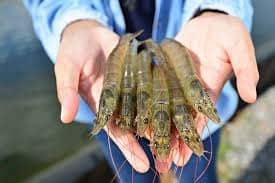
Shrimps in Vietnam
The initiative leverages Dutch breeding genetics programs for both shrimp and clams to advance Vietnamese aquaculture. By combining Dutch genetics expertise with Vietnamese farming knowledge, the project creates sustainable solutions that strengthen value chains, enhance farmer livelihoods and position the Netherlands as a premium genetics supplier in Southeast Asia. In practical terms, better shrimp genetics lead to healthier animals and higher survival rates, while clam integration allows farmers to generate income from ponds and wastewater that are currently underutilized.
The challenges in Vietnam's aquaculture sector
Vietnam is a major seafood producer and the largest exporter of aquaculture products to the Netherlands, including shrimp and clams. Dutch companies are therefore increasingly active in Vietnam and establishing strong bilateral relationships representing vital economic cooperation between the two countries.
Beeld: © Larive International
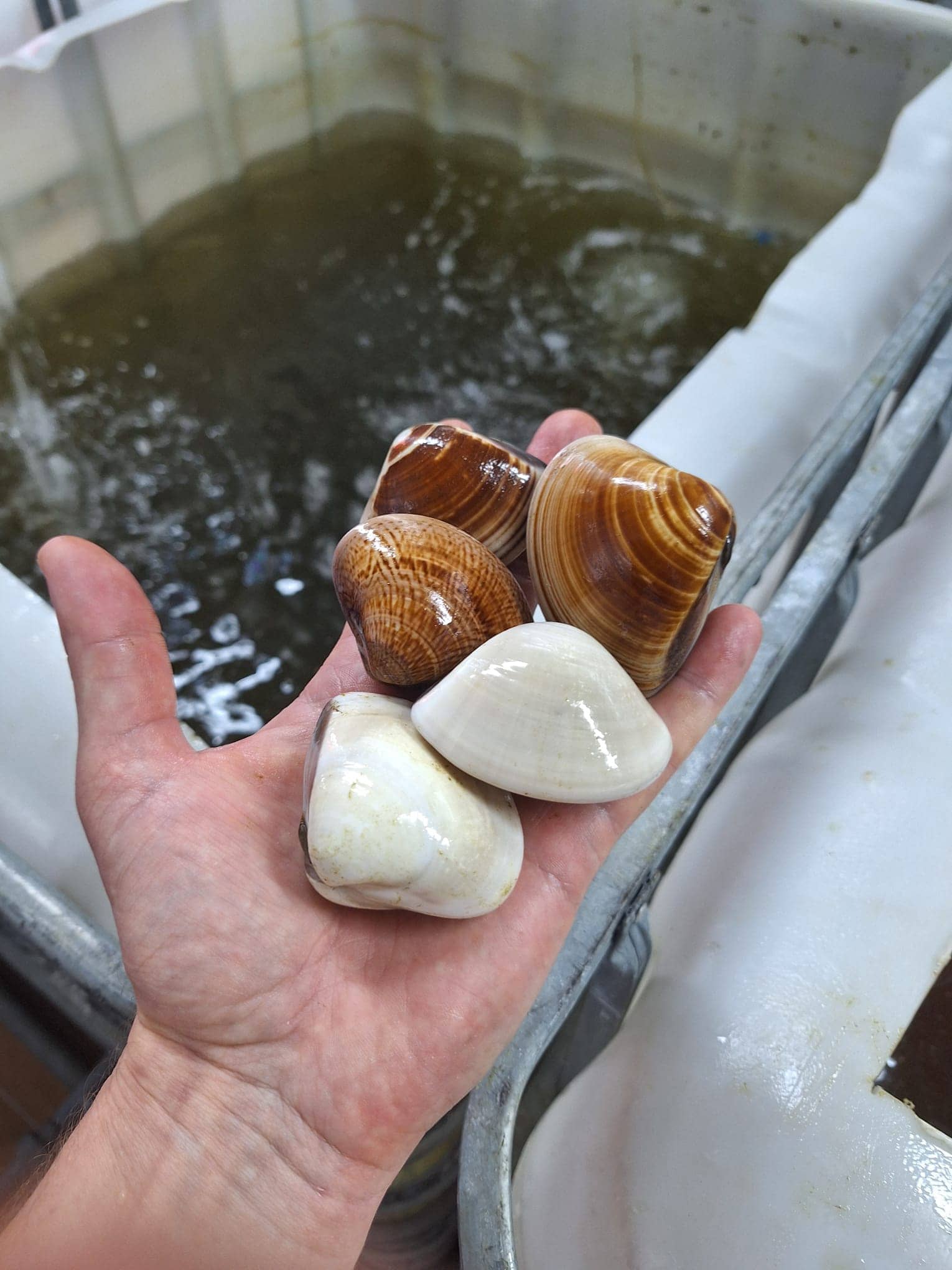
Photo of clams
However, beneath this success, the Vietnamese aquaculture faces challenges threatening its long-term sustainability. These challenges include:
• Disease pressure at hatchery level: Major shrimp disease outbreaks, such as EHP and White Spot Disease, originate at hatchery level, reducing survival rates to 25-30%, causing heavy losses for farmers and increasing costs throughout the chain.
• Market price volatility makes planning difficult: Shrimp market prices fluctuate sharply. When prices fall while production costs are high (due to disease related losses), farmers lose money for entire crop cycles. This uncertainty discourages investment and slows modernization.
• Few alternative income streams if shrimp become unprofitable: Many farmers in brackish water currently have limited viable crop alternatives. Wastewater ponds are often necessary for treatment but rarely generate income. This lack of income diversification increases vulnerability during low shrimp price periods.
These challenges affect the entire value chain: when ponds are underused, demand also drops for feed, probiotics and farm technology. Leading to revenue decline for suppliers and service producers across the value chain. Without effective intervention, these challenges will continue to undermine Vietnam's competitiveness in global aquaculture markets.
The AquaGene Approach: two complementary solutions
AquaGene Vietnam addresses these challenges through a dual approach: shrimp genetics for better performance and clam genetics for diversification and circular farming.
Advanced shrimp breeding adapted to Vietnam
A key bottleneck is the availability of high-quality, disease-free post-larvae (PL); the young shrimp stocked into ponds to grow out to market size. Hendrix Genetics will introduce an advanced shrimp breeding program that is adapted to Vietnamese environmental conditions, disease pressures and farming practices. The program is developed with a focus on survival, growth and disease resistance; and is supported by local trials and performance data showcasing. Improved genetics will limit pathogen spread and boosts productivity across the Mekong Delta.
Clam cultivation in brackish shrimp farming systems
Traditional clam varieties struggle in brackish water conditions typical for shrimp farming areas in the Mekong Delta. Lugten Aquaculture B.V., supported by Hendrix Genetics knowledge-sharing, will develop a clam strain that tolerates brackish water. This will enable farmers to generate extra income streams and strengthen water management.
Clams will become part of the circular aquaculture system at the farm. Nutrients from shrimp farming are no longer ‘waste’ but used as a resource. With the help of biofilters, dissolved nutrients can stimulate algae growth, the natural feed for clams. Clams help to filter the water, improving overall pond conditions.
This innovation enables farmers to: diversify income during periods of shrimp market volatility, generate income from underutilized ponds, including wastewater and treatment ponds and implement water quality by using clams to filter nutrients from shrimp farming production.
Beeld: © EKN Hanoi
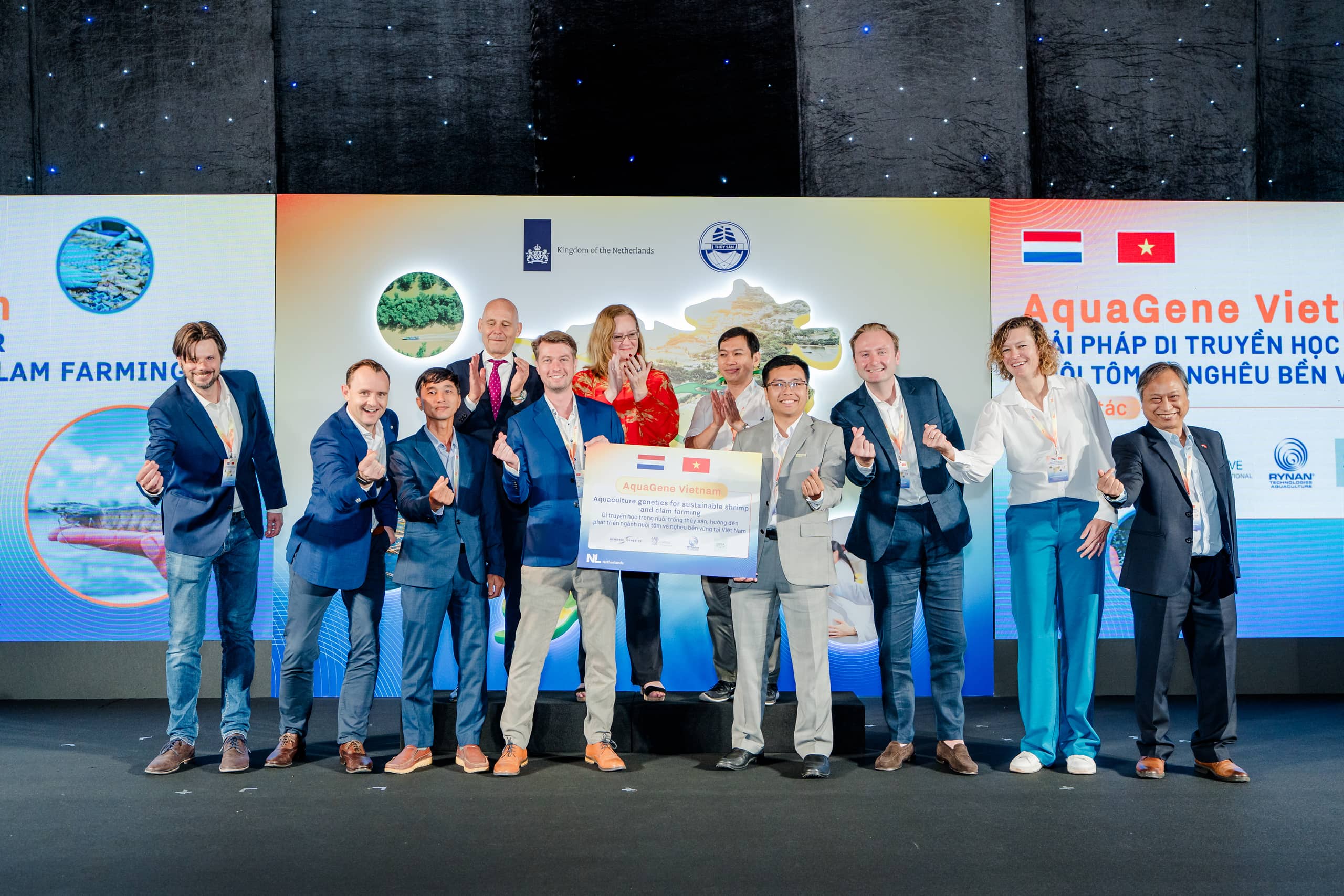
AquaGene Vietnam Program Launch in November 2025 in Ho Chi Minh City, Vietnam
AquaGene Vietnam: Project impact and activities
The AquaGene Vietnam project will deliver transformative impacts across economic, environmental, and social dimensions:
Economic Impact
Less disease spread in hatcheries and ponds lead to more stable yields, creating a more attractive investment climate. This stability enhances profitability across the shrimp industry while clam diversification provides an additional income stream. The project also strengthens the Netherlands’ position as a premium genetics supplier in Southeast Asia, strengthening the bilateral trade relationship.
Environmental Impact
The project transforms wastewater into a resource. Clams improve water quality in integrated ponds, while advanced technologies drive modernization. Detailed genetic performance data supports sustainable operations and helps farms reduce their environmental footprint.
Social Impact
Farmer training program and access to disease-free genetics help farmers with improving farming practices. Reliable performance data supports better decision-making and more sustainable production can support EU market access opportunities, strengthening farming livelihoods across the region. The AquaGene Vietnam project follows from innovation to practical application, working through five activities:
• Integrated shrimp genetics trials: Field trials in the Mekong Delta will test shrimp lines under local conditions, combined with health monitoring. The goal is practical: genetics that perform reliably in Vietnam.
• Clam genetics trials: Breeding and controlled trials will develop clam varieties suited for brackish-water shrimp systems.
• Demonstration of clams’ water-filtering capacity: Demonstration sites will show, in practice, how clams can help treat shrimp pond wastewater.
• Business case development for clam integration: Farmers and investors will receive clear cost–benefit analyses and investment projections for integrating clams or shifting part of production.
• Sharing findings and knowledge: Results from shrimp and clam performance will be shared with stakeholders so lessons move from trials to real adoption.
Beeld: © Larive International
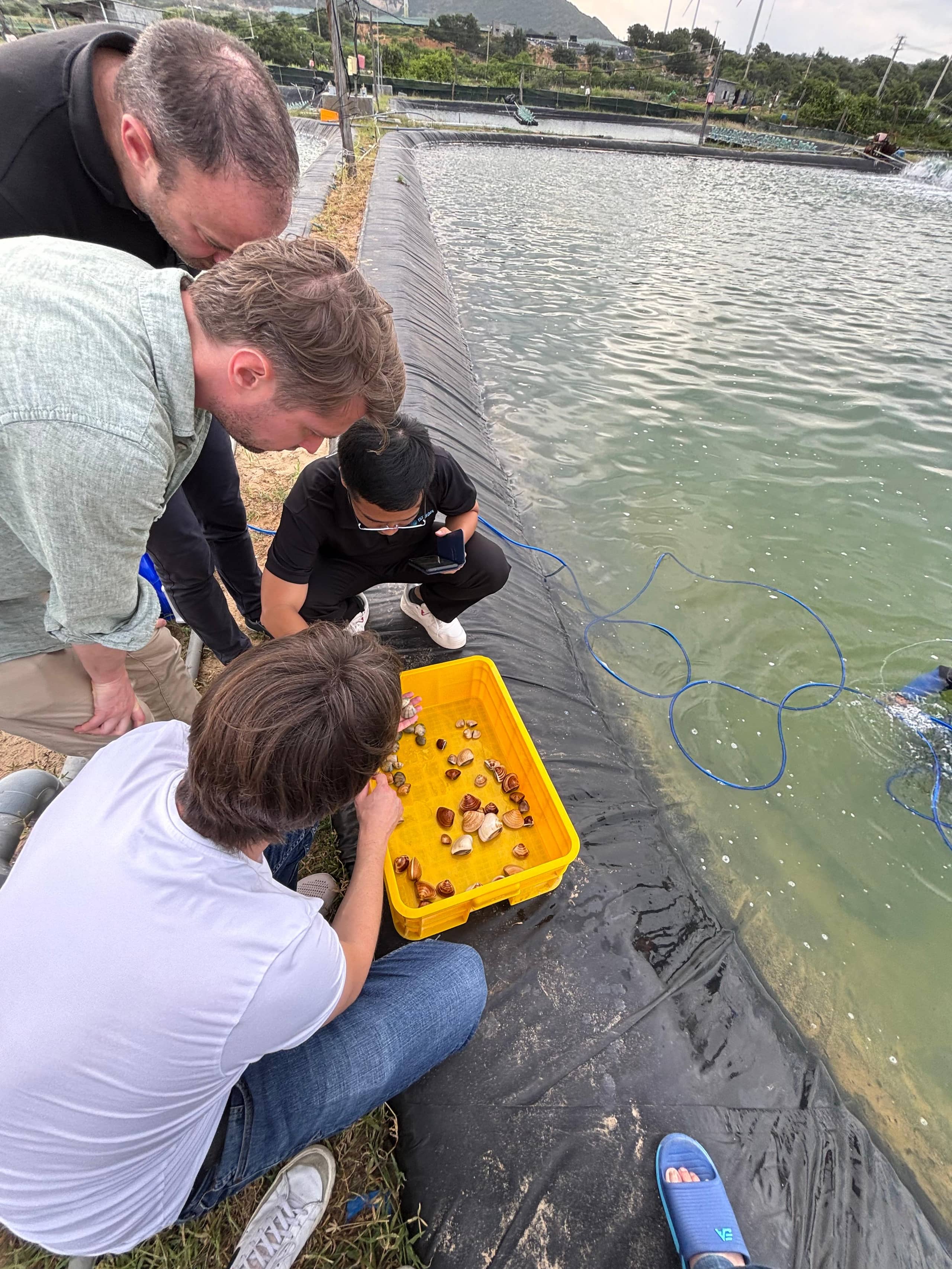
Vietnamese and Dutch partners of AquaGene Vietnam Program working together on the farm
Looking ahead
AquaGene Vietnam runs from October 2025 to October 2027 and aims to position the Netherlands as a key partner in modernising Vietnam's aquaculture sector while also opening commercial opportunities for Dutch companies across the genetics and farming innovation value chain. For Vietnamese farmers in the Mekong Delta, the project offers practical solutions such as improved survival rates, reduced disease pressure and new income diversification opportunities through clam cultivation. For the broader sector, it provides a pathway toward more sustainable, profitable and resilient aquaculture production.
Contact information
Do you have any questions for the Agriculture Department at the Netherlands Embassy in Vietnam? If so, please send an email to HAN-LVVN@minbuza.nl or HCM-LVVN@minbuza.nl. For the latest updates, news, funding opportunities and more, follow our LinkedIn: Netherlands Agricultural Network in Vietnam.
Beeld: © Larive International