
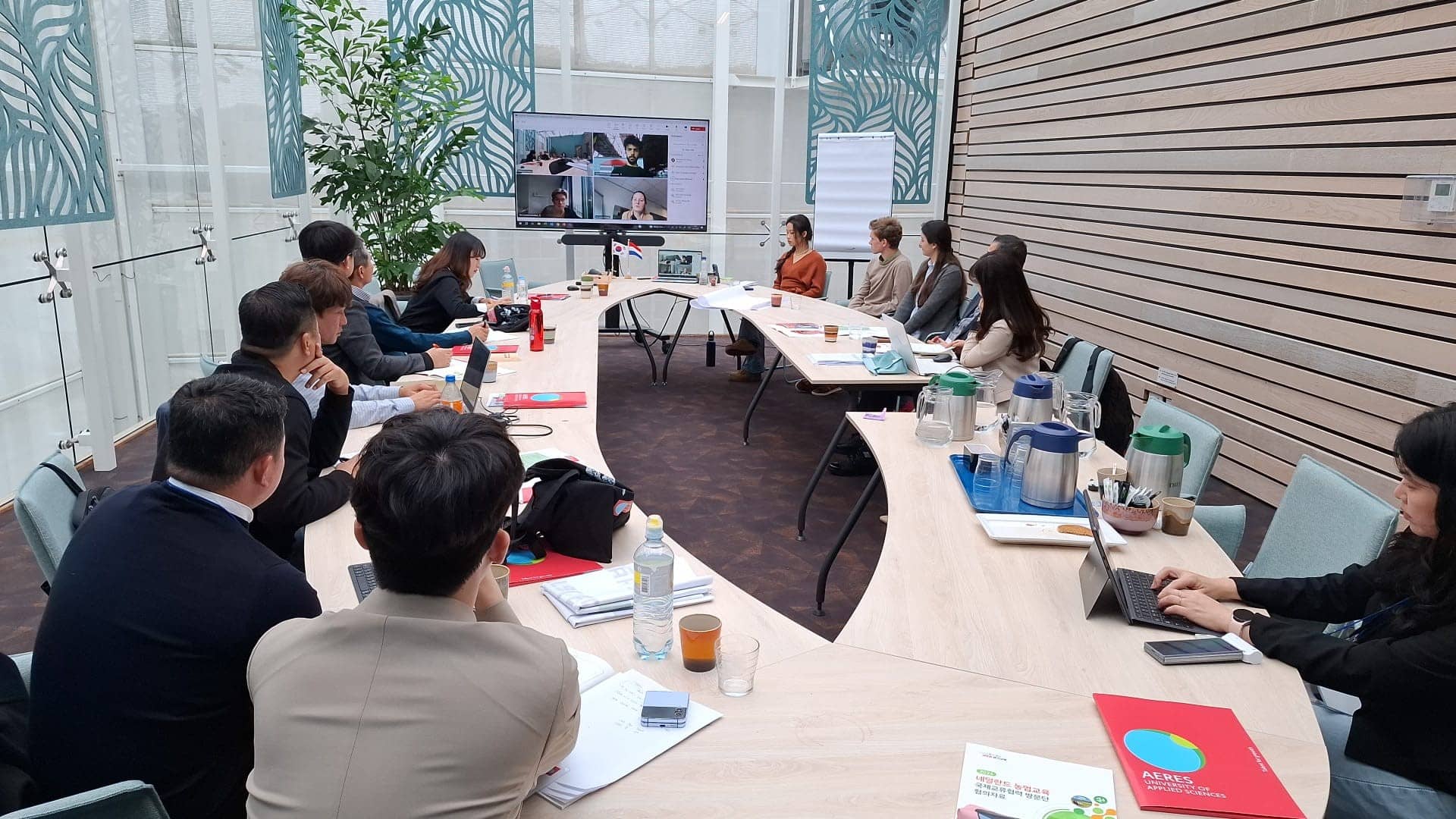
In May 2024, Aeres University of Applied Sciences (Netherlands) and the Gyeonggi Provincial Office of Education (GOE, South Korea) formalized their partnership through a Memorandum of Understanding (MOU). The agreement, supported by the Agricultural Department of the Netherlands Embassy in Seoul, aims to foster innovation in agricultural education through shared expertise, training exchanges, and capacity building. This collaboration, which also involves Yeoju Agricultural High School, represents an important step toward advancing sustainable agri-tech education in Asia. This article summarizes the key achievements and lessons learned over the past one and half years.
Beeld: © SEO-LVVN
Key Achievements
Since the signing of the MOU, the partners have achieved several important milestones:
- Knowledge Exchange and Capacity Building: In October 2024, a delegation of ten Korean educators and administrators from Yeoju High School and GOE visited Aeres’ campuses in Dronten, Almere, and Wageningen. The visit initiated discussions on a joint roadmap for educational innovation, facility improvement, and curriculum development.
- Pilot E-Learning Program in Hi-Tech Horticulture: Between April and May 2025, Aeres conducted a six-session online course for 20 Korean trainees. This pilot marked the first step toward integrating Dutch expertise in hi-tech horticulture into Korean vocational education. Feedback from participants was very positive and emphasized the value of practical and demonstrative teaching approaches, adapted to students’ varying levels.
- A visit by Professors Changgil Kim and Daegeun Choe (members of the Yeoju High School development committee) in June 2025, along with a visit by educational staff and students from Yeoju High School and GOE for tomato cultivation training in Dronten in August 2025, further deepened the collaboration. Building on these experiences, the partners plan a 16-session blended course in 2026, with half of the sessions to be delivered online by Aeres.
Challenges and Lessons Learned
While progress has been substantial, the partnership also revealed key challenges typical of international educational collaborations:
Communication and Language Barriers: Differences in language and academic terminology sometimes hindered knowledge exchange. Strengthening translation support and maintaining clear reporting will be critical for future phases.
Teaching Methods and Practical Focus: Korean educators highlighted the need for more hands-on, demonstration-based learning. Future training will therefore place greater emphasis on applied, practice-oriented modules.
Complex Decision-Making Structure: The involvement of multiple Korean institutions—GOE (funding and policy), Seoul National University (administration), and Yeoju High School (implementation)—occasionally created coordination challenges for Aeres.
Planning and Logistics: Short notice for missions and incomplete information on visit objectives affected preparation and outcomes. Early scheduling and transparent coordination will be essential moving forward.
Maintaining Momentum Beyond Horticulture: Some MOU targets, such as curriculum reform and facility enhancement, remain pending. Both sides recognize the importance of continued commitment and long-term planning.
Looking Ahead: Expanding the Partnership
The next stage of collaboration will focus on curriculum overhaul at Yeoju Agricultural High School, with technical input from Aeres Dronten and Wageningen. The partners envision Yeoju as a regional knowledge hub for sustainable agriculture and smart greenhouse technologies, extending impact to dairy, poultry, and livestock education. Exchange programs for teachers and students, including potential 'training of trainers,' will help embed Dutch educational expertise within Korea’s vocational system.
Conclusion
The Aeres–Gyeonggi partnership demonstrates how international cooperation can accelerate educational innovation and capacity building in agri-tech. The lessons learned—from aligning governance structures to adapting teaching methods—offer valuable insights for policymakers and businesses seeking to bridge European expertise with Asian educational ambitions. As both partners continue to 'grow knowledge together,' this collaboration sets a model for how practical, evidence-based, and inclusive approaches can strengthen agricultural education and innovation across borders.
Source: Aeres University of Applied Sciences