
From 3-6 November this year, the Singapore International Agri-food Week (SIAW) 2025 took place at Marina Bay Sands Expo & Convention Centre, bringing together innovators and leaders in the agri-food sector under the theme “Accelerating Climate Resilience in Asia-Pacific’s Agri-Food System”.
The Asia-Pacific region, which houses a majority of the world’s population, faces growing food insecurity and increasing risks in food supply chains. With climate change, agricultural production faces rising instability from shifting environmental conditions. The climate footprint of industrial agriculture also makes it unsustainable in the long term, with more efficient methods of food production needed.
This shift in agriculture has also spurred greater research and investment in newer and more innovative agriculture and food production methods. There is a rising focus on climate resilient agriculture that is more sustainable and food production methods which require less inputs.
The Netherlands at SIAW 2025
As one of the key agri-food events in the region, there were several Dutch organizations active in food-tech and agri-tech involved in SIAW 2025 activities. There were Dutch companies taking part in the Asia-Pacific Agri-Food Innovation Summit, sharing about financing and commercialization of agri-food innovation in the region. The Protein Brewery, a Dutch food-ingredients company utilizing biomass fermentation, even debuted several products at this Summit.
At the Agri-Food Tech Expo Asia (AFTEA) there was a Dutch Pavilion featuring 7 leading companies in high-tech & sustainable farming, alternative food ingredients (from fermentation) and financial services. We organized a successful networking event, attracting many trade visitors to engage with our companies. On the second day of AFTEA, we hosted Minister Grace Fu, the Minister of Sustainability and Environment of Singapore, at our Pavilion.
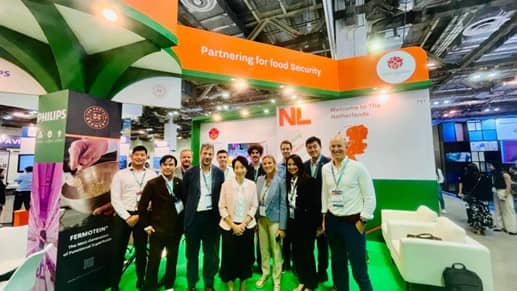
Beeld: © LVVN Singapore
Minister Grace Fu at the Netherlands Pavilion
For the Dutch companies to get a first-hand view of the Singapore agri-food ecosystem, they also went on two off-site visits to agri-tech and food-tech research facilities in Singapore. A visit to Singapore Polytechnic Food Innovation & Resource Centre (SP FIRC) gave the Dutch companies a comprehensive overview of the Singaporean food-tech ecosystem. FIRC is a center for food-tech innovation that supports businesses with solutions at all stages of product development and commercialization.
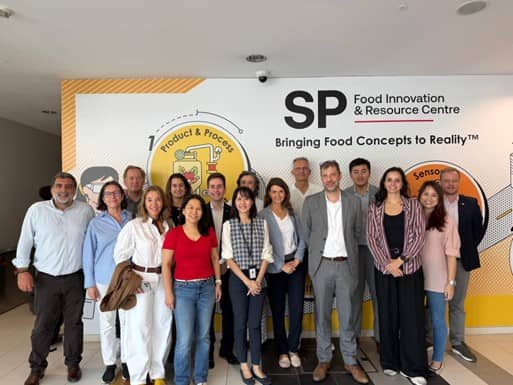
Visit to SP Food Innovation & Resource Centre
Dutch companies also visited Republic Polytechnic AGRI Centre, a cutting-edge applied research facility building R&D partnerships across the urban agriculture value chain. The AGRI Centre also supports the build-up of innovation capabilities for agri-enterprises and works with these enterprises to problem-solve hurdles in their business operations.
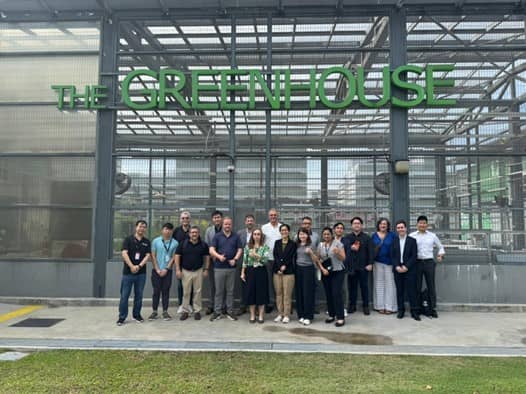
Visit to RP Agri Center
Singapore Government Food Strategy
During the SIAW 2025, the Singapore government unveiled the new strategy for ensuring food security in Singapore. In contrast to the 30-by-30 goal (in which 30% of food consumed in Singapore is to be produced locally) which focused more on local production, the government now adopted a more diversified approach involving 4 pillars to promote food security. This approach is meant to safeguard Singapore’s food supply especially during times of supply chain shocks or logistical disruptions.
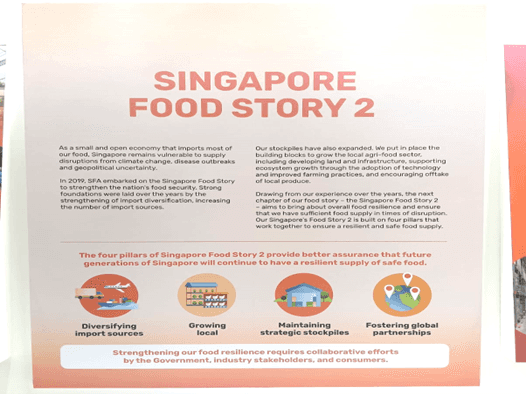
Singapore Government Food Strategy, 4 Key Pillars
For the first pillar, the Singapore government committed to maintaining larger stockpiles of essential food items. These would provide a buffer stock of food during times of uncertainty. With these plans by the Singapore government, a greater number of food storage facilities that are more resource-efficient are also needed. This offers opportunities for agrologistics companies in the Netherlands
As for the next pillar, the Singapore government stated that they would continue to diversify food import sources. This is an ongoing measure that they have undertaken for the past few years, and it ensures that there are alternative food sources in case of supply shortages/disease outbreaks from one source.
Local production is still an area of interest for the Singapore government, forming the third pillar. In a development to the 30-by-30 goal, the government now aims to produce 20% of fiber needs and 30% of protein needs by 2035. With these aims, there is also government interest to develop agri-food tech R&D in Singapore, and the Singapore government announced funding available for organizations involved in seed-breeding and alternative foods.
The last pillar is forging more G2G partnerships, fostering deeper collaborations in food security, safety, and innovation. This ensures that trading of essential food supplies continues during periods of uncertainty, risks in food safety are communicated, and co-innovation in food production is encouraged.
A Collaborative Future – The Netherlands and Singapore
These new plans announced by the Singapore government open many windows of opportunities for partnerships between Dutch and Singaporean stakeholders. With the 4 pillars of food security established, there are several aspects in which Dutch organizations active in the region and in Singapore can work with Singaporean researchers and companies. As these partnerships form, there are also support provided by the Dutch and Singaporean government in terms of advisory and funding, to support the establishment and growth of the joint initiatives.
If you would like to learn more about collaboration opportunities for sustainable food production in Singapore, please reach out to our Agricultural Advisor, Lucas Jiang, at sin-lvvn@minbuza.nl.