
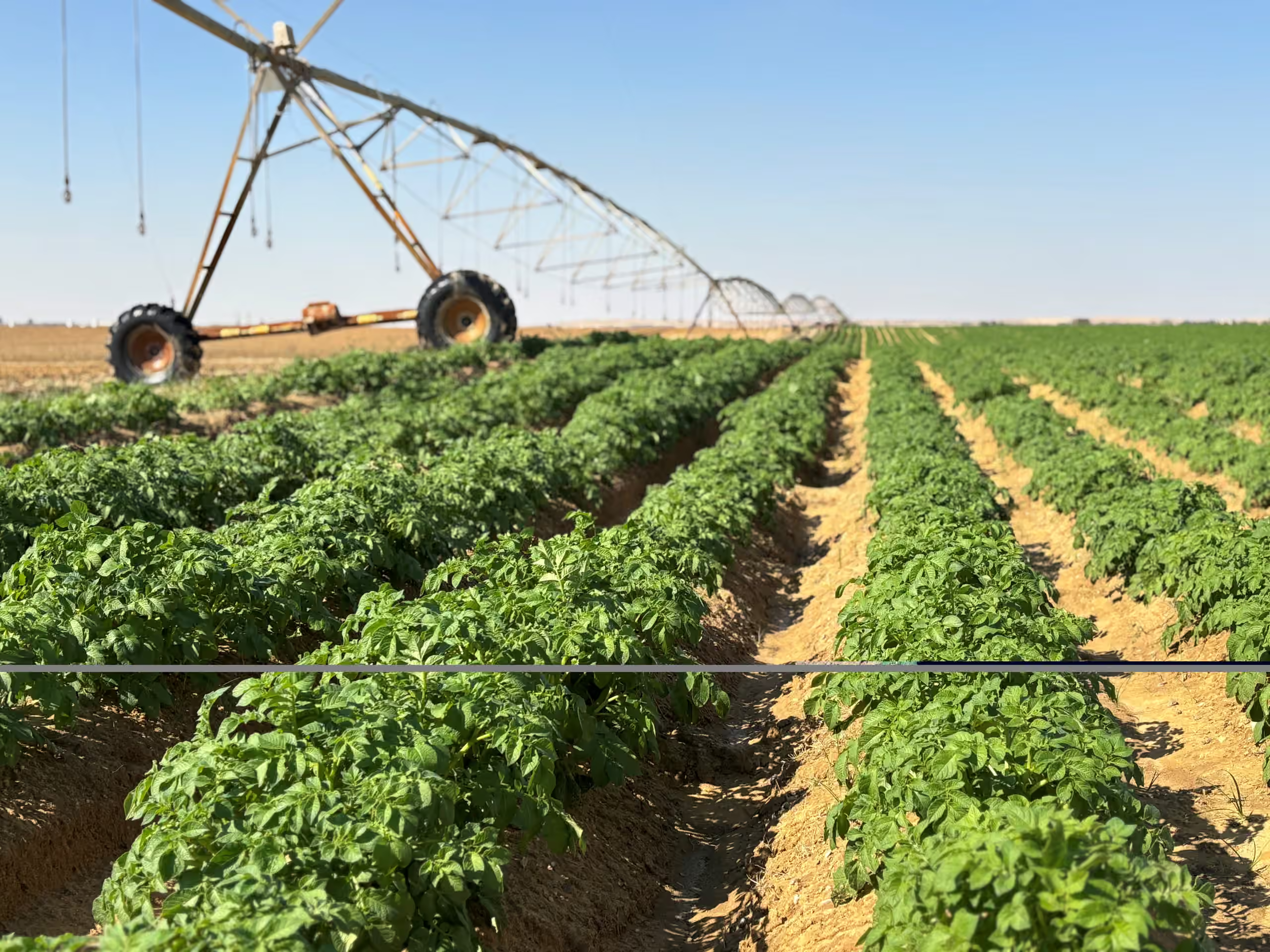
Egypt builds innovation under pressure
Dutch-Egyptian collaboration connects knowledge, technology, and business
Climate change, salinization, rising energy costs and diminishing groundwater resources are putting Egypt’s food system under increasing pressure. At the same time, the country is strengthening its own research and innovation capacity and looking for technologies that can support more resilient, efficient, and export-oriented agriculture. Dutch companies, knowledge institutions and the Netherlands Agricultural Network (LAN) team at the Dutch Embassy in Cairo is working with Egyptian partners on crop resilience, water efficiency, greenhouse horticulture and post-harvest technology.
High pressure can be a breeding ground for innovation. Egypt’s food system must serve a rapidly growing population while coping with climate change, salinization, rising energy costs and diminishing groundwater resources. At the same time, the country wants to strengthen agricultural exports. Over the past decade, Egypt has started to invest more in its own research and development (R&D) and innovation capacity, through universities, who introduced curriculum for more entrepreneurial and R&D-skills and the growth of in-house R&D at companies.
The Netherlands has long been a partner in knowledge exchange and innovation and is building on this changing landscape. The Egyptian government as well as the private sector look to The Netherlands for inspiration, knowledge and partnership. By the words of Minister of Agriculture and Land Reclamation Alaa Farouk, ‘the collaboration between Egypt and the Netherlands, the exchange of technology and the knowledge sharing benefits the Egyptian people and its agriculture.’
Minister Alaa Farouk on Netherlands-Egypt relationship

Minister Alaa Farouk reflects on Netherlands-Egypt relationship
Download
Long-standing Dutch-Egyptian cooperation
Dutch companies and research institutes are deeply rooted in Egypt’s business and innovation landscape. Partnerships in seed potatoes and vegetable breeding, for example, often go back decades. This year even marks 50 years of Dutch-Egyptian water cooperation.
During the visit of Dutch Minister Sjoerd Sjoerdsma in May 2026, more than 21 Dutch and 600 Egyptian companies and institutions met during the ‘Netherlands-Egypt Agricultural Partnership Summit. Sharing data and knowledge is an important part of the Dutch approach to innovation, with companies competing by turning those insights into new applications and technologies.
As an example of such exchange, eLeaf monitored water use and could link that to crop development in the field through partnering with Canal Sugar. As a result, they could further improve their models and interpretation of data, providing better services through their application. The LAN team in Cairo, supported by the Combi-Track on Climate and Water Smart Agriculture, facilitates this cooperation through acceleration programs, business matchmaking, networks connecting knowledge institutions, and crystallization points – places where demonstration, training and co-creation can happen in one location.
‘Egypt’s dry, hot and mostly sandy conditions make it a challenging testing ground for agricultural innovation’
Four innovation trajectories
Dutch-Egyptian cooperation brings together several areas of expertise. Egypt’s dry, hot and mostly sandy conditions provide a demanding environment in which new approaches can be developed and tested. Four innovation trajectories currently stand out:
-
Reducing reliance on synthetic pesticides and fertilizers, while also reducing pesticide residues on crops and meeting maximum residue levels required for export. Projects and business partnerships focus on biological crop protection, new natural enemies, resistant crop varieties, and precision farming.
-
Building resilience to climate change and salinity. Sensor- and satellite-driven technologies can improve irrigation and water-use efficiency. Dutch-Egyptian cooperation also has a long history in selecting and developing vegetable and seed-potato varieties. Newer approaches include soil biodiversity and regenerative agriculture.
-
Developing controlled environment agriculture and greenhouse horticulture. Egypt has several high-tech greenhouses and a much larger area of mid-tech greenhouses. Innovation focuses on climate control, irrigation, soilless cultivation, and biological crop protection.
-
Improving automation. The scale of Egyptian production requires specialized technology for sorting, grading, packing, freezing, and juicing. These technologies need to be adapted to production scale and target markets. The same applies to technologies for planting, potting, and grafting.
Across these trajectories, artificial intelligence (AI), the Internet of Things (IoT), robotics and sensor technology provide a common technological base.
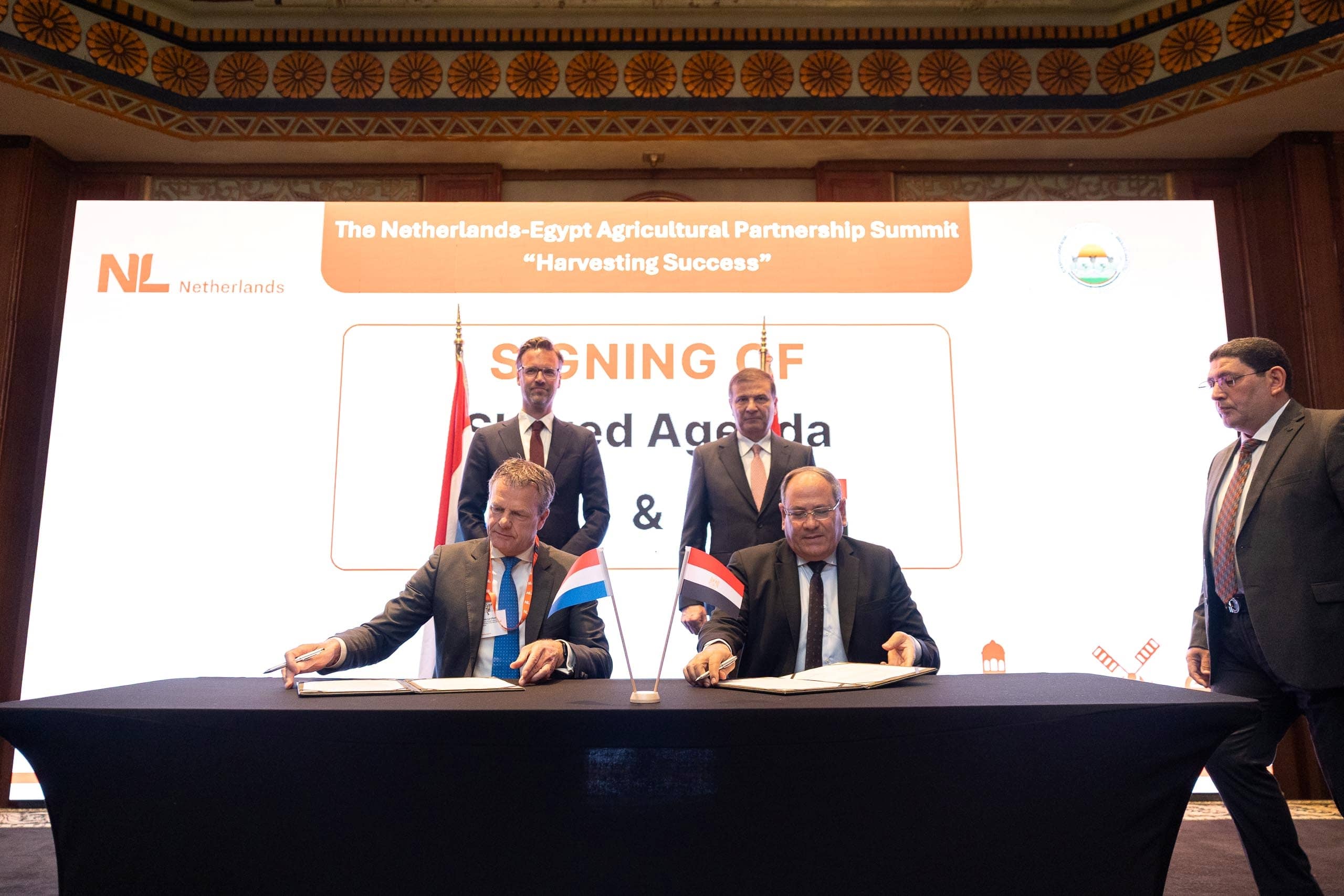
Signing of the shared agenda during the summit
Partnering with the Netherlands
The growing emphasis on innovation is also visible in Dutch-Egyptian cooperation. During the summit of May 2026 four forms of collaboration were highlighted: acceleration programs, business partnerships, knowledge crystallization points, and collaboration between knowledge institutions.
Acceleration programs
Dutch programs began focusing on scale-ups in Egypt around six years ago. Small and medium-sized enterprises (SMEs) that survive the start-up phase can still struggle to reach the market and grow. Several programs therefore target young entrepreneurs in different regions and sectors, offering technical training, support with financing and business-case development, and direct contact with potential partners and clients. Together, these acceleration programs currently reach more than 100 SMEs a year. They include Orange Corners, the horticultural supply-technology program Agrovance and support for SMEs working on the Water-Energy-Food nexus. The new Water Footprint Network in Action program is expected to add further momentum.
These programs also connect these young Egyptian companies to the Dutch business and knowledge community. Over the years, participants and alumni from these programs have entered partnerships with Dutch organizations, facilitating the Dutch company in accessing the Egyptian market, while strengthening the Egyptian business partner. Examples include Tamkeen and Hydrosat, and Grow Egypt and Eurofins.
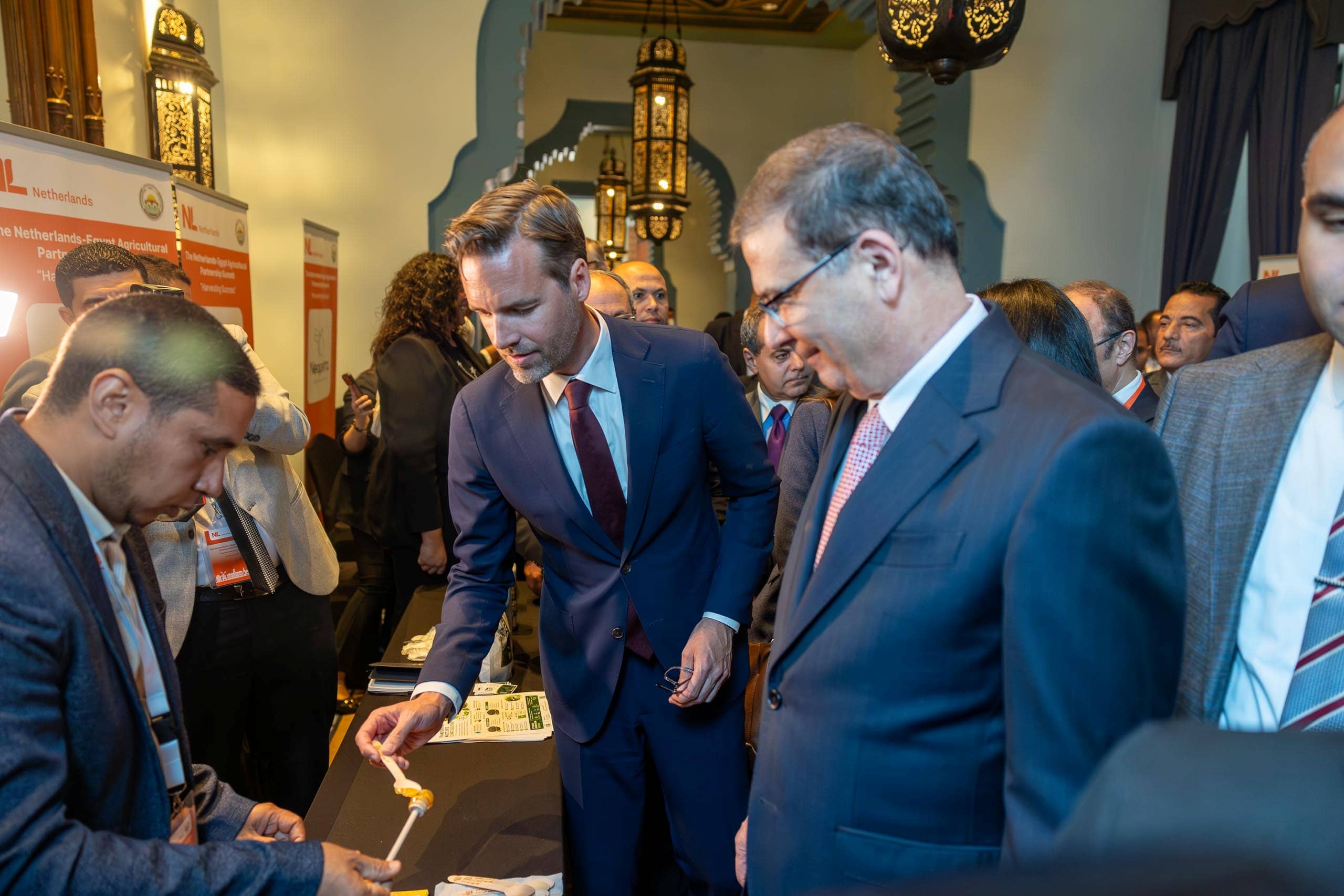
Sjoerd Sjoerdsma and Alaa Farouk interacting with participants at the booths during the summit
Business partnerships
Matchmaking can help companies find the right counterpart and, in many cases, continue business development without further government support. Where a business case looks promising, but the market is not yet ready, or where a sustainable concept is ahead of the market, the Netherlands Enterprise Agency (RVO) can provide additional instruments.
The LAN team helps companies identify these instruments and connects Dutch companies with Egyptian partners. This matchmaking has contributed to initiatives including Rootgrow, a pre-breeding program, work on soil biodiversity in desert farming, an e-learning for smallholder farmers and the discovery of new natural enemies.
Financing is another area of innovation. Alongside government-facilitated projects, Dutch companies are introducing and co-developing technologies in Egypt. Two examples are:
-
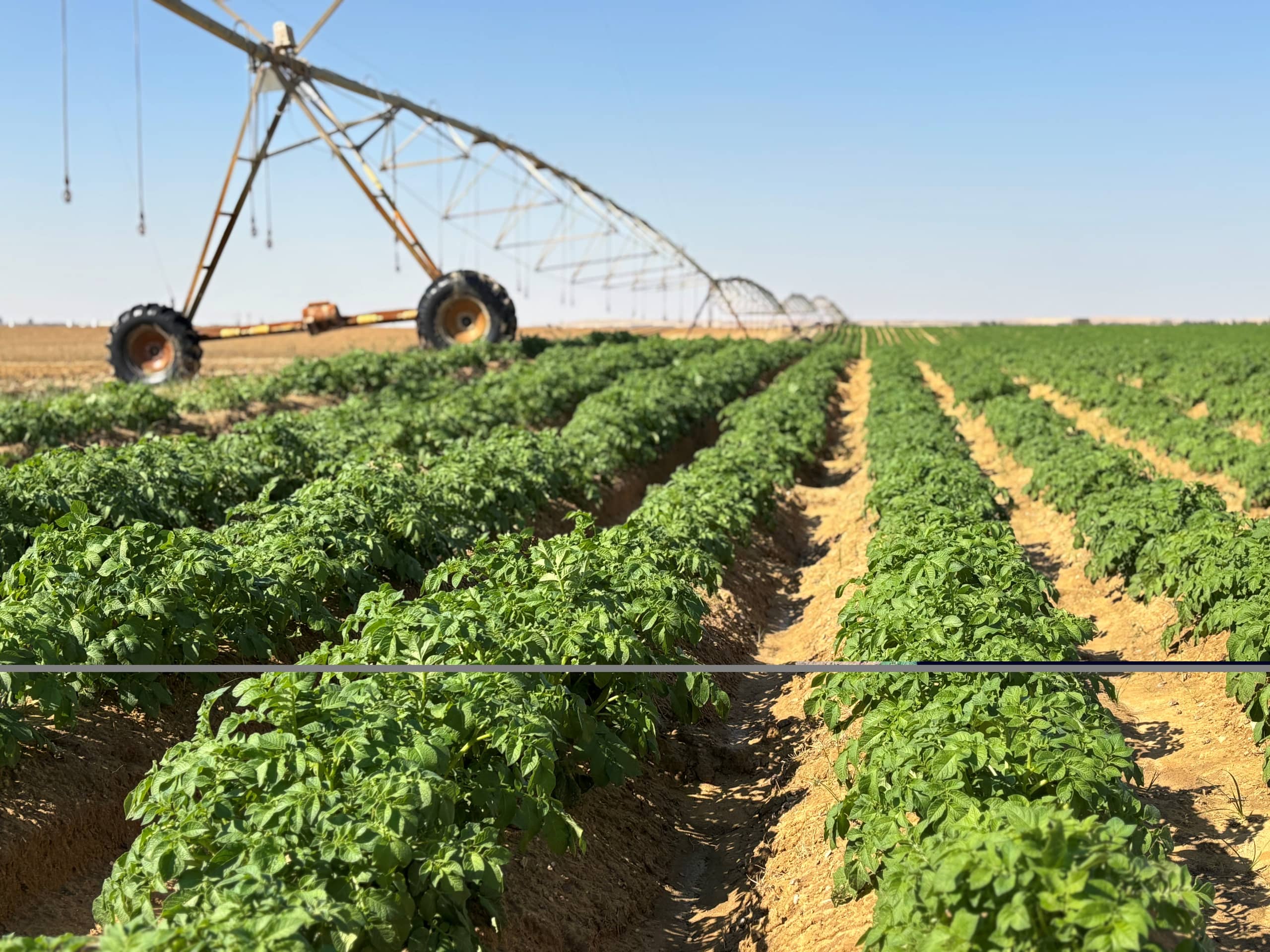
HZPC’s potato variety Panamera, which is aimed at organic agriculture. According to the project information, it can use around 25 per cent less nitrogen, produce higher yields than popular varieties such as Spunta, and offer greater resilience to Phytophthora.
-
Ridder’s climate-control system for more than 230 greenhouses, covering more than 1,000 hectares. Individual greenhouses can be monitored and controlled centrally through systems for ventilation, screens, fogging, and recirculation fans.
Crystallization points
Innovation also depends on users having the knowledge to apply new technologies effectively. A new tool or insight does not automatically find a market: demonstration and training can help users understand innovation, attract new users, and support further co-creation. The Netherlands supports, through Impact Clusters and the new program of WaterFootprint in Action (WFiA), this often pre-competitive work on knowledge sharing and capacity building, while the private sector remains in the lead.
Together with the private sector, several demonstration and crystallization points have been developed: physical locations where technology is seen in practice and workshops and trainings are supporting knowledge sharing and co-creation. Examples can be found along the Alexandria Desert Road for citrus cultivation, in the Obour area for greenhouse horticulture and along the Dahab Road for resilient soil cultivation. The Water Footprint Network in Action program will further develop activities at these crystallization points and establish new locations.
‘Crystallization points can become places for co-innovation, knowledge collaboration, and long-term partnerships’
Crystallization points can in turn become places for co-innovation and long-term partnerships. The LAN team is exploring how the crystallization points, as developed in the mentioned projects, can find a lasting support-base and a business case to ensure continued Dutch presence at these locations, to support innovation in Egyptian agriculture.
Collaboration between knowledge institutions
More fundamental questions require cooperation between knowledge institutions. Wageningen University & Research, IHE Delft, Aeres, the University of Twente and Maastricht University work with Egyptian universities, research institutes and the Agricultural Research Center on research and development between the two countries.
Long-standing knowledge cooperation between Egypt and the Netherlands has increasingly moved towards the joint development and testing of practical tools and innovations for water management. Practical solutions include controlled drainage, lining of canals, introducing drip irrigation, and of course the models for water-use-efficient irrigation. Through different projects and programs, Egyptian and Dutch knowledge institutions combine field experiments, Earth observation and modelling. This connects farm-level innovation and decision-making with regional and national water and food planning.
Building a lasting innovation partnership
The LAN team in Egypt focuses on business cooperation and collaboration on innovation. It aims to build lasting (innovation) partnerships through acceleration programs, where innovative scale-ups partner with Dutch companies to open up markets in Egypt and in the Netherlands. This is done through the crystallization points, where we find continued demonstration and co-creation of Dutch technology in Egypt and through K2K networks with institutes like Wageningen University, EHI, Twente University and Aeres and counterparts in Egypt.
These efforts depend on alignment with the ambitions and perspectives of the companies and institutions involved. The aim is to strengthen the Egyptian business climate while creating opportunities for Dutch companies and knowledge institutions.
More information
If you would like to know more about agrifood innovation and Dutch-Egyptian cooperation, visit Egypt's country page on this website. You can also contact the LAN team at the Dutch Embassy in Cairo: kai-lvvn@minbuza.nl.