
Dutch-Serbian cooperation improves post-harvest performance
Serbia takes practical steps to reduce losses and protect value
Serbia has built a strong agri-food export profile, yet value is still lost before products reach the consumer. From berries, apples and vegetables to maize, wheat and soy, these losses rarely show up as visible waste. Instead, they appear in shorter shelf life, lower grades, rejected lots, weaker margins, and missed market opportunities. Food loss in Serbia is therefore more than a waste issue. It is also a matter of farm income, food security, resource efficiency, environmental sustainability, and export performance. The main areas for improvement are handling, cold chains, storage, logistics and quality assurance, offering clear scope for knowledge exchange, cooperation, and practical engagement with the Netherlands.
Serbia’s export data explain why food loss matters. Serbia’s Green Book 2024, the Ministry of Agriculture’s annual report on the state of agriculture, shows that fruit (fresh, frozen, dried and temporarily preserved) was the country’s largest agri-food export category in 2024, worth EUR 746.5 million, or about 14.5% of total agri-food exports. Globally, fruit and vegetables are the product group with the highest losses, which makes Serbia’s export-oriented horticulture especially vulnerable.
That also makes post-harvest performance a real business case. In highly perishable chains, small lapses in timing or temperature can quickly translate into lost value. Fruit harvested in the heat, delays before pre-cooling, rough handling, poor airflow in storage, temperature fluctuations during transport, or inconsistent grading can all lead to food loss. In grains and oilseeds, the risks are different, but the underlying logic is similar: if quality declines during drying, storage or handling, the product becomes harder to sell at the intended price or in the intended market.
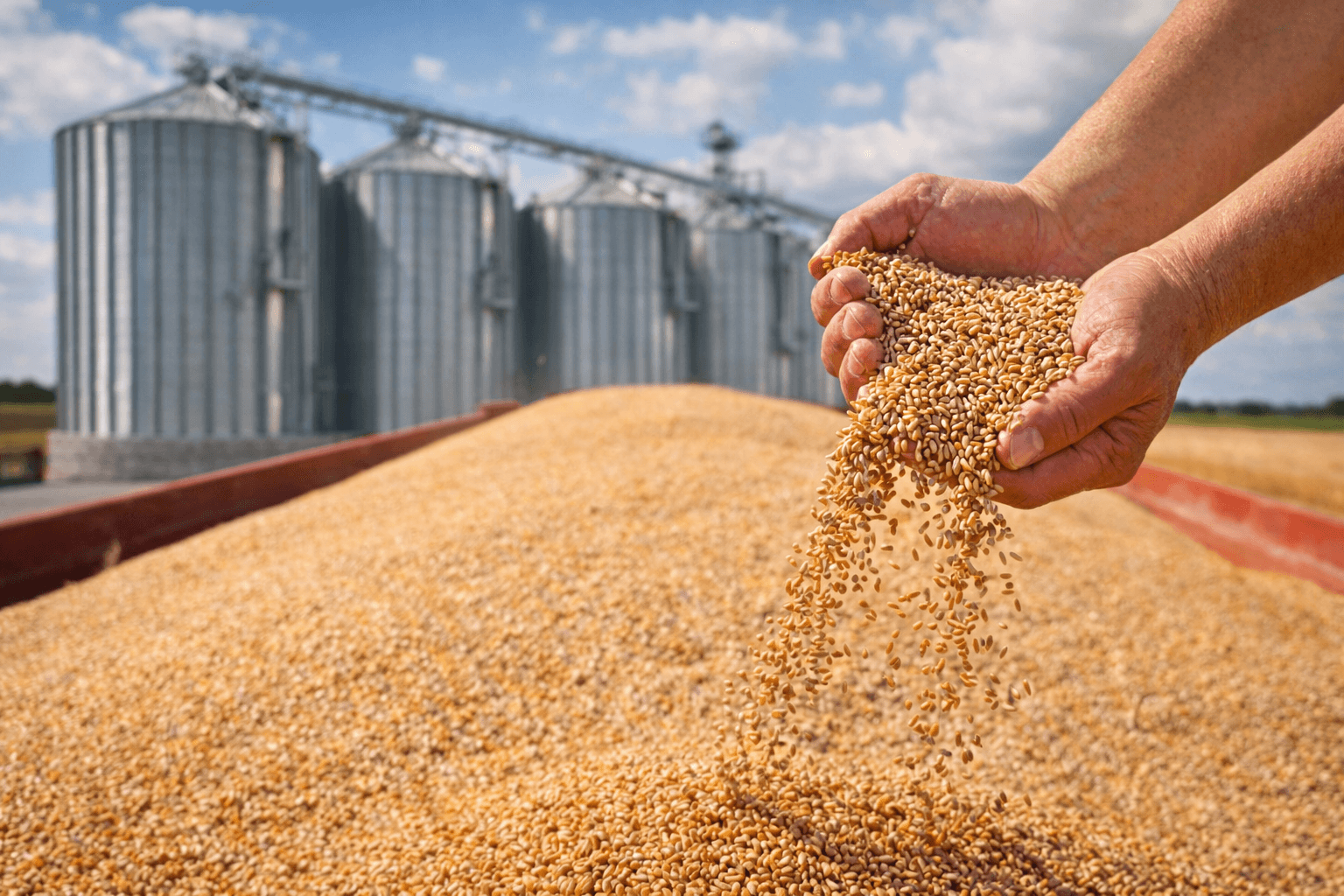
Beeld: © AI generated, Illustration Dragana Radovanovic
Food loss cycle
Capacity on paper does not always mean performance in practice
Serbia does not have a regularly published national overview of food loss by commodity and stage in the chain. As a result, policymakers, exporters and investors often rely on IPARD data and company experience rather than on one shared national baseline. IPARD, the EU’s Instrument for Pre-Accession Assistance in Rural Development, is one of the main ways Serbia aligns rural investment with EU standards and supports co-financed investment.
An older but still frequently cited regional reference point is the 2012 cold-chain assessment on the state of cold chain and postharvest loss of fruits and vegetables in Croatia and Serbia. It estimated annual post-harvest losses for fruit and vegetables in the Western Balkans at 30% to 40%. It also placed Serbia’s refrigerated and frozen storage capacity at 500,000 to 600,000 ton, including 29 controlled-atmosphere facilities with a combined capacity of 50,000 to 60,000 ton. These figures still provide useful historical context, even though storage infrastructure and sector practices have improved since then.
A more recent and useful operational picture comes from Serbia’s IPARD II documents. According to those documents, Serbia has 181 registered cooling facilities for fruit and vegetables, with a total capacity of 608,000 ton. At the same time, many existing cold stores are outdated and often lack air-conditioning, while only about 12 facilities were reported to use Ultra-Low Oxygen (ULO) storage technology or formal quality-assurance systems such as HACCP or ISO standards.
That gap matters. A sector can have storage capacity on paper and still lose value in practice. Cold chains depend not only on buildings and equipment, but also on monitoring, maintenance, trained operators, standard procedures, and good coordination between growers, packhouses, traders and exporters.
‘If quality declines during drying, storage or handling, the product becomes harder to sell at the intended price or in the intended market’
Not every commodity loses value in the same way
Fruit, berries, and many vegetables remain the most exposed segment because their quality depends heavily on speed, temperature control, and consistent handling. In addition, they can deteriorate quickly when field heat is not removed fast enough or when storage conditions fluctuate.
Cooperation Takovo Berry in Serbia shows how parts of the sector are moving toward more resilient and market-oriented production, combining regenerative and biological blueberry cultivation with subcontractor networks and GlobalG.A.P. certification for domestic and export markets. But examples like this also show the wider challenge: strong individual players by themselves cannot create the common handling standards, reliable pre-cooling routines and quality-control discipline needed across fragmented supply chains.
In grains, the pattern is different. Here, losses are less about rapid cooling and more about proper drying, safe moisture levels, aeration, hygiene, pest control and regular monitoring. Serbian research on stored maize and wheat shows that storage pests still matter, both for quantity and quality, especially where routines are weak.
Soy and other field crops face a broader mix of risks, from harvest timing and drying to cleaning, storage and quality control across fragmented farms and buyer networks. In these chains, problems often only come to light when a processor or exporter rejects a lot that has already passed through several stages of handling and transport. This is where organizations such as Donau Soja are relevant. In Serbia, Donau Soja works with more than 3,000 farmers, collectors and cooperatives; it supports certification and lot-based traceability for sustainable, non-GMO soy. While this does not help to measure food loss directly, it helps identify quality problems earlier in storage, transport, or handling. It reduces the risk of quality deterioration and costly late-stage rejections.
Beeld: © Dragana Radovanovic
Takovo Berry, a regenerative agriculture blueberry producer
Policy is moving, but measurement still lacks
Serbia’s Waste Prevention Plan 2025–2030 is an important policy signal because it reflects the prevention-first approach of the EU Waste Framework Directive 2008/98/EC. It includes food-waste measures aligned with EU practice, such as voluntary agreements, food-donation rules and incentives, awareness-raising and data collection. The plan also states that the EU food donation guidelines should be taken into account. However, food loss before retail and households still needs much better stage-by-stage measurement if policy and investment are to become more precise.
Another legal instrument that matters is the Food Safety Law. It sets the framework for food safety, traceability, imports, exports, and official controls. For exporters, weak hygiene, traceability, or documentation can quickly turn technically edible products into downgrades, rejections or lost commercial value. Food safety is therefore not just a compliance issue; it also shapes how much marketable food makes it through the chain.
In the short term, investment is the strongest lever. Under IPARD III, planned support for Serbia exceeds EUR 580 million, combining EU funding, national co-financing and beneficiary contributions. That creates room for the practical upgrades needed to reduce food loss, including modern cold stores, packhouses, grading and sorting equipment, drying systems, grain storage, traceability tools and technical support for farms and processors working to meet higher standards.
‘Fruit and berries remain the most exposed segment because their quality depends heavily on speed, temperature control, and consistent handling.’
What is already happening and where Dutch partners fit in
The stakeholders consulted for this article include retail, manufacturing, and primary-production actors such as Ahold Delhaize Serbia, Nestlé, Donau Soja and Takovo Berry. That matters because food loss in Serbia does not sit in one segment alone. It plays out differently in farming, sourcing, processing, storage, distribution, and retail.
Dutch-Serbian cooperation has already tried to close some of the gaps in Serbia’s soft-fruit chain, from limited technology and open-field production limitations to weaknesses in logistics, harvesting and post-harvest handling. The Netherlands Soft Fruit Solutions project showed what this can look like in practice: field exchange, business matchmaking and longer-term professional ties. It also pointed to the next step not as much technology in general, but more targeted solutions in varieties, planting material, greenhouse production, packaging, equipment, and logistics, where they can improve productivity, food safety, and quality.
A second example comes from Wageningen University & Research. The Lighthouse Farm Lab in Serbia, hosted by the large-scale organic farm LoginEKO, looks at how data and technology can help scale sustainable farming systems. That matters for food loss too, because Serbia’s biggest gap is not awareness, but better measurement and better decisions between field, storage, logistics and market.
Another example comes from the retail side. Ahold Delhaize Serbia has linked its food-waste work to the wider Ahold Delhaize 2030 reduction target and to donation systems for edible but unsold food. Although it does not solve pre-retail food loss on farms and in storage, it shows that major actors in Serbia are already working on waste prevention, redistribution, and traceability further down the chain.
LAN team promoting Dutch Diamond approach
The Dutch role, in other words, is not limited to supplying hardware. Through the Netherlands Agricultural Network (LAN) team at the Dutch Embassy in Belgrade, the Netherlands is already putting its well-known Dutch Diamond approach into practice, linking knowledge institutes, applied researchers and training providers. Together, they address practical needs such as loss measurement, shelf-life testing, digital traceability, cold-chain design, post-harvest protocols, and operator training.
On the one hand, Serbia has agricultural potential, export markets and investment interest. On the other hand, it still lacks key parts of the chain is consistent post-harvest performance and a shared way of measuring where value is being lost before food reaches the market. Once that becomes clearer, the agenda for policy, investment and Dutch-Serbian cooperation also becomes more concrete.
‘Knowledge institutes, applied researchers and training providers address practical needs such as loss measurement and cold-chain design’
More information
If you would like to know more about Serbia’s agri-food sector and opportunities in areas such as post-harvest handling, cold-chain development, and sustainable production, you can go to the country page of Serbia at this website. You can also send an e-mail to the LAN team at the Dutch Embassy in Belgrade: bel-lvvn@minbuza.nl.