
Innovation finds its way to Romania
Dutch manure-related knowledge
Romania’s agricultural sector balances traditional practices with the need for more sustainable farming methods. With a focus on livestock farming and manure management, the country faces challenges in boosting productivity while minimizing environmental impact. Meanwhile, the Netherlands offers cutting-edge expertise in manure processing, soil health, and circular agriculture. This creates ample opportunity for collaboration between the two nations, where knowledge exchange and innovative practices can help Romania develop sustainability and reduce reliance on synthetic fertilizers.
Located at the eastern EU border, Romania has an area of 238,391 km², making it six times larger than the Netherlands. It is home to approximately 19 million people, with about 13 million hectares of agricultural land—9 million hectares of arable land and 3.6 million hectares of pastures and hayfields. With 45% of the population living in rural areas and 18% working in agriculture, Romania remains largely an agricultural country. However, livestock numbers are below the country’s feed base’s sustainable capacity. Romania has 1.8 million bovines, 3.2 million pigs (it imports pork and piglets), but much higher numbers of poultry (79 million) and sheep and goats (almost 12 million).
Romania’s farming structure is not very diverse, consisting of many small family farms (2.8 million) and relatively few large farms (around 25,000 registered companies). The development of middle-sized farms has been slow.
Nutrient shortage and lack of organic and chemical fertilizers
Traditionally, Romanian farmers prefer synthetic fertilizers, according to the National Research and Development Institute for Soil Science, Agrochemistry, and Environment (ICPA Bucharest).
Beeld: © National Institute of Statistics
Fertilizer use in Romania. Source: National Institute of Statistics
The figure above shows the downward trend in the use of synthetic fertilizers in Romania in the 90’s, after the fall of communism and dismantling of large farms and cooperatives, and the growing trend after 2007 (EU accession). While the application of organic fertilizers is done on less than 7% of the agricultural area.
The lack of proper manure storage and improper use of organic and chemical fertilizers, especially among small farms, has led to unintended water pollution with nitrates. In larger, more intensive livestock operations, manure management systems are more efficient, but these are mostly found on commercial farms.
Romania’s geopolitical situation has caused fluctuations in the availability and price of synthetic fertilizers. Meanwhile, soil quality continues to decline. According to ICPA Bucharest, Romania does not produce enough manure to adequately fertilize its farmland.
Since 1989, this has led to nutrient shortages in Romanian soils, especially due to small farmers’ inability to provide sufficient fertilization and proper crop management. The two tables below show Romania’s nitrogen and phosphorus imbalances, demonstrating these nutrient deficiencies compared to the EU.
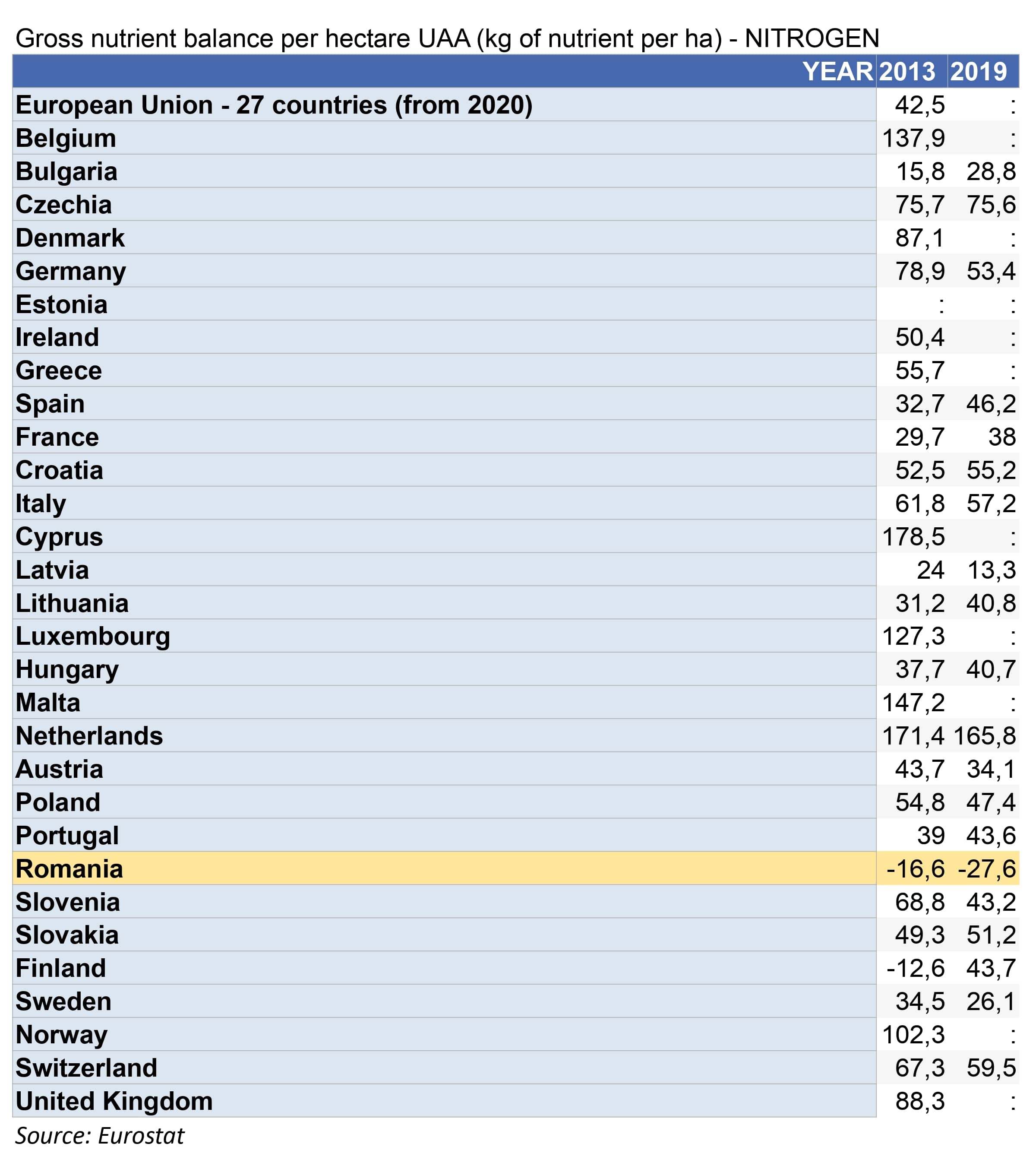
Nitrogen (left) & phosphorous (right) balances in Romania and the EU. Source: Eurostat 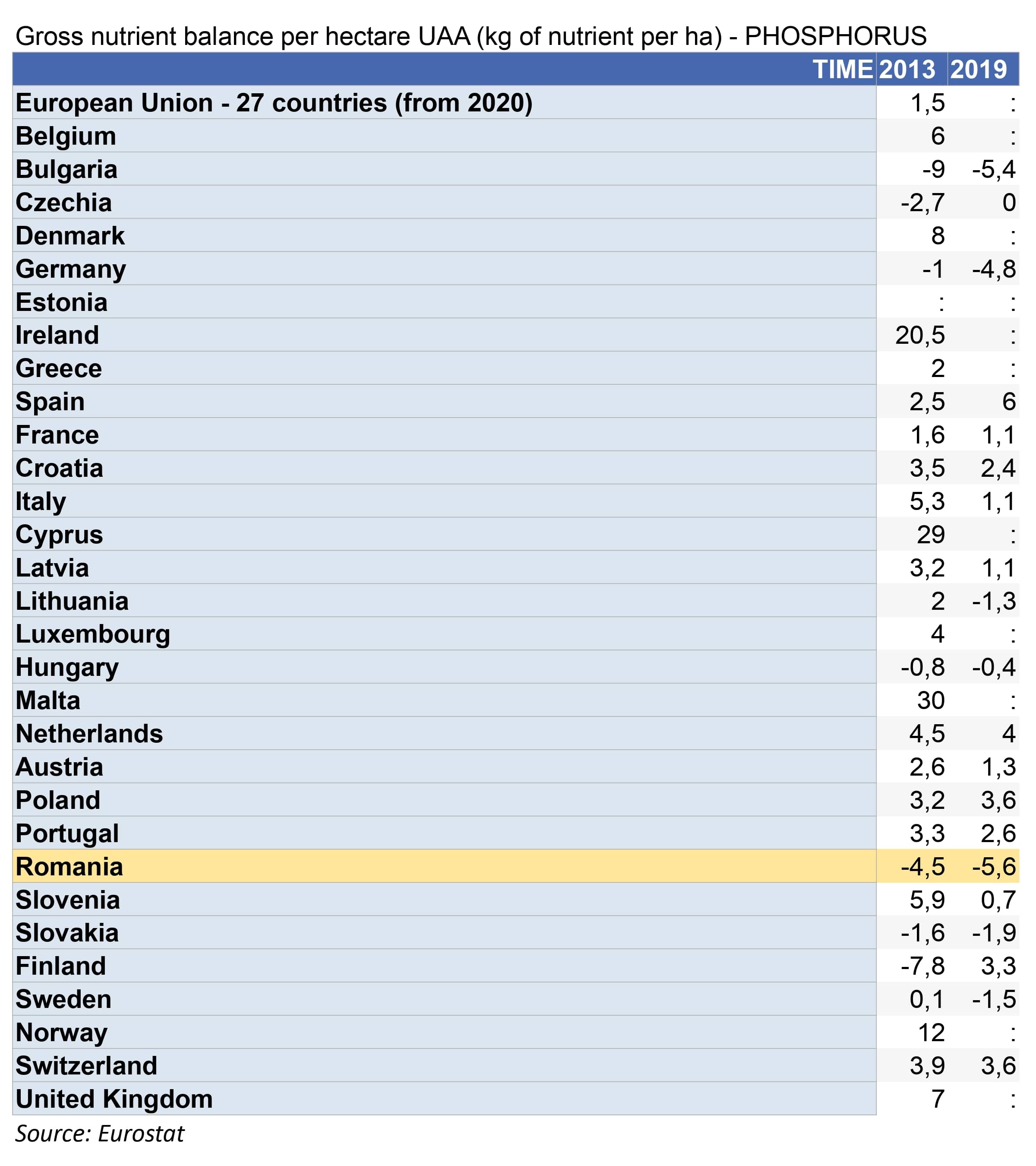
Policies: between intentions and results
The Romanian government aims to develop its livestock sector and reduce dependency on imports. However, reversing the downward trend in dairy and pig farming has proven challenging, despite EU and domestic support for animal breeding. Environmental concerns are also growing regarding the impact of current and future livestock farms.
The Nitrates Action Plan (information only available in Romanian) requires local public administration authorities to decide on the manure storage system used in administrative territorial units (ATUs), considering local conditions. Options include communal, individual, or combined systems. Larger farms can apply for Common Agricultural Policy (CAP) funds to modernize manure management systems. Smaller farms can apply for EU funds through the National Recovery and Resilience Plan (NRRP), which includes a special financing line for manure management at the commune level.
In autumn 2023, the Ministry of Environment allocated €228 million from the NRRP to finance manure collection and recovery systems at the communal level. The funding is divided into €172 million for new manure management systems and €56 million for modernizing existing systems. These funds cover expenses for site preparation, construction, installation, and equipment for transporting and spreading manure.
‘Romania does not produce enough manure to adequately fertilize its farmland’
LAN team promotion of circular agriculture
The Netherlands Agricultural Network (LAN) team at the Dutch Embassy in Bucharest has proactively promoted circular agriculture, even before it became a common term in Romania and its neighboring country Bulgaria. Early efforts by the LAN team include organizing circular agriculture tours with Dutch experts, hosting the Circular Agriculture Challenge during the pandemic in a Dutch owned supermarket parking lot in Bucharest, and producing a booklet on Dutch soil and water management solutions which Romanian farmers can get inspiration from.
In 2024, the LAN team organized a major event on healthy soils during Romania’s INDAGRA fair, highlighting the role of soil health in food production and sustainability. Recognizing Romania’s dual farming structure, both small and large farms contribute to rural vitality and food security. As such, sustainability must be central to both production systems.
The LAN team supported the regenerative agriculture initiative of ALPA in Transylvania by forming a team with the Netherlands Enterprise Agency (RVO), Wageningen University & Research (WUR), and Nieuwe Bodem, a Dutch regenerative farm. This collaboration resulted in the development of a business strategy for a training center and a pilot farm focused on regenerative agriculture practices.
Additionally, DN Agrar, a Dutch company that entered the Romanian dairy sector in the mid-2000s, has grown into the country’s largest integrated dairy farm. The company’s commitment to sustainable practices includes investing in a biomethane production facility using manure, as well as a manure composting facility. An interview with Peter de Boer, a member of DN Agrar’s Board of Directors, provides further insights into this initiative. You can read the interview with him below.
Beeld: © DN Agrar Group SA
APOLD farm DN Agrar. Source: DN Agrar Group SA
Opportunities for knowledge exchange, joint research, and collaboration
Romania’s livestock density (0.35 livestock units per hectare of utilized agricultural area) is among the lowest in the EU, while the Netherlands has the highest density. Romania also faces nutrient deficits in its soils, while the Netherlands experiences surpluses. This contrast presents opportunities for knowledge exchange, joint research, and collaboration on organic fertilizers and RENURE products (which can replace synthetic fertilizers). Other potential areas for cooperation include dairy farming development, manure management technology, and equipment supply.
To explore these possibilities, the Dutch knowledge center for the valorization of manure (NCM) has expressed interest in conducting a survey on Romania, tentatively scheduled for the second half of 2025. Additionally, the LAN team in Bucharest is planning a high-level Dutch agri-food mission to Romania, most likely coinciding with the INDAGRA fair, which will be held from October 29 until November 2, 2025. The mission will focus on dairy and organic fertilizer sectors, which could greatly benefit from such a collaboration. To indicate your interest in joining, please contact the LAN team in Bucharest.
More information
Would you like to know more about the Romanian manure and fertilizer market? You can visit the country page of Romania on this website. You can also send an email to the LAN team at the Dutch Embassy in Bucharest: BKR-lvvn@minbuza.nl.
Interview DN AGRAR
DN AGRAR Group is the largest integrated zootechnical farm in Straja, Romania, with cow milk production and vegetable production. Below you will find an interview with Peter de Boer, BoD Member & Strategy and IR Director.
Beeld: © DN Agrar Group SA
Peter de Boer, Investor Relations Manager DN Agrar Group SA. Source: DN Agrar Group SA