
December 2025 - As part of the Agricultural Road Map—a joint initiative between the Ministry of Agriculture of Jordan and the Government of the Netherlands—agricultural marketing was identified as a strategic priority, particularly for key crops such as tomatoes and lemons. In Jordan, production and price volatility for these crops remains a persistent challenge, driven by a combination of structural and market-related factors. These fluctuations not only diminish farmers’ income and consumer purchasing power, but also place added pressure on already scarce resources, especially irrigation water.
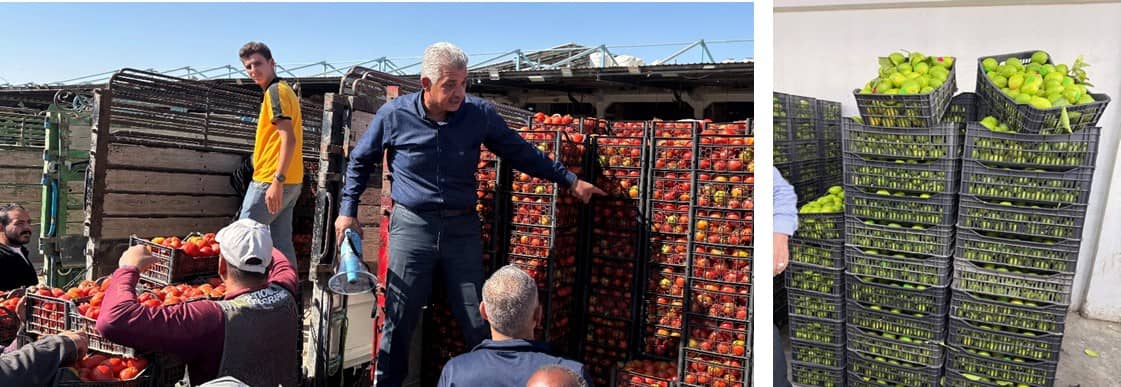
Production, imports, exports and consumption
Tomato
Tomatoes are Jordan’s most produced and exported agricultural commodity. As stipulated in table (1) below, over the past three years, the average production amounted to 587 thousand tons, while the export averaged to 210 thousand tons with zero import. The self-sufficiency ratio has exceeded 150%, with annual per capita consumption averaging 33 kg, equivalent to around 6% of annual food consumption.
Production is concentrated in the Jordan Valley and highland areas, primarily under irrigation and plastic culture. There remains significant potential to improve land and water productivity and reducing tomato loss, thereby increasing farmer profitability.
Lemons
While Jordan was once a lemon exporter during the past century, it has become a net importer over the last few decades. However, as shown in table (1), domestic production has increased significantly in recent years, reaching 57 thousand tons in 2024 up from 29 thousand tons in 2021. During 2022-2024, imports averaged around 12 thousand tons annually, reflecting both higher consumption levels and improved self-sufficiency reaching 90% in 2024 while the per capita consumption in 2024 was around 5.5 kg.
Lemon cultivation is concentrated in the Northern Jordan Valley, which accounts for approximately 20,000 dunums—around 71% of the total lemon-growing area in Jordan. Most orchards rely heavily on drip irrigation. In recent years, a major challenge has been the limited availability of cold storage facilities, a gap that has contributed to market volatility, increased post-harvest losses, and growing concerns among lemon farmers.
It is worth noting that Jordan has around 942 thousand lemon trees, of which 331 thousand or 35% are still non-bearing. These trees are expected to enter into production in the coming few years, leading to a substantial increase in domestic output that is likely to surpass current import levels.
Price formation of tomatoes and lemons in Jordan
Tomato price changes according to supply and demand which fluctuate over months and years, shaped by seasonal production cycles, product quality, and retail location. As Jordan is a net exporter of fresh tomatoes with no imports, domestic prices are particularly sensitive to fluctuations in local supply especially in the Jordan Valley and north-eastern Badia.
As shown in table (2), the gap between the farm gate and wholesale prices during 2022-2024 averaged to around 170% (75 JOD), while the retail–wholesale gap averages 272% (313 JOD). At the same period, the total markup from retail to farm gate has averaged 388 JOD, which constituted about 459% of the farm gate price. The highest tomato retail price in 2024 was 717 JOD in December while the farmgate and wholesale prices were 233 JOD and 321 JOD respectively in the same month as shown in table (5).
For lemons, Jordan relies on imports mainly from South Africa, Egypt, and Türkiye and to lesser extent from Palestine, import is allowed between May and September.
Table (3) shows that the average difference between wholesale price and farm gate price of lemon is 88 JOD, while the average difference between retailer and wholesale price is 660 JOD and the average difference between the retailer and farm gate price is 748 i.e. 277%. As stipulated in table (5) in 2024, the wholesale to farm gate price difference averaged to around 78 JOD during October–April, rising to about 101 JOD during May–September, with a peak of 113 JOD in June. Retail to wholesale differences is significantly larger, ranging from 478 JOD (February–April) to 792 JOD (May–July).
The significant monthly differences and fluctuations in lemon prices between wholesale and retail levels warrant in-depth investigation, particularly given that imported lemons are sold in the wholesale market. This explains the increase in wholesale prices and, to a lesser extent, retail prices.
Key challenges affecting producers and consumers of tomatoes and lemon
Stakeholders across the value chain—from production to post-harvest and consumption—face several challenges and constraints that directly influence the costs and prices of tomatoes and lemons, ultimately affecting farmer profitability and consumer expenses.
- Production
- Significant monthly, seasonal, and annual fluctuations in production volumes.
- Limited water availability
- Low productivity
- Farmers and dealers’ decisions depend on speculations of previous year prices
- Post-Harvest and Infrastructure
- Inadequate grading, packaging, storage/cooling, transportation, and processing facilities.
- Weak quality control and grading systems, reducing market competitiveness.
- Marketing
- High marketing cost margins especially between the wholesale and retail prices, in addition to the low share of farmers from the retailer prices.
- Weak wholesale markets infrastructure and services.
- High price volatility driven by unstable supply and demand patterns.
- Seasonal demand spikes during Ramadan and summer months.
- Export instability due to restrictions on destination markets and growing competition from rival countries.
- Provision of Services
- Limited access to finance.
- Poor advisory and technology transfer services.
- Institutional and Organizational Weaknesses
- Limited coordination and overlap in roles among national and international stakeholders.
- Weak policy coordination and coherence.
- Weak and under-resourced farmer cooperatives, especially for smallholders.
Recommended short and medium-term actions
To ensure the most efficient use and returns on resources, particularly scarce irrigation water and to fully harness available opportunities, the following actions and interventions are proposed:
Baseline quality-care and market information:
- Introducing Quality Standards for grading, food safety and packaging material (and quality-control inspectors to enforce it at the central market and in the value chain.
- Centralised data on market sizes and price-formation (national and at relevant international markets), including planted areas, price data, forecasts, and demand projections.
- Equip the extension services to help farmers in the pre-harvest phase to increase shelf life (varieties, cultivation practices)
- Review quantitative restrictions and barriers to trade imposed on seasonal basis.
- Encourage greater involvement of the private sector and cooperatives in decision-making processes.
Infrastructure and facilities
-
Modernize the transportation fleet and cooled storage, including the internal logistics at the hub (Central Market), collection transport and distribution.
- Electronic sales platform (auction) to overcome the laborious sales process
- Processing capacity of over-production (though over-production should remain limited when more market-information becomes available!)
Market development
-
Support brand-development among cooperatives: create sufficient aggregation of product through cooperatives, establish an internal collective quality-standard and collaborate in value chains to reach the required access to market.
- Knowledge sharing on early- and late-bearing varieties (citrus) to widen the production season and reduce the high peek of the high-season
- establish farmer-to-consumer markets in densely populated and low-income areas to enhance market reach and farmer incomes.
More information
For more information about the price formation of tomatoes and lemons in Jordan, you can reach out to the LAN team in Jordan:
December 2025