
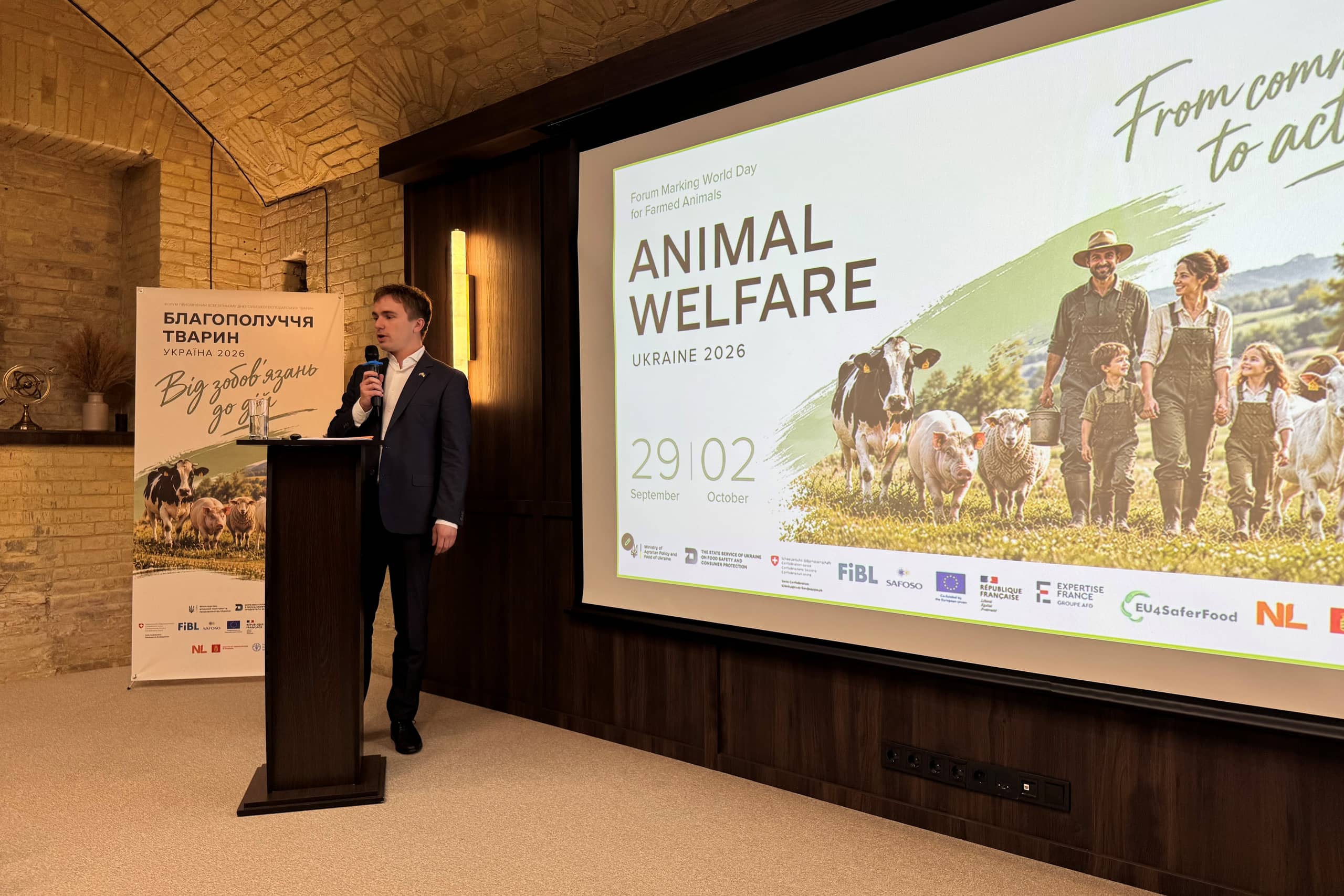
Ukraine’s Animal Welfare Forum 2026 focused on turning EU requirements into practical improvements in livestock production. Representing the Netherlands, Timo Cober highlighted long-term cooperation on education, knowledge exchange and stronger public institutions to support this transition.
Beeld: © #UAgroUA
Held in Kyiv and online on 29 September and 2 October, the forum “Animal Welfare – Ukraine 2026: From Commitments to Actions” brought together public authorities, livestock businesses, professional associations, universities and international partners. Marking World Day for Farmed Animals, it was the third annual event in a series launched in 2024.
The forum centred on Ukraine’s transition from legislative harmonisation to the effective implementation of EU animal welfare rules. Its programme addressed progress under the Roadmap for Ensuring the Implementation of EU Animal Welfare Legislation in Ukraine for 2025–2027, alongside practical challenges and opportunities for coordinated international support.
Making animal welfare part of everyday practice
Animal welfare is an integral part of responsible and sustainable livestock production. Alongside its ethical importance, it contributes to animal health, product quality and safety, international trade and the competitiveness of Ukrainian producers.
A central theme of the forum was that adopting legislation is only the first step. Implementation also requires trained personnel, prepared businesses, effective official controls and accessible practical guidance. Requirements need to translate into consistent practices throughout animals’ lives, including during keeping, transport and slaughter.
The first day focused on exchanging French and Ukrainian experience, covering public policy, training, official veterinary services and practical approaches in poultry and dairy farming. The second day addressed the Animal Welfare Roadmap, with sessions on legislative alignment, the readiness of the official control system, awareness raising and the contribution of sector associations. A panel discussion focused on progress, remaining needs and priorities for further cooperation.
A long-term priority for Dutch–Ukrainian cooperation
The Netherlands was represented by Timo Cober, Coordinator for Ukraine at the Dutch Ministry of Agriculture, Fisheries, Food Security and Nature (LVVN).
Cober emphasised that animal welfare remains a long-term priority in the Netherlands’ agricultural cooperation with Ukraine. It is closely connected to Ukraine’s EU integration and the development of a sustainable livestock sector.
Dutch support combines practical knowledge for producers, education and cooperation between government institutions. One example is support for the development of UAdairy – the Knowledge Centre for Milk and Dairy Products, which gives the dairy sector access to practical knowledge and information on EU requirements, including animal welfare.
Building the skills needed to apply these requirements is another priority. An assessment of existing animal welfare curricula and training needs has been completed. Work is now under way with four agricultural universities, the State Service of Ukraine on Food Safety and Consumer Protection, and the Association of Milk Producers to develop an animal welfare curriculum for the dairy sector.
Strengthening cooperation between authorities
At government-to-government level, two study visits on animal welfare have enabled Ukrainian officials to learn from the work of the Netherlands Food and Consumer Product Safety Authority (NVWA) and LVVN. These exchanges provided opportunities to discuss how animal welfare legislation is developed and implemented at both national and EU level.
A further step followed in April 2026, when NVWA and the State Service of Ukraine on Food Safety and Consumer Protection signed a three-year Joint Statement on enhanced cooperation. Animal health and animal welfare are among its key areas, and the partners are now working on practical implementation.
The Embassy of the Kingdom of the Netherlands in Ukraine also works closely with Ukrainian dairy and agricultural associations and supports their institutional development. These organisations are important partners in connecting policy, knowledge and farm-level practice.
Coordinating support for the next steps
Cober also highlighted the importance of coordination among international partners. The Netherlands coordinates its activities with other EU Member States at embassy level in Ukraine and maintains contact with the EU Delegation and EU-funded technical assistance projects. This helps ensure that activities complement one another and align with Ukraine’s broader EU integration process.
The forum reflected this collaborative approach. It was organised under the patronage of Ukraine’s Ministry of Agrarian Policy and Food and in cooperation with the State Service of Ukraine on Food Safety and Consumer Protection, with support from Switzerland through the Swiss-Ukrainian QFTP programme, France through Expertise France, and the European Union through EU4SaferFood. Partners included the EU Delegation, the Dutch and Danish embassies, and FAO.
Animal welfare will remain a priority for the Netherlands. Further joint activities are being developed with Ukrainian institutions, universities, sector associations and European partners, supporting the move from legislative commitments to sustained implementation.