
Economist Camelia Gavrilescu of the Institute of Agricultural Economics in Bucharest (Romanian Academy), has made an interesting analysis of the country’s agri-food trade balance deficit and the role played by processed products. Despite efforts to improve this situation in the post-EU accession period, Romania remains a net importer of agri-food products.
The role of processed products in Romania’s agri-food trade balance
In her analysis “Contribution of processed products to Romania’s agri-food trade balance deficit”, economist Camelia Gavrilescu (Agricultural Economics Institute) reveals interesting insights into the evolution and structure of the country’s imports and export of agri-food products.
The analysis may also serve as an alarm signal regarding the perhaps underestimated role food processing could and should play in turning Romania’s agri-food trade balance into a “healthy” one, by reversing the current negative trend and bringing the trade balance in line with the country’s agricultural potential.
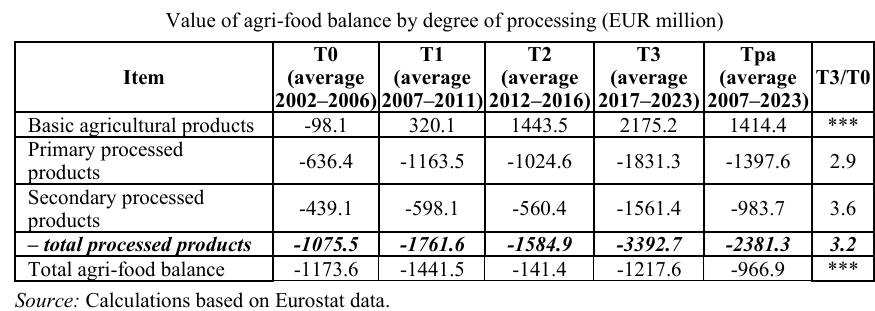
The author’s main conclusion is that, all along the examined post-accession period (2007-2023), Romania has made significant efforts to increase the quantity, quality, efficiency and competitiveness of its agri-food products and to become a more important player in the European and international markets. The result, however, is that in the analysed 17 years after accession, Romania has not yet managed to become a net exporter of agri-food products.
EU accession: main driver of economic development
Undoubtedly, Romania’s accession to the EU has been the main driver of its economic development in the last (post-accession) years. Access to the Single Market and to other extra EU markets with which the EU has preferential trade agreements have favoured important developments in this sector. The EU financing in the pre- and post-accession period (funds from the second pillar of the CAP) as well as foreign and domestic capital investments, generated growth in the agricultural and food sector through the establishment of new enterprises, development of existing ones and provision of modern technologies, which have facilitated the implementation and compliance with the strict sanitary and veterinary regulations and high quality levels necessary for presence on the Single Market.
At the same time, the Single Market rules allowed unrestricted access of Community products to the less developed and less competitive Romanian markets, which were therefore confronted with foreign competition at lower prices, better quality and with a more diversified range of products, adapted to the continuously changing consumption pattern of Romanian consumers.
Due to their lower purchasing power than that of consumers in other EU countries, the low-income segments of domestic consumers keep on seeking very cheap and often lower-quality products. Their excessive presence on the Romanian market has been detrimental to domestic producers who are trying to develop their businesses by supplying good quality products manufactured with local raw materials. It is however true that Romania has managed to achieve an increase in exports.
The Romanian agri-food sector: still far from reaching its potential
The analysis of Romanian agri-food trade highlighted a series of positive developments in the post-accession period: the increase in trade flows (mainly in exports); significant improvement in the quality, quantity and diversity of processed products. However, these positive developments were not sufficient to increase the share of processed products in exports and reduce their share in imports; but they allowed maintaining the positive trade balance with countries outside the EU, starting with 2010 (through the massive contribution of basic agricultural products – cereals, oilseeds, live animals).
Romania remained in the area of large imports from the EU, especially processed products, resulting in a quasi-continuous agri-food trade deficit.
After accession, the ratio between agricultural goods and processed products improved. First of all, a strong increase in the value of exports can be noticed: 9.5 times for basic agricultural products, 6.7 times for primary processed products and 13.3 times for secondary processed products.
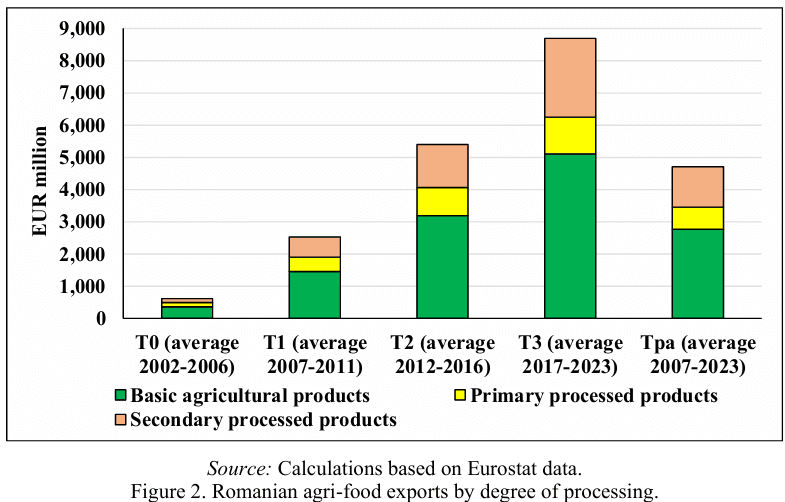
In recent years, the average share of processed products in exports has varied between 41–43%, of which approx. 13% semi-processed products and 28% highly processed products. At the same time, the share of processed products in imports is around 69–70% compared to 73% in the pre-accession period.
Causes of sector underdevelopment
The factors that have contributed the most to the weaker development of the Romanian agri-food sector, compared to the other Member States are:
• Unfavourable structure of agricultural production (crop/animal production ratio), strongly favouring the production of cereals and oilseeds for export, and increasingly moving away from subsectors generating higher added value (such as animal husbandry and local processing of agricultural products).
• Lack of development efforts that would allow the local transformation of these raw materials (cereals, oilseeds) through primary and secondary processing, thus reducing the need for imports, increasing and diversifying exports in quantitative, qualitative and value terms.
• A deficient structure of the agricultural production sector (low share of medium-sized farms, with a commercial vocation, inclined towards concentration, capitalisation and financing).
• Small farmers’ reluctance to various forms of association, which thus maintain underdeveloped or fractured agri-food chains, unable to concentrate supply in subsectors dominated by small family farms, but potentially generating high added value (vegetables, fruit, dairy and meat production).
• An inadequate and still underdeveloped structure of food industry, which is polarised: on the one hand, a small number of very large processing units (generally transnational companies) and on the other hand, many very small units, operating at local level. The share of medium-sized processing units, able to efficiently valorise local raw materials, to integrate into local and regional value chains, so as to concentrate sufficient activity with development potential for export, is very small.
Editor’s note: There are obviously more factors which contribute to the underdevelopment of the agri-food sector in general, however mostly related to the primary sector. For example, lack of adequate basic infrastructure such as irrigation, low level of agri education of most of the smaller farmers, insufficient practical training, aging farmers and the problem of generational renewal, worsening climate conditions (increasingly frequent droughty years, putting pressure on the economic viability of farms), etc. The author’s focus is mainly on the food sector. However factors affecting primary producers have an impact on the competitiveness of the raw materials they supply to the food industry, and therefore they indirectly contribute also to the negative agri-food trade balance, as processors turn to more competitive foreign-sourced raw materials, instead of making use of domestic ones.
Possible solutions
In this context, which is becoming increasingly complicated due to unpredictable developments in world markets, in the opinion of the author the future targets of the Romanian agri-food production and trade sector should be:
• increasing production and concentrating supply in order to reduce imports of basic products (meat, fruit, vegetables);
• medium and long-term investment programmes in the food industry for a significant improvement in the use of domestic production of agricultural raw materials, to diversify the range of exported products and increasing on this basis the share of products processed for export;
• increasing the number of products integrated into European quality systems (PDO, IGP, TSG, mountain product), as well as investments in the local organic product processing industry;
• last but not least, significantly improving the marketing of Romanian agri food products on European and extra-European markets.
The full analysis is available here.
More information
For more information, you can reach out to the Netherlands Agricultural Network in Romania via: bkr-lvvn@minbuza.nl