
India is one of the world’s 17 mega-biodiverse countries, home to around 7–8% of recorded species despite covering just 2.4% of Earth’s land area. It includes major IUCN-recognized biodiversity hotspots such as the Himalaya, Western Ghats, North East India, and Sundaland, which are globally important for their rich species diversity and high levels of endemism. India’s biodiversity strategy links conservation with food security, livelihoods, health, climate resilience, and sustainable resource use, while its legal and institutional framework supports conservation through the Biological Diversity Act, 2002, National Biodiversity Authority, State Biodiversity Boards, local committees, protected areas, and wildlife laws.
To ensure that the use of biological resources also supports biodiversity conservation, Access and Benefit Sharing Mechanisms (ABS) are being strengthened. By linking access rights with fair returns to communities, traditional knowledge holders, and local institutions, the framework creates incentives to protect ecosystems, conserve species, and use resources more responsibly.
Sacred groves: biodiversity preserved by culture and local traditions
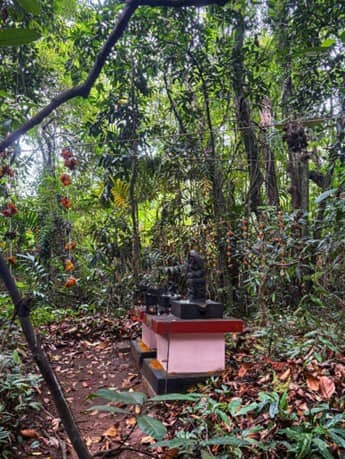
Sacred grove well preserved by community for several generations in Paravur, Kerala
In Kerala, sacred groves called ‘Kaavu’ are one of the most remarkable community-led traditions of biodiversity conservation. Protected for generations through cultural and spiritual beliefs, these small forest patches shelter a rich variety of native plants, birds, insects, and other wildlife, while also helping maintain local water sources and soil health. Their continued survival shows how deeply rooted traditions can support ecological protection, offering a powerful example of conservation shaped by community stewardship rather than formal enforcement alone. With different names, such sacred groves also exist in other Indian states like Maharashtra, Rajasthan, Meghalaya, Karnataka, Himachal Pradesh, Bihar and Jharkhand.
Conserving biodiversity helps build resilience in agrifood systems by protecting the genetic, ecological, and cultural diversity that supports food security. Pokkali, a good example of native rice variety, developed from local rice landraces that farmers conserved and selected over many generations in response to specific coastal and wetland conditions. This indigenous rice variety thrives in saline, flood-prone wetlands and is often integrated with prawn farming, while Kagga rice in coastal Karnataka is another example of such variety that survives in similarly harsh conditions, showing how locally adapted biodiversity can support food security, farmer livelihoods, and climate resilience.
Circular Agriculture: after harvest of Pokkali Rice, leftover biomass returning life to wetlands for nourishing Zero-Input Shrimp Farming
Digital advisory strengthen biodiversity action in coffee landscapes of Western Ghats
In the coffee-growing landscapes of India’s Western Ghats, biodiversity is not an abstract idea. It shapes soil health, pollination, water retention, shade, and the long-term resilience of farms and forests alike. A pilot project supported by Netherlands Agriculture Network, led by IDH and Precision Development, together with the Coffee Board of India is showing that simple, well-designed digital advice can help farmers make choices that are better for nature and their own livelihoods.
Beeld: © IDH - India Coffee Climate Resilient Landscape initiative
A coffee grower planting Jackfruit tree for providing shade in coffee plantation
The initiative was envisioned to play a catalytic role in integrating the Biodiversity component into India Coffee Climate Resilient Landscapes Program, with strategic co-investments from leading private sector companies such as Unilever and JDE Peets as a part of their global sustainability plans. The project developed digital advisory on biodiversity conservation and climate action in coffee landscapes. The advisory was delivered to coffee growers via Coffee Krishi Taranga, a two-way Interactive Voice Response platform. The project reached about 25,000 farmers in Karnataka and Kerala, including 28 percent women farmers, making it a large-scale effort to turn ecological knowledge into practical action.
Turning advice into action
The advisory content was designed around ten topics that matter directly to coffee growers, including agroforestry, intercropping, beekeeping, nutrient management, irrigation, and soil management. To make the messages easier to understand and use, they were translated into local languages, Kannada and Malayalam.
Beeld: © IDH - India Coffee Climate Resilient Landscape initiative
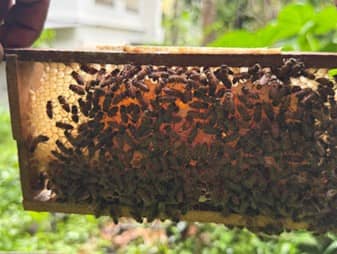
Beekeeping adopted in coffee landscapes in India
What changed on the ground
By the end of 2025, all 25,000 farmers in the programme had received digital advisories, and 70 percent adopted at least one biodiversity-friendly practice. Around 70,500 native agro-forestry trees were planted, covering 10 species. Beekeeping was taken up by 15.7 percent of farmers, and women showed especially stronger adoption rates.
Lessons from farmers
Farmers were less responsive to messages that bundled too many actions together, used jargon, or focused heavily on ecological theory instead of practical guidance. They are open to sustainable practices when those practices are practical, understandable, and supported over time. The main barriers were not ideological resistance but knowledge gaps, labour shortages, financial risk, fear of yield loss, weather uncertainty, and limited access to inputs like planting materials etc.
Why this model matters
This project offers a practical model by combining digital communication, local language delivery, behavioral insight, and follow-up. It also shows how technology can support conservation in working landscapes where farm productivity and ecosystem health must advance together.
The work is already influencing what comes next. The pilot resulted in discussions underway on a tripartite agreement involving IDH, Karnataka Forest Wildlife and Climate Change Foundation, and local NGOs to strengthen biodiversity interventions, including the possibility of subsidizing native tree saplings and expanding supply from around 200,000. India Coffee Climate Resilient Landscapes Program is also looking at scaling impact across the crop cycle, strengthening business incentives for transition, and improving access to finance and inputs at community level.
Dutch companies are prioritizing biodiversity across agri-food value chains in India
Several Dutch organisations are showing how biodiversity conservation can aid and be built into everyday farming and supply chains. IDH works through landscape approaches that promote regenerative, low-carbon, and deforestation-free agriculture, while Solidaridad supports sustainable production in key commodities such as cotton through regenerative practices and responsible sourcing. Raddis Cotton offers a practical example from India, where regenerative cotton farming is being used to improve soil health, reduce toxic inputs, increase farm biodiversity, and strengthen farmer livelihoods by better price realization for the produce. Nedspice, a Dutch spice processor and exporter supports biodiversity conservation through its sustainable sourcing initiative, farmer partnership programs and collaboration with the National Sustainable Spices program across India. Reka Group BV, another Dutch company has a bio-inputs manufacturing facility in Hyderabad for production of mycorrhiza and other biological solutions that improve soil health, reduce reliance on chemical inputs, and help build healthier, more resilient farm ecosystems.
Healthy soil is a breeding ground for diverse organisms to perform essential ecosystem function. Through a series of activities around soil health, Netherlands Agriculture Network in India is promoting regenerative agriculture practices and strengthening the core-ecosystem that’s forms basis of a robust biodiversity. Under the overarching theme of co-creating sustainable agri-food systems, a seminar focusing on sustainability in Spice Value Chains was organised by Consulate General of the Netherlands in Kochi, where emphasis was given to soil health and biodiversity conservation.
Seminar organised by the Consulate General of the Netherlands in Bengaluru in collaboration with World Spice Organization in Kochi on 6th May 2026
In conclusion, biodiversity conservation is most effective when it is rooted in people’s lives, local knowledge, and practical livelihoods. From community-managed ecosystems and resilient crop varieties to farmer-led advisory systems and responsible business initiatives, models prioritizing sustainable use of biodiversity and nature can sustain the future of the planet.