
Each year on February 2, on World Wetlands Day, we are reminded that wetlands are among Europe’s most underappreciated assets. Europe has lost a large share of its wetlands over the past century, leaving territories more exposed to climate extremes. It was the case of the Valencian Wetlands after the floods in October 2024. Restoring them is not an act of kindness. It is a strategic investment in resilience, food security and long-term competitiveness. The workshop “Wetlands across borders” connected diverse Dutch and Spanish stakeholders with two goals in mind: bettering wetlands governance in Valencia and safeguarding the grutto.
Beeld: © iCatalist / iCatalist
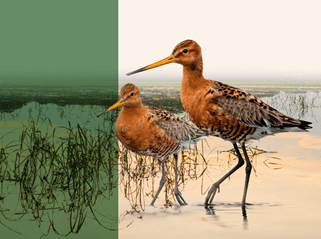
The black-tailed godwit (Grutto) connects two countries
Few species illustrate the continent’s ecological interdependence as clearly as the black-tailed godwit (Limosa Limosa), the Dutch National bird. This creature breeds in the damp meadows of the Netherlands and migrates thousands of kilometers south to Spain, relying on coastal wetlands as refueling stations whilst enjoying the rich soils seeded with rice and insects. Wetlands regulate floods, buffer droughts, filter pollutants, store carbon and sustain biodiversity at a scale far beyond their surface area.
The godwit’s journey is a reminder that wetlands are not isolated landscapes but shared infrastructure. Preserving wetlands covers many dimensions. Wetlands in Spain have a cultural value too. The signature dish, the Valencian paella, portrays the designation of origin of the Valencia’s wetlands. They are part of history identity and of its citizens. Meadow birds, bring families and scholars together for birdwatching , to understand their behaviour. Their presence is a symbol of healthy and living ecosystems.
Wetlands and water management
Sites such as l’Albufera in Valencia are not peripheral habitats; they are critical nodes in a trans-European ecological network. When water management falters in one country, breeding success declines in another. It was against this backdrop that “Wetlands Across Borders / Coastal wetlands: connecting people and nature” convened on January 15th 2026 in l’Albufera, Valencia.
The event formed part of the Valencia Water Management Planning project from the Generalitat (regional government) and supported by iCatalist and Embassy of the Netherlands in Spain. Its purpose was to strengthen cooperation around the water–agriculture–biodiversity nexus in Mediterranean coastal wetlands, with a focus on two Valencian wetlands Marjal de la Safor and els Estanys d’Almenara. Both will serve as a blueprint to manage the entire Valencian wetland system.
Beeld: © LAN Team / LAN Team
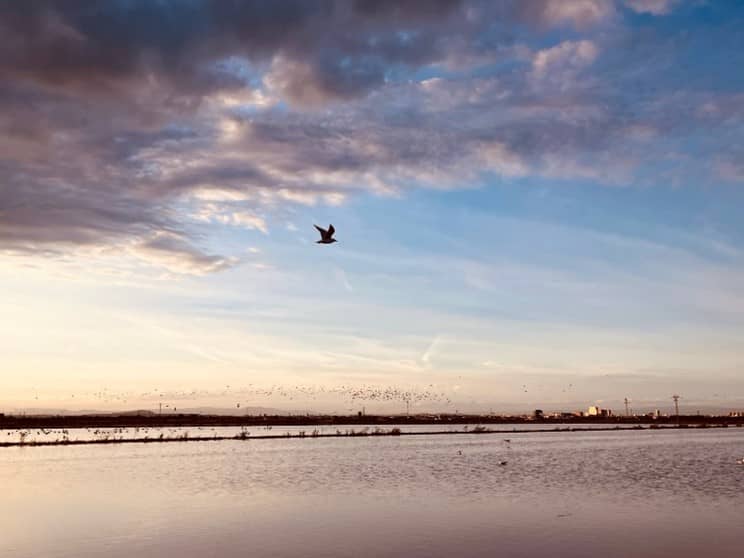
Afafar, Valencia
European collaboration: Spain and NL work together in wetlands conservation
The workshop blended technical presentations, institutional dialogue and a participatory session, preceded by a field visit to contextualize debate among different realities: pressure from agriculture, urbanization and climate stress. Representatives from public administrations, wetland managers, researchers, environmental organisations and the farming sector joined both in person and online. From the Dutch side, Wouter Vansteelant, Visiting Researcher of the University of Amsterdam and BirdsEyes of Groningen portrayed the connections between the habitat for the black-tailed godwit and other migratory birds; Mark van der Wal, Senior Ecologist of the International Union for Conservation of Nature (IUCN) pinpointed the role of wetlands in Climate resilience and Eduardo Marín Salas, Biological Researcher from Felixx mentioned the Dutch Program “Water as Leverage” to advance water governance.
Participants of the workshop identified a pragmatic agenda for conservation. Priority actions included: restoring natural water flows, reducing urban and agricultural pressures through smarter coastal planning and aligning agricultural subsidies with environmental services. Nature-based solutions featured prominently. Likewise, institutional innovation was equally emphasized. Participants called for coordinated water governance, stronger land stewardship schemes and, where necessary, public acquisition of strategic land. Crucially, hydrology was seen not merely as an engineering issue but as a cultural one. Integrating local knowledge with technical planning was framed as essential for durable outcomes.
Beeld: © LAN Team / LAN Team
Field visit to Albuera lagoon
What is next in the collaboration between Spain and the Netherlands ?
The exchange revealed many leads. The Netherlands’ expertise in flood management and participatory governance offers lessons for Mediterranean regions facing episodic overflows. Spain’s experience with prolonged drought and water scarcity provides insight into allocation, efficiency and adaptation under constraint. The transfer of restoration techniques and stakeholder-driven governance models was deemed highly feasible.
Thank to LAN Spain as facilitating stakeholder together with Icatalist, future collaboration may take shape through European frameworks, including initiatives focused on migratory flyways such as LIFE Godwit Flyway and LIFE IP GrassBirdHabitats. Ideas ranged from payments for ecosystem services for farmers to cross-border volunteer exchanges linked to wetland stewardship. Of course, other initiatives on this theme will also be considered in order to enforce the aspect of mutual learning.
If the godwit’s migration teaches anything, it is that ecological continuity underpins economic and social stability. Wetlands moderate weather extremes, sustain agriculture and anchor biodiversity. In a continent wrestling with climate volatility, wetlands are central assets. The January workshop suggested that cross-border cooperation will determine whether Europe’s wetlands decline further or become exemplars of adaptive governance. The choice, like the flyway itself, stretches across borders.