
On 24 November 2025, the Embassy of the Kingdom of the Netherlands held a Sharing Session on Advancing Agroforestry Practice in Indonesia at the Library of Erasmus Huis, Jakarta. The event aimed to disseminate lessons learned, promote best practices, and deepenthe collective understanding of agroforestry production systems and value chains in Indonesia.

Beeld: © JAK LVVN
Group photo of participants of the sharing session
Attended by around 60 participants representing government agencies, private-sector actors, NGOs, and knowledge institutions, the session created an inclusive platform for peer learning, open exchange, and networking. The event was opened by the Ambassador Marc Gerritsen and concluded with brief closing remarks by the Deputy Ambassador Adriaan Palm.
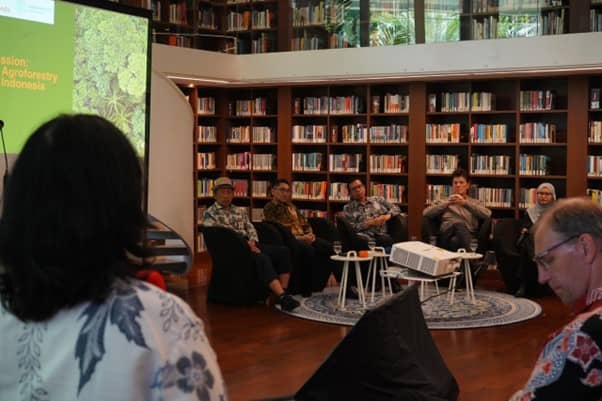
Through a series of presentations from four speakers representing diverse perspectives, participants explored strategies to scale up agroforestry, strengthen value chains, and unlock funding opportunities at the intersection of agroforestry, forest conservation, and landscape restoration.
Beeld: © JAK LVVN
Left to right: Edi Purwanto (Tropenbos Indonesia), Chandra Panjiwibowo (Rainforest Alliance), Iman Budi Utama (SNV/DFCD), Willie Smits (Masarang Foundation), and Nofalia Nurfitriani (Dutch Embassy Jakarta)
Edi Purwanto (Director of Tropenbos Indonesia) highlighted the key findings from a recent study and multi-stakeholder working group commissioned by the Embassy. Their work produced two policy briefs that outline actionable pathways for mainstreaming agroforestry in Indonesia:
- Pathways to progress: opportunities for contributing to the adoption of agroforestry in Indonesia to reach impact at scale
- Mainstreaming Intensive Agroforestry: Toward Sustainable Community-based Agroforestry Enterprises
In addition, Tropenbos Indonesia shared inspiring field experiences from West Kalimantan through their rubber agroforestry project:
Chandra Panjiwibowo (Senior Director for Asia Pacific of Rainforest Alliance) presented lessons from the Dutch-funded SDGP project, Transforming the Cocoa Sector in Indonesia Through Value Addition for Smallholders (TRACTIONS) that supports cocoa smallholders:
- Project Profile: Transforming the Cocoa Sector in Indonesia Through Value Addition for Smallholders (TRACTIONS)
- Visit TRACTIONS project of SDGP Facility in Bali, Indonesia
Complementing the field experiences, Iman Budi Utama (Innovative Finance Advisor of SNV/ Dutch Fund for Climate and Development (DFCD)) provided an overview of its financing instruments available to support climate-resilient and nature-based business models in Indonesia: Unlocking climate-resilient growth in Indonesia. This segment helped participants
better understand how to mobilize finance for agroforestry ventures and restoration-oriented enterprises.
The final speaker, Willie Smits (Founder of the Masarang Foundation), discussed the plan to scale sugar palm (Arenga pinnata) agroforestry, an initiative supported by the Indonesian government. Sugar palm is a highly versatile and multipurpose species, with uses ranging from food products to bioethanol feedstock. Its ecological value, especially in restoring degraded lands, makes it a promising commodity for sustainable rural development:
The atmosphere throughout the session was enthusiastic. Participants appreciated the format: simple yet informative, practical, and highly relevant to current challenges in agroforestry development. The event also provided a valuable opportunity for stakeholders to connect, share ideas, and explore potential collaborative projects.
More information
For more infomation, please reach out to the Netherlands Agricultural Network (LAN) team at the Dutch Embassy in Jakarta: jak-lvvn@minbuza.nl