
Three years ago, the SustainPalm consortium started an ambitious journey to support sustainable palm oil production along its value chain by establishing living labs that highlight best practices. The project team is a collaborative initiative between Wageningen University and Research (WUR), Van Hall Larenstein University of Applied Sciences (VHL), IPB University (IPB), University of Lambung Mangkurat (ULM), and National Research and Innovation Agency (BRIN) funded by the government of the Kingdom of the Netherlands and supported by the Indonesian Government.

Beeld: © LAN JAK
Closing Meeting SustainPalm, 2-3 September 2025, Bogor, Indonesia.
In the final meeting held in Bogor from September 2- 3, results were presented to key stakeholders from policy, private sector, NGOs, and research. The meeting was opened with a keynote address by Mr Dida Gardera from the Coordinating Ministry for Economic Affairs of the Republic of Indonesia, followed by a keynote by Mr Joost van Uum, Agricultural Counsellor of the Embassy of the Kingdom of the Netherlands for Indonesia, Malaysia, and Singapore. IPB was represented by Professor Dr. Arif Satria, while ULM was represented by Dr. Yusuf Azis.

Keynote speech by Mr Dida Gardera, S.T., M.Sc. Coordinating Ministry of Economic Affairs. 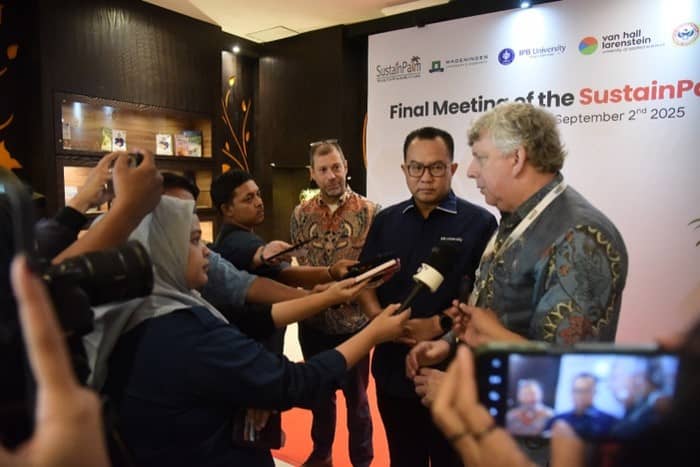
Interview with Joost van Uum (Agricultural Counsellor of the Embassy of the Kingdom of the Netherlands for Indonesia, Malaysia, and Singapore), Professor Dr. Arif Satria (Rector IBP), and Dr. Jan Verhagen (Wageningen UR).
The approach
SustainPalm was structured around 3 main themes:
- Increasing yield, crops and livestock integration
- Sustainable residue use and circularity
- Carbon and Biodiversity Rich Landscapes
The subsequent sections provide an overview of the key highlights and principal outcome.
Increasing yield, crops and livestock integration
On the first day, Maja Slingerland (WUR) summarized activities and locations showcasing integrated systems, starting with watermelon and extending to crops like banana, coffee, rice, and corn. For livestock, it was about cattle and goats. Benefits included feeding and weeding cost savings, plus manure as fertilizer. It grew from smallholders to large estates, with expertise shared between Bengkulu and South Kalimantan. A webinar series connected others in the field.
Specifically, regarding livestock integration, Ika Sumantri (ULM), added that reducing weeding costs is especially attractive for large plantations. Oil palm smallholders with only a few cattle formed a single herd that rotated through their fields, reducing the risk of overgrazing and the need for supervision.
In intercropping systems, circularity is enhanced when crop residues are used as cattle feed, and the manure is returned to the field. Engaging with SISKA’s community of practice allowed us to benefit from their expertise and training, and to share our findings, which benefited the network.
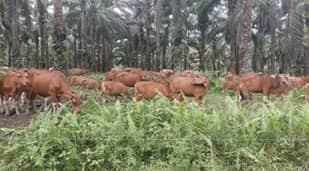
Livestock palm oil integration 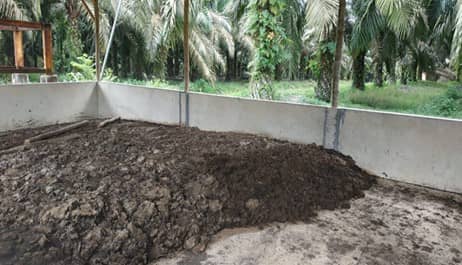
Manure as a source of nutrients
The financial benefits of intercropping, as shown by Suria Tarigan (IPB), are often associated with sharecropping, in which oil palm owners provide the land for other farmers, who cultivate other crops between the oil palms. Horticultural crops generate the highest revenue, and because they receive good care, including organic and synthetic inputs, the spillover may benefit palm trees. Corn, rice and feed crops have lower revenues per ha but also need much lower investment needs.
In central Kalimantan, Aritta Suwarno has linked coffee and banana intercropping in smallholder oil palm fields with market-oriented value chains that generate additional benefits, such as banana chips or “origin-preserved” coffee. During the meeting, attendees had the opportunity to sample these various products. Joost van Uum from the Dutch embassy sliced a watermelon to share with the audience.
Justinian Saubara Orpha Yanda (PT Arconesia) shared his experience of developing and implementing business models that made intercropping with horticultural crops financially beneficial for smallholders, companies and other supply chain actors. This work ultimately contributed to scaling intercropping systems.
The audience, including oil palm estates, highly appreciated the practices and found the business models helpful and convincing. However, more intensive monitoring of ecosystem services could strengthen the case for integrated systems as examples of regenerative agriculture practices.
On the second day two lines of discussion were followed. The first line was with banks, which indicated that their experience is more related to unprocessed horticultural crops, but are open to financing processed food and feed crops. Concrete bilateral agreements were initiated between the banks and IPB for the cultivation of kacang koro. The second line of discussion was with researchers and NGOs who emphasised intercropping and livestock integration as examples of regenerative agriculture. Rebranding may be needed to highlight practices and fill knowledge gaps. A community was formed to gather scientific knowledge on regenerative practices and Maja Slingerland was notified and later invited to participate in discussions with RSPO about the topic.
Sustainable residue use and circularity
The opening and introduction of this session, by Wolter Elbersen (WUR), focused on the various aspects of residue use in the palm oil production industry and the significance of connecting the industry to the advantages of ‘Sustainable Residue Use and Circularity’.
The group focused on 4 areas:
- Residual oils from mill biomass
- Biogas and the circular palm oil mill
- Using starch and sugars from trunks
- Producing wood products from oil palm trunks
Elbersen emphasized the significant economic and circularity benefits of more efficient utilization of residual oils from mill biomass, particularly POME and mesocarp fiber. There are substantial opportunities to enhance both economic value and circularity by optimizing the use of these residual oils.
The significant potential and economic value of gula production from oil palm for both large estates and smallholders remain untapped. Yessie Widya Sari (IPB) presented a video on the processing of gula and starch from tree trunks. This activity may reduce pressure on land-use conversion for sugar and starch.
Agung Nugroho (ULM) introduced that expanding biogas production will lower energy costs and reduce harmful emissions.
A video clarified the added value and increased circularity of wood products derived from oil palm trunks. The product range related to palm oil timber is very wide and includes furniture and building materials, such as flooring panels, as well as serveware and decorative products, presented by Yessie Widya Sari (IPB) and Agung Nugroho (ULM).
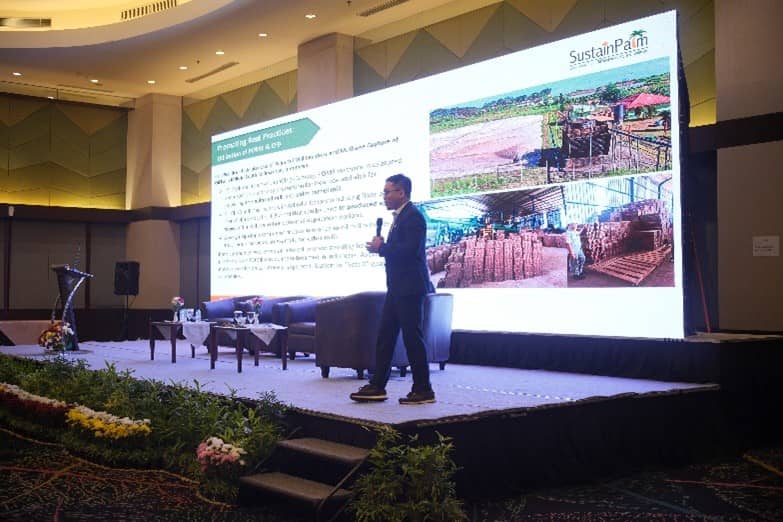
Beeld: © JAK LVVN
Dr Agung Nugroho (ULM) presented the recommendations in the biogas from palm oil mill effluent policy brief.
Carbon and Biodiversity Rich Landscapes
Around 10% of oil palm plantations in Indonesia (1.6 million hectares) are established on drained peat soils. This is highly problematic: draining peatlands leads to massive CO₂ emissions, land subsidence, and a greatly increased risk of fires. Also the clearing of the original peat swamp forest and replacing it with oil palm plantations has led to a severe decline in biodiversity.
At first glance the solution seems simple: no oil palm on peat. In practice however this is not so straightforward. Alternatives such as cultivating peat-adapted crops, vegetables, and timber species on rewetted peat (paludiculture) offer far better environmental outcomes, but are often not yet economically viable. Growing these crops in mixed paludiculture systems can help to reduce CO₂ emissions, enhance biodiversity, and generate additional income for local farmers.
Results were presented at the closing meeting in Bogor. Promising business cases from our Living Labs in Sumatra and Kalimantan were presented, showing a range of potential crops and products which can be grown on (rewetted) peat.
Several crops and associated business cases where presented, including Kelekai (Fern, used as food), Purun (reed, used for handicrafts), Gelam (timber, used for construction), Batik (using eco-prints based on peat forest species), Chilli, watermelon, orange and coffee We calculated that by combining various crops in mixed paludiculture systems (e.g. Purun, Kelakai and Gelam) the income can reach around 123,945,000 IDR or 7,746 Euros by a farmer group at Banjar (South Kalimantan). This calculation is only an initial product estimate; if scaled up further, it will continue to increase.
Various groups of farmers were trained to overcome marketing challenges and limited facilities. Also, online platforms (marketplaces) were promoted to oil palm farmers, especially the younger generation, who are already familiar with online sales.
In Kalimantan a cooperation agreement was signed with the business incubator program at the PT. Hasnur Center (part of PT. Hasnur Group, one of the largest palm oil companies in South Kalimantan). They will provide guidance to oil palm farmers in our Living Labs in developing businesses based on kelakai and agricultural crops on peatlands. They also assist in the marketing of Kelakai products (based on a local fern grown naturally in peat swamp forest areas) and other crops grown in rewetted peat areas. It is clear however that the new business cases are not as profitable as oil palm. To make them viable, additional funding mechanisms are essential, for example through carbon credits, public–private partnerships, or climate finance.
Strategies for improving carbon and biodiversity where presented. Some of the detailed carbon stock maps where shown which gives important information in developing carbon-off-set program which may give additional income to peat areas which will be rewetted. Also, a plan to improve water management in a shallow peat area in South Kalimantan was presented. This is very important to prevent flooding during the rainy season, drought and fires during the dry season, as well as maintain groundwater levels.
The next steps needed to implement further and scale up these alternatives were discussed with local stakeholder groups representing farmers, local government agencies, NGO’s and academia. An agreement was made for future actions. The first step is to develop further and finalize plans which support the implementation of the business models of some of the crops. These plans (proposals) will be submitted in the near future to donor-organizations for continued activities in our Living Labs.