
On 11 December 2025, the XVII Ukrainian Dairy Business Conference “Dairy Business 2025” was held in Kyiv, bringing together participants from government institutions, international organisations, industry associations, analytical centres and private companies. The event was supported by the Embassy of the Kingdom of the Netherlands in Ukraine and focused on the future of Ukraine’s dairy sector in the context of global market trends and closer integration with the European Union.

Beeld: © Union of dairy enterprises of Ukraine
Global trends and market transformation
Speakers highlighted that global growth in milk production is expected to remain limited in the coming years. According to international forecasts presented at the conference, global milk collection is expected to grow by only around 0.7% annually up to 2030, with particularly low growth projected in the EU (around 0.1% per year).
At the same time, demand is increasingly shifting towards products with higher added value. Global production growth for cheese and yoghurts is forecast at approximately 1.4–2.6% annually, while demand for whey proteins and dairy-based protein ingredients is expected to grow even faster. These trends reinforce the move away from bulk commodities towards processed and functional dairy products.
Challenges and opportunities in Ukraine
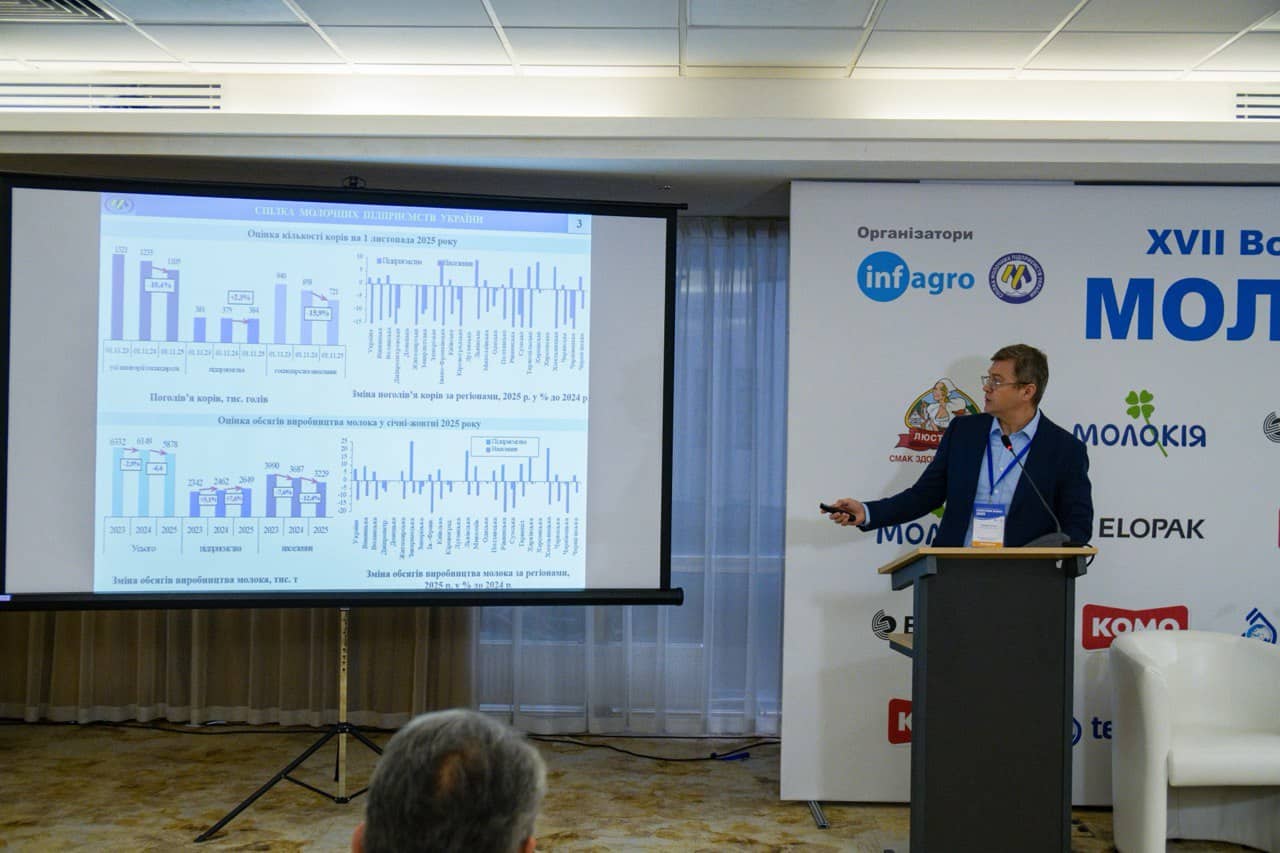
Ukrainian experts noted that the country’s dairy sector faces structural challenges, including a long-term decline in raw milk production and fragmentation of primary production. At the same time, Ukraine retains growth potential compared to many EU Member States, particularly through consolidation and industrial-scale production.
Analysts stressed that without investment in processing capacity and scale, exporting raw milk or low-value commodities will become increasingly uncompetitive. Strategic emphasis was therefore placed on deep processing, improved efficiency and compliance with EU standards on food safety, animal welfare and environmental sustainability.
EU-Ukraine trade framework
A significant part of the conference focused on the evolving EU–Ukraine trade framework. Following the expiry of the EU’s Autonomous Trade Measures on 5 June 2025, a revised EU–Ukraine trade agreement entered into force on 29 October 2025.
Under the new agreement:
- Annual EU tariff-rate quotas for Ukrainian dairy products were expanded, including:
- Milk and cream: up to 15,000 tonnes
- Skimmed milk powder: up to 15,400 tonnes
- Butter and dairy spreads: up to 7,000 tonnes
- Trade in fermented dairy products (such as yoghurt and kefir) was fully liberalised, with 0% duty and no volume limits.
- Ukraine committed to aligning its legislation with relevant EU acquis by 31 December 2028, a condition for maintaining and expanding trade preferences.
Beeld: © Union of dairy enterprises of Ukraine
Export dynamics and market data
Market analysts presented updated data showing that Ukrainian dairy exports continued to grow in 2025, despite the reintroduction of quotas. In value terms, exports of dairy products to the EU reached approximately USD 430 million in 2025, while imports also increased, underlining growing competition on the domestic market.
Exports of value-added dairy products showed particularly strong dynamics:
- Supplies of finished dairy products to the EU exceeded USD 50 million in the first eleven months of 2025.
- This segment accounted for around 30% of total Ukrainian dairy exports to the EU.
- Key growth categories included cheese, packaged butter, ice cream and private-label dairy products.
Technology, innovation and Dutch relevance
The conference featured presentations from international technology providers demonstrating modern dairy processing solutions, including automated lines for cheese, cottage cheese and fermented products with capacities ranging from 50,000 to 500,000 litres of milk per day.
These discussions underlined the relevance of Dutch expertise in:
- Milk quality and control systems
- Energy-efficient and sustainable processing
- Cooperative models and producer organisation
- High-value dairy product development
Such expertise aligns closely with Ukraine’s reform agenda and investment needs in the dairy sector.
Outlook
Dairy Business 2025 demonstrated that Ukraine’s dairy sector is actively repositioning itself towards EU integration, higher value-added production and long-term sustainability. With global dairy markets becoming more competitive and regulated, the importance of technology, scale and regulatory compliance was repeatedly emphasised.
The Netherlands, with its globally recognised dairy sector and experience in sustainable agri-food systems, remains a reliable partner for Ukraine as it continues to modernise its dairy industry and integrate more closely with the European market.