
Agricultural innovation and EU integration are gaining momentum in the Western Balkans, with Serbia focusing on strategic investments, Albania advancing its EU accession, and the region embracing smart, regenerative, and organic farming solutions. These developments showcase a growing commitment to productivity, sustainability, and technological progress in the agri-food sector.
Beeld: Guillaume Périgois
Albania opens final cluster in EU accession negotiations
Albania is set to open its sixth and final cluster in its EU accession negotiations today, marking its entry into the final stage of the membership process. At the seventh session of the accession conference, Cluster 5 – Resources, Agriculture, and Cohesion will be opened. This cluster encompasses the chapters on agriculture and rural development, food safety and veterinary policy, fisheries, regional policy and structural instruments, and financial and budgetary provisions.
Brussels notes that Tirana opened its first cluster in October 2024. Prime Minister Edi Rama described the completion of all six clusters within a year as a “record achievement,” underscoring Albania’s rapid progress in aligning with EU acquis and standards.
LAN team would like to highlight that Albania, after Montenegro, is the second Western Balkan country to open Cluster 5, although the screening for this cluster was completed two years ago. Looking ahead, Albania faces a challenging path, with a goal to complete all accession negotiations by the end of 2027.
Serbia’s 2026 budget positions agriculture as a strategic investment opportunity
Minister of Agriculture Dragan Glamočić stated that the proposed 2026 budget confirms the government’s view of agriculture as a strategic investment rather than an expenditure. A total of 1.26 billion EUR has been allocated to the sector, reflecting Serbia’s intent to strengthen its agricultural capacity and long-term competitiveness.
Within this allocation, 94 million EUR is dedicated to fuel excise refunds, accounting for 7.1% of total tax revenues. Agriculture remains the single largest recipient of state support, with more than half of all Serbian subsidies directed to the sector. Of this, 946 million EUR will go directly into incentives managed through the Directorate for Agrarian Payments.
The minister emphasized that the budget is increasingly focused on measures designed to enhance the resilience and stability of agricultural production. “Climate change has forced us to adapt. If we do not invest in these systems, we risk facing the same damages every year,” the minister warned, highlighting the government’s determination to align agricultural development with climate adaptation.
The LAN team expects these investments and commitments to be important to align with the critical needs of modern agriculture, including soil health preservation, biodiversity protection, advanced water management, and the growing demand for Agri-tech innovation. This strategic direction creates clear opportunities to strengthen cooperation with Dutch companies, whose expertise and advanced technologies can support Serbia in meeting its agricultural, climate resilience, and sustainability goals.
Serbian autonomous tractor AgAR named finalist for “Robotic Tractor of the Year”
The Serbian autonomous tractor AgAR, developed through a collaboration between the company COMING and the Faculty of Mechanical Engineering at the University of Niš, achieved major international recognition at AGRITECHNICA in Hannover, one of the world’s most prestigious agricultural machinery fairs.
This innovative robot was selected as a finalist for the “Robotic Tractor of the Year” award, marking a significant acknowledgment of Serbian smart technology on the global stage. Although the Dutch robot AgXeed won the award, as in the previous year, AgAR stood out as a technology that successfully combines automation, efficiency and sustainability.
AgAR was created to increase productivity, support regenerative farming practices and make the work of agricultural producers easier, positioning Serbia as an emerging force in advanced autonomous agricultural technology.
In the LAN team’s view, AgAR is a good example of innovations taking place in the region. It demonstrates Serbia’s awareness of Europe’s growing labour and productivity challenges. Its ability to work with existing equipment and operate reliably in real orchard conditions shows that this technology is not just experimental but ready for real deployment.
Beeld: © Dragana Radovanovic
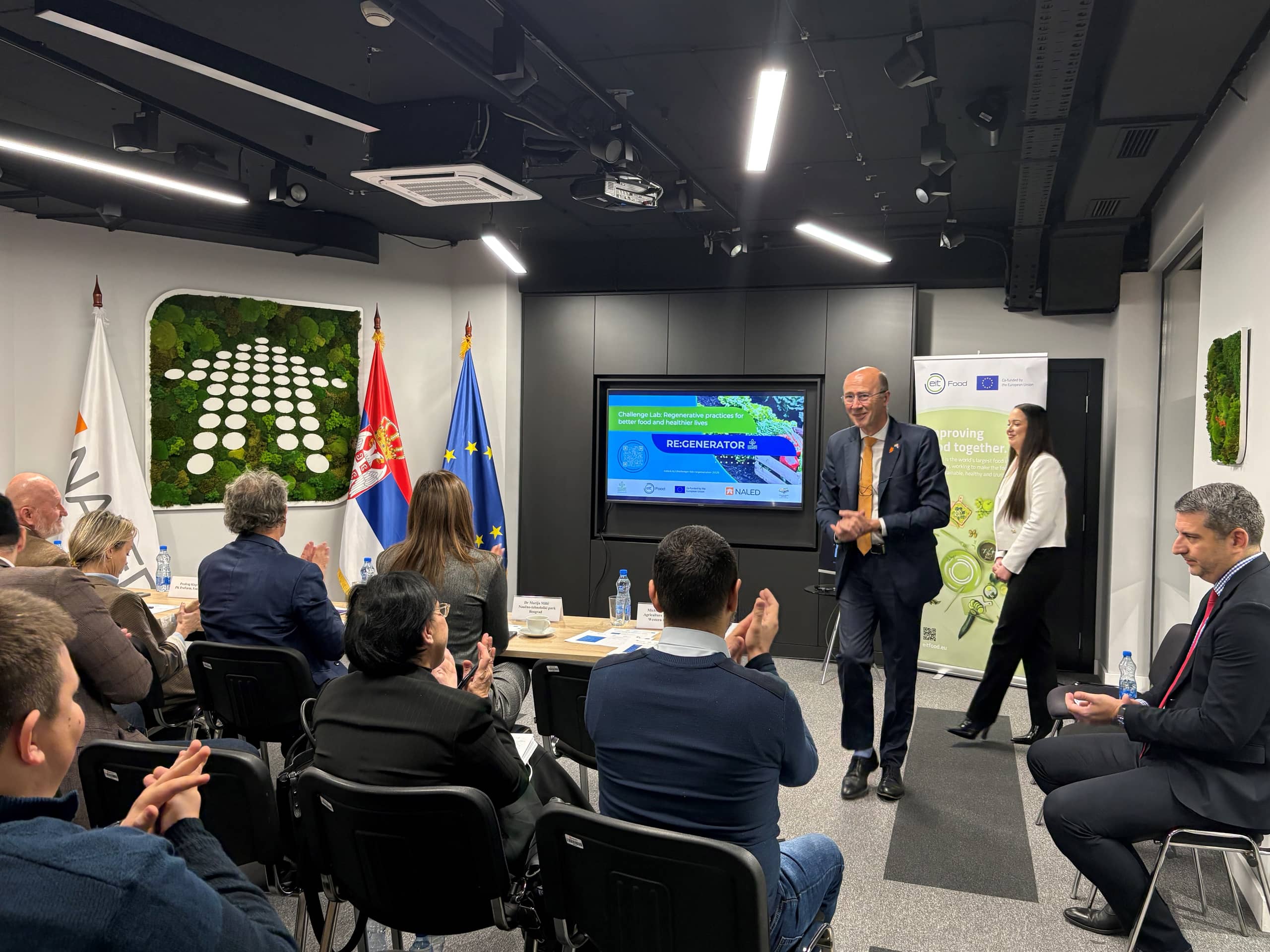
Agricultural Counsellor Michiel van Erkel attending a competition on regenerative agriculture
Challenge Lab Re:Generator 2025: advancing innovation in regenerative agriculture
NALED, in partnership with the University of Novi Sad – Faculty of Agriculture, launched the Challenge Lab Re:Generator 2025 as part of the EIT Food Hub programme, a competition designed to spark sustainable, regenerative ideas for Serbian agriculture. The initiative brought together students, researchers, entrepreneurs, and startups to reimagine how land, bio-resources, and human and financial capital can be used to rebuild healthier agricultural ecosystems.
Seven teams took part in the competition, focusing on themes such as optimizing land and bio-resource use, maximizing financial and human resources, and strengthening ecosystem functionality.. The winning team, Pollinators, sees a solution in simple test strips and winter cover crops that help preserve soil fertility and prevent degradation during the winter. The top three teams were awarded cash prizes, while all participants received mentorship, training, and networking opportunities with companies from the agri-food sector, providing a valuable platform to transform ideas into real-world impact.
Michiel van Erkel, Agricultural Counsellor to the Western Balkans and head of the LAN team, participated as a member of the jury for the Challenge Lab Re:Generator 2025. During his participation, he highlighted the importance of international collaboration and knowledge exchange in advancing the region’s agricultural innovation.All participating teams were also awarded with small tokens of appreciations from the Netherlands Embassy.
Beeld: Freepick
LoginEKO: innovation in organic farming
LoginEKO is redefining sustainable agriculture across 3,250 hectares of certified organic land, growing a diverse range of crops including sunflower, oats, peas, wheat, chickpeas, and flax. About 490 hectares are dedicated to biodiversity zones, supporting pollinators, birds, and soil health.
The farm combines traditional farming with advanced technology, using in-house software to monitor fields in real time and ensure complete traceability from seed to consumer products like their meal-in-a-bottle brand, Njamito, at present being tested in the Slovenian (EU!) market. In 2025, LoginEKO harvested 9,871 tonnes of organic crops and conducted 11 field trials to optimize crop rotation, intercropping, and natural plant protection methods.
Recently, the LAN team visited LoginEKO, touring the premices and meeting the R&B and tech teams, and had an inspiring exchange of ideas with founder Mr. Samo Login. The visit offered valuable insights into large-scale, data-driven sustainable farming and the potential of open knowledge sharing to transform the food system.