
Agriculture accounts for about 13% of Sweden’s total greenhouse gas emissions. However, farming can also help capture CO₂ from the air. Carbon farming is gaining attention as a key strategy to reduce the agricultural sector's contribution to climate change and to achieve set climate goals. The EU promotes carbon farming through policies like the LULUCF Regulation and the Common Agricultural Policy (CAP).
Can carbon farming help reach the EU climate goals?
Through photosynthesis, crops absorb CO₂ and convert it into biomass—branches, roots, and leaves. Soil organisms break down this organic matter. By applying the right measures to increase organic material, more CO₂ can be stored in the soil. This practice, known as carbon farming, helps sequester carbon in the soil while reducing emissions.
Sweden is set to provide the EU’s largest carbon sink by increasing carbon sequestration in forests and soil by 4 million tons of CO₂ equivalents per year by 2030, compared to a historical baseline.
To reach this target, additional measures are needed, with carbon farming expected to play a role. However, many current initiatives are still in their early stages or limited in scale. Scaling up efforts in the coming years will be crucial to meeting the goal.
Combined research from the European Joint Programme (EJC SOIL) suggests carbon farming could offset 10% of Sweden’s agricultural emissions. That is more than in the Netherlands, where the potential for carbon storage in agriculture is only 5.5% of the sectors emissions.
If next to carbon farming, the sector also adopts fossil-free machinery and heating for farms and greenhouses—aligned with Fossil-Free Sweden’s 2030 vision—agriculture could become a net-negative sector.
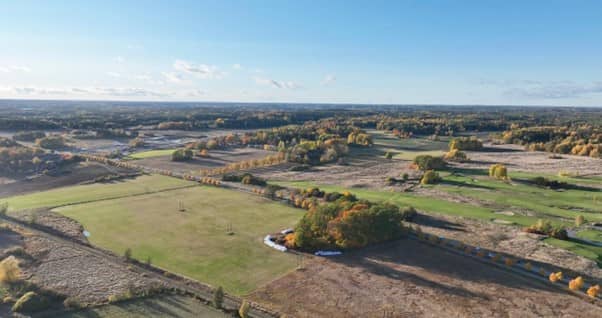
Beeld: © Shuai Feng
Relevant EU Policies Supporting Carbon Farming
Land Use, Land-Use Change, and Forestry Regulation (LULUCF): Regulates how much carbon dioxide is stored in forests and land. Each EU-country has specific targets.
Common Agricultural Policy (CAP): The EU’s main agricultural policy supports farmers, ensures food security, promotes sustainability, and strengthens rural economies. It is funded and managed at the EU-level.
So, what are the carbon farming measures used in Sweden?
Research shows that combining different carbon farming measures leads to higher carbon storage than using them individually. The most effective measures include:
- Catch and cover crops: Keeping the soil covered with green all year round helps capture carbon. Catch crops grow quickly between successive plantings of main crops, while cover crops are planted between main crops to cover the soil from erosion. Since 2022, Sweden’s Board of Agriculture (Jordbruksverket) has provided CAP payments to support farmers. According to the Swedish Environmental Protection Agency (Naturvardsverket), there is a potential for catch and cover crops for 400,000 hectares of land in Sweden.
- Reduced tillage: Reducing or avoiding soil disturbance helps store carbon. It also saves fuels used for machinery. Farmers can cut diesel consumption by 30-40%, leading to both carbon uptake in the soil and less emissions to air.
- Mixed farming: Around 40% of Sweden’s arable land is used for multiannual forage crops, i.e. temporary grasslands. These grasses and legumes grow for several years before being plowed for other crops, supporting grazing and hay production. In recent years, ley farming like this has increased in Sweden.
- Afforestation: With two-thirds of Sweden covered by forests, the country has further potential to convert 100,000 hectares of unused farmland into new forests that can take up CO2.
Many different groups are positive about carbon farming
Positive developments are that carbon farming has strong government, corporate, and farmer engagement in Sweden. Farmers protested when grassland subsidies were cut, and they are expected to return.
There is even market potential
Even green industries explore business models using voluntary carbon credits. In 2024, the EU introduced the Carbon Removals and Carbon Farming (CRCF) Regulation, its first voluntary certification framework for carbon removals and storage. The CRCF encourages investment in carbon farming.
However, carbon farming research is still in its early stages. This also complicates market valuation.
Current national soil models, based on 2,000 samples from 1990 cropland soils, provide broad-scale accuracy for different crops but lack precision for regional and small-scale. At the farm level, high costs are a barriers for funders and farmers to do measurements and monitor. As a result, identifying the most effective local strategies is a challenge.
Meanwhile, carbon market initiatives that sell credits use the national levels. This can lead to overly optimistic calculations to calculate compensation efforts of companies.
The key challenge ahead: improving monitoring and developing reliable measurement tools across the EU
And there are some other challenges too…
- Regional limitations: cover crops are not viable in Sweden’s northern regions due to short growing seasons. Clay soils in many areas also make no-tillage farming difficult, leading to yield reductions. Fortunately, most farming in Sweden happens in the middle and west of Sweden.
- Leakage risks: in the short term, carbon farming can lower yields, impacting already low farm profitability. This may also lead farmers to expand farmland to maintain production levels, contributing to land-use change.
- Financial barriers: large farms with resources can adapt measures readily, but small-scale farmers need more targeted support. Government support is needed to increase profitability.
*Reduced tillage lowers operating costs but requires high initial investments in new machinery.
*Since the grassland subsidy was removed, farmers are replacing permanent grasslands with annual crops like maize and grains, reducing carbon storage. - Knowledge gaps: During a breakfast seminar hosted by Lund University’s Centre for Environmental and Climate Science (CEC), a farmer mentioned:“There’s a need for more guidance and information. It’s easier to convince someone if they understand what you’re trying to achieve and why.“
Carbon farming increases resilience to climate change
Climate change is expected to extend Sweden’s growing season but will also increase weather variability and extreme events, posing risks to agriculture. To ensure future food security, farms must become more climate-resilient.
Soil carbon plays a key role in soil fertility and is a strong indicator of soil health. Higher carbon levels enhance biodiversity and ecosystem services that improve crop yields, such as better water retention, increased plant nutrients, reduced nutrient runoff, and lower risk of soil compaction and erosion. In carbon-poor soils, increasing soil carbon can significantly boost yields, especially under extreme weather conditions.
More agriculture in Sweden requires more carbon farming
Carbon farming has great potential in Sweden. As climate change brings rising temperatures and milder winters, more land is becoming suitable for farming in the north of Europe.
Sweden will increasingly contribute to both EU and domestic food security. For example, the wheat-growing boundary has moved from Uppsala to Umeå in recent years, and the price of agricultural land is rising. But, climate change also brings risks for agriculture.
Carbon farming can make agriculture more resilient. With its co-benefits, carbon farming could boost profitability for farmers in the long run (see BOX 2). But we need more efforts to reach climate goals: forests and nature conservation.
When it comes to carbon storage in land use, forests remain the most important factor, accounting for over 70% of Sweden’s LULUCF targets. Read more about Sweden’s forestry here.
Another key measure to reduce land use emissions is rewetting peatlands, which were historically drained for forestry and agriculture. Today, Sweden’s peatlands emit 4 million tonnes of CO₂ equivalents. This is 40% of Sweden’s agricultural emissions, despite peatlands covering only 5% of cultivated land.
Researchers warn that current rewetting efforts are too slow. It is important that rewetting happens on both farmland as well as on forest land. EU Nature Restoration Act sets binding targets for member states to do so.
At the national level, the Swedish government is investing 3.7 billion SEK in long-term efforts to restore wetlands by 2030. Sweden’s Nature protection Agency has proposed a rewetting grant to compensate landowners in this transition.
For carbon farming to be a future-proof practice, innovative and cost-effective solutions, such as digital tools, are needed for farm-level application. Cross-border collaboration promoting best practices in the Netherlands and Sweden could enhance profitability.
Carbon farming, forests and nature restoration: all efforts to tackle the climate challenge are important. Agriculture and sustainable food production will continue to play a key role in the climate strategy of the Netherlands, Sweden and the EU.
More information
This article was written with valuable input from Thomas Kätterer, professor of ecosystem ecology at the Swedish University of Agricultural Sciences. He is also involved in European research through the EJC Joint Programme.
Aimee Chan, Junior Policy Officer at the Netherlands Embassy in Stockholm in cooperation with Netherlands Agricultural Network in Copenhagen, February 2025
For more information please contact the Agricultural Department (for the countries Denmark, Norway and Sweden) of the Embassy of the Kingdom of the Netherlands in Copenhagen via email kop-lvvn@minbuza.nl