
With the European Union delaying the implementation of the EU Deforestation Regulation (EUDR) by another year, producing countries now have a crucial opportunity to prepare their supply chains. Vietnam, the world’s second-largest coffee exporter, is using this time as an opportunity to lead. Through collaborative innovation and bold action on the ground, Vietnam is building a traceable, deforestation-free coffee sector which does not only meet European market requirements but set a new standard for sustainable agriculture.
Beeld: Lan Nguyen
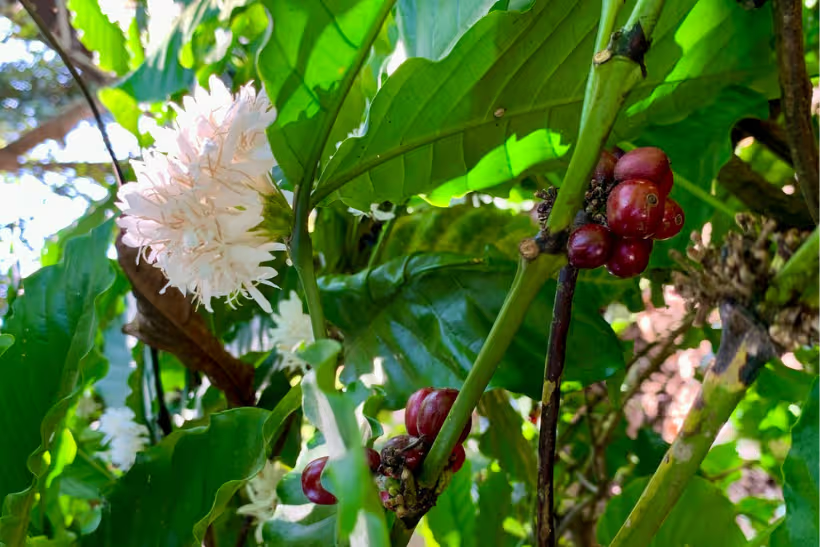
Close-up coffee tree in a farm in Central Highland, Vietnam
In the Central Highlands, where the majority (66%) of Vietnam’s coffee is grown, local authorities, companies, and smallholder farmers are working together to align coffee production with global sustainability requirements. These partnerships have come together in the Protection-Production-Inclusion (PPI) compact model, a landscape approach that balances environmental protection, inclusive growth, and responsible production.
EUDR pilots prove traceability and compliance are achievable
Between 2022 and 2023, two EUDR pilot projects were successfully implemented in Lam Dong and Dak Lak provinces. Co-funded by the Dutch government through the Sustainable Landscape Program (ISLA) and by JDE Peet’s, with support from Vietnam’s Ministry of Agriculture and Rural Development (MARD), the pilots focused on building a credible, cost-efficient traceability system.
Together, they mapped 137,000 hectares of coffee farmland and 123,000 hectares of forest, creating a database that links coffee production areas to deforestation risk. This demonstrated not only the technical feasibility of traceability at scale but also the cost-effectiveness of a shared, sector-wide system. When government and companies work in partnership, traceability systems can cost up to three times less than those developed by individual companies alone. “By bringing government, companies and farmers together, we create real impact and a pathway for Vietnam’s coffee sector to meeting increasing global sustainability requirements,” said Ms Chi Tran, Sourcing Director, IDH.
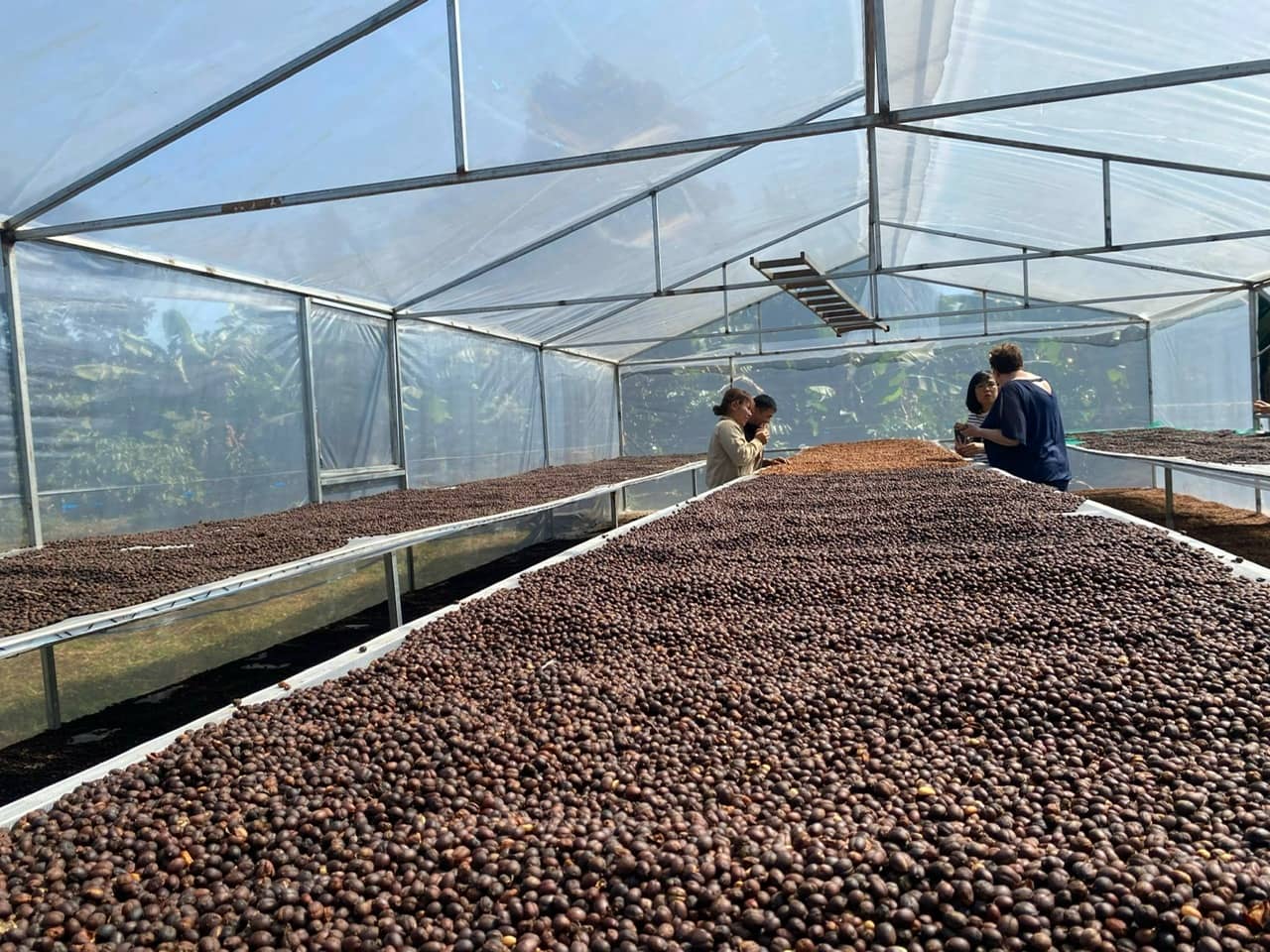
Coffee farm visit
Collaboration for scaling up
A key success factor in these pilots was the formation of a pre-competitive EUDR Alliance—an initiative where leading coffee companies joined forces to pursue compliance collectively, rather than competitively. The Alliance offers a new model for how companies can collaborate on sustainability challenges that affect the whole sector.
The next phase is now underway: scaling these efforts to the entire Central Highlands, which account for roughly 66 percent of Vietnam’s total coffee production. This scale-up will form the backbone of a national, sector-wide system to demonstrate compliance with the EUDR. It will also lay the foundation for broader sustainability outcomes, including carbon accounting, reduced emissions, and long-term climate resilience. The goal is not simply to meet European regulations, but to build a coffee sector that is future-fit—transparent, equitable, and environmentally sound.
From framework to tangible improvements on the ground
Since 2018, co-funded by the Netherlands government, The Sustainable Trade Initiative (IDH) has played a pivotal role in facilitating this transformation. By working alongside local governments and companies, IDH has helped implement PPI compacts that integrate forest protection, sustainable production, and smallholder inclusion into shared development plans. These compacts are not just theoretical frameworks—they are delivering measurable impact on the ground.
From 2016 to 2023, forest loss in the compact areas remained below one percent, mostly due to planned infrastructure and legal timber harvesting. At the same time, farmers participating in the program have seen significant improvements in their livelihoods. Incomes have risen by 15 percent, production costs have dropped by 10 percent, and the use of banned pesticides has declined by 98 percent. Carbon emissions have also fallen by 20 percent across participating farms.
These results show how landscape approaches can effectively reduce deforestation risk while improving economic outcomes for farmers. The Programme is designed to ensure that all farmers—regardless of size or location—are supported in transitioning to deforestation-free practices and have equitable access to markets, including the EU.” said Mr. Do Ngoc Sy, Sustainability Director, JDE Peet’s.
Towards a sector-wide system for sustainable and deforestation-free coffee
Vietnam is now moving from pilots and local initiatives to system-wide transformation. The EUDR pilots are being scaled up to cover the whole Central Highlands region, evolving from district-level agreements into provincial-level commitments. This shift embeds forest protection and sustainability deeper into government planning and company practices, forming the foundation for a sector-wide system that ensures traceability, compliance and long-term sustainability for Vietnam’s coffee sector.
The EUDR extension offers Vietnam a unique window of opportunity to complete this transformation. With the compliance deadline now pushed back, the country has additional time to refine its traceability systems, expand coverage to all key growing areas, and ensure that smallholder farmers—who produce the majority of Vietnam’s coffee—are not left behind. This is particularly important, as complex regulations like the EUDR risk excluding smallholders if support mechanisms are not in place.
For international partners, particularly Dutch businesses, Vietnam’s progress offers both a model and an opportunity. This transformation creates opportunities to source reliable, deforestation-free coffee and to contribute expertise in areas such as traceability solutions, data management, regenerative agriculture and climate finance.
The Netherlands, as the main gateway for Vietnamese coffee into Europe, can continue to play a vital role in facilitating compliance, in connecting sustainable Vietnamese coffee with global buyers.
This is the moment to act. Vietnam’s coffee sector has gradually demonstrated that forest protection, sustainable production, and inclusive development can go hand in hand.
The clock may have been reset, but the urgency remains. Let’s use this time to build systems that are fair, transparent, and ready for the future.
Contact information
Do you have any questions for the Agriculture Department at the Netherlands Embassy in Vietnam? If so, please send an email to HAN-LVVN@minbuza.nl or HCM-LVVN@minbuza.nl. For the latest updates, news, funding opportunities and more, follow our LinkedIn: Netherlands Agricultural Network in Vietnam.