
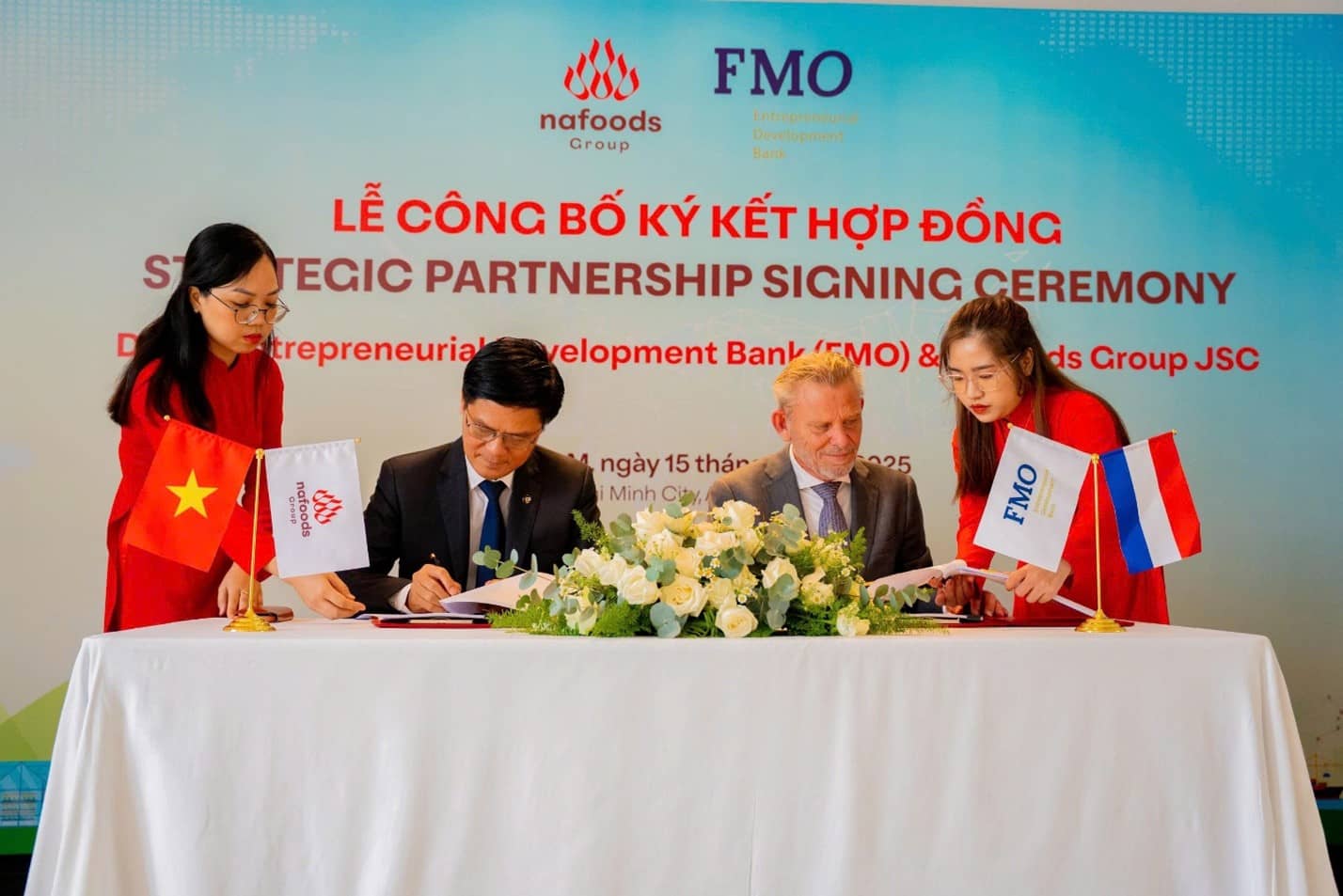
FMO and Nafoods Group signed a 20 million USD - cooperation agreement.
Beeld: © EKN Hanoi
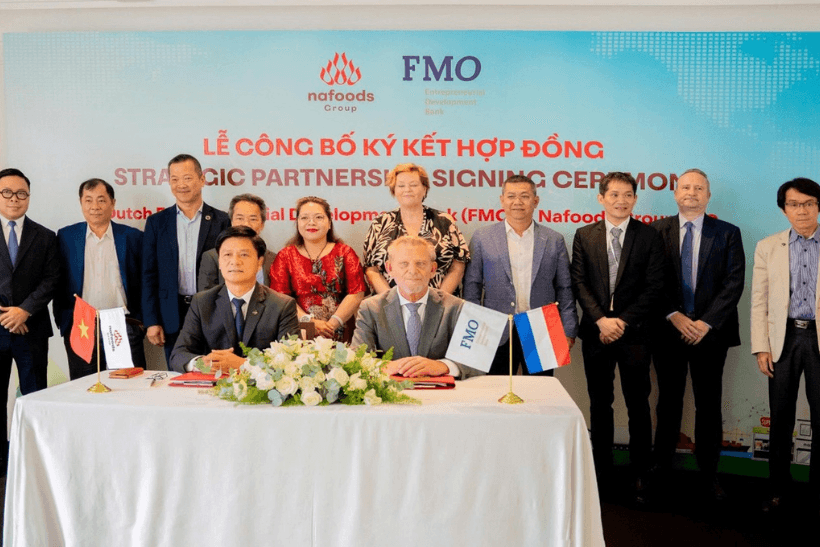
Cooperation agreement signing ceremony. Photo courtesy of Nafoods.
The Netherlands Entrepreneurial Development Bank (FMO) signed the first cooperation agreement in fruit processing and export sector in Asia. The funding of 20 million USD is allocated to Nafoods (one of Vietnamese leading fruit processors and exporters with products available in 70 countries worldwide) during 2025 – 2030. This investment aims to expand production capacity, to diversify the product portfolio as well as to upgrade its value chain for more competitive and environmentally sustainable development.
“This partnership is aligned with FMO’s strategy to expand into more agricultural subsector and support farmers and sustainable businesses. By partnering with companies like Nafoods, we believe we can help drive positive change” said Mr. Bas Rekvelt at FMO.
And Ms. Ingrid Korving, Netherlands Agricultural Counsellor in Vietnam believed that “the collaboration today between FMO and NaFoods Group will contribute to a safer, more sustainable and competitive Vietnamese horticulture sector in the international market”.
Fruit sector in Vietnam at a snapshot
Fruits and vegetables prove their increasingly significant contribution to the agricultural development in Vietnam. With a diversified ecological and geographical conditions, Vietnam produces a wide variety of fruits on the rapidly increasing production area in the past few years, reaching about 1.3 million ha by 2024 (up from 1.1m ha in 2019 and 1.22m ha in 2022). Mekong Delta, remains the fruit hub of the whole country, contributing about 70% of the total fruit production. Central Highlands and the north of Vietnam join to make the complete fruit map of the country, including high-value potential ones like durian, mango, passion fruit, pineapples, citrus, coconuts… The sector emerges as a major economic driver within the agriculture, which is a cornerstone of Vietnam’s economy.
Beeld: © EKN Hanoi
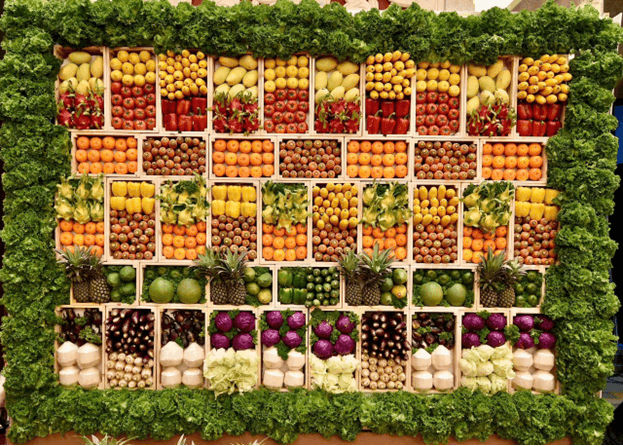
Fruit wall in Vietnam - Netherlands Food systems conference. Photo courtesy of EKN Hanoi 2024
Vietnam’s fruit and vegetable industry is experiencing impressive growth
In 2024, export revenue surged to an unprecedented $7.15 billion, nearly doubling the 2018 high, with durian alone generating nearly $3.3 billion. These numbers reflect a robust growth from the lows of 2020–2022 and reaffirm the country’s ambition to be a global supplier of tropical fruit.
Beeld: © EKN Hanoi
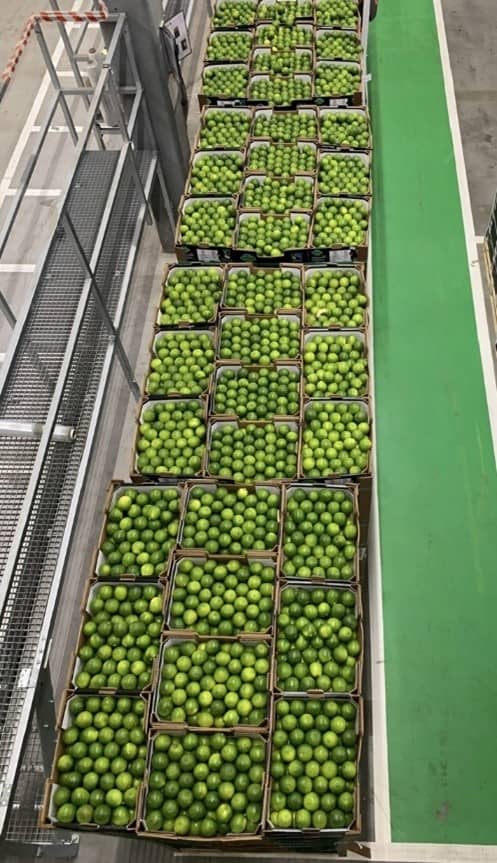
Lime imported into the Netherlands.
Vietnam is keen on upgrading its fruit production and processing quality by applying modern farming practices, quality control, expanding high-tech farming zones, creating integrated supply chains. Setting the target of 10 billion export revenue by 2030, 6 fruits are identified as billion-USD potential fruits: durian, passion fruit, bananas, pineapples and coconuts.
Despite its export success, the country still lags in value-added processing. Processed fruits—including frozen, dried, and juice varieties— accounts merely 12-17% out of the total 31 million tons of fruits harvested annually. Majority of export (80-90%) are in fresh or semi processed products. Establishments with modern processing facilities are limited. Establishment of at household-level operations are abundant. Most shipments remain fresh or semi-processed, revealing significant untapped potential in processed products.
Key challenges need to be tackled for sector development
As the sector grows, structural challenges remain. Post-harvest inefficiencies continue due to underdeveloped, fragmented cold-chain infrastructure and disjointed logistics, leading to significant losses (30-35%). Cost of agricultural logistics is also high, accounting for 20-25% of product value on average, much higher than the global average of 14%, and almost double if compared with a country in the region like Thailand.
Beeld: © EKN Hanoi
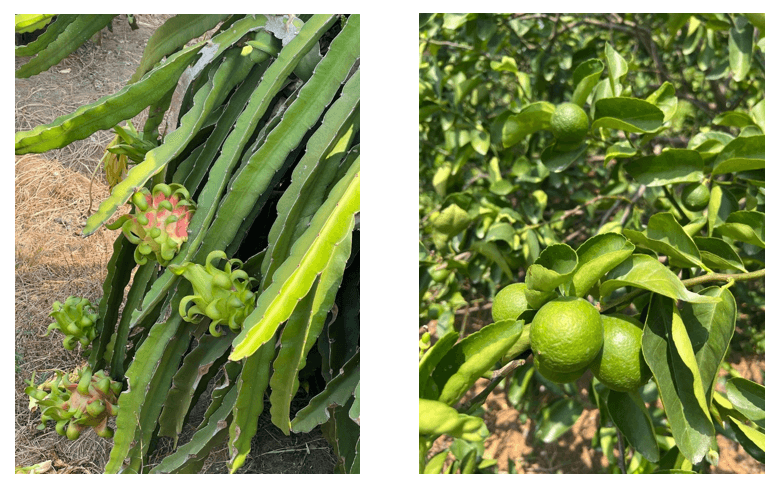
Dragon fruits and limes in Vietnamese farms.
Seedling quality is also inconsistent, as many growers depend on informal, unregulated nurseries, leading to reduced crop yields and compromised resilience. First, genetic resources are fragmented and underutilized, limiting the development of new, resilient varieties. Many local fruits posse unique qualities but lack systematic improvement, making them less competitive in export markets. Secondly, many seedlings are still produced in small, informal setup without strict quality control, leading to underqualified and diseased planting materials, which result in low yields and greater vulnerability to pest and climate stress. Without professional nurseries applying standardized propagation techniques and modern infrastructure, breeding achievement cannot be translated into stable, competitive and sustainable production.
Enhancing processing infrastructure, improving logistics, and professionalizing nursery systems are critical steps for sustainable development.
FMO - Nafoods partnership becomes transformative
The partnership between FMO and Nafoods is a significant step forward. By investing in expanding production, promoting sustainable practices, and strengthening operations, this agreement helps modernize the fruit supply chain. With this support, Nafoods is set to become a regional leader in producing high-quality processed fruit. As Mr. Nguyen Manh Hung at Nafoods strongly emphasized that the funding would help Nafoods to realize their goal of “becoming the pioneer in digitalized, green and sustainable agriculture, achieving the leading position in passion fruit seedlings, and successfully building the Nafoods consumer brand.”. This transformation is driven by a focus on technology, sustainability, and building a strong brand presence.
Beeld: © EKN Hanoi
FMO and Nafoods signing the agreement. Photo courtesy of Nafoods group.
Vietnam's fruit and vegetable industry is under rapid development, shifting from a focus on volume to emphasizing quality, innovation, and value. This transformation is evident in the sector's impressive growth, with export revenues reaching $7.2 billion in 2024, up from $5.6 billion in 2023. As the country continues to strengthen its position in global markets, this partnership supports the country's ambition and vision to agricultural excellence and sustainable growth.
Contact
Do you have any questions for the Agriculture Department at the Netherlands Embassy in Vietnam? If so, please send an email to HAN-LVVN@minbuza.nl. For the latest updates, news, funding opportunities and more, follow our LinkedIn: Netherlands Agricultural Network in Vietnam.