
By 2030, our planet is projected to generate at least five billion tonnes of waste each year, 79% of which is currently produced by livestock. Untreated livestock waste, such as manure, contributes to water pollution, soil degradation, and the release of harmful greenhouse gases like methane and nitrous oxide. As the number of livestock continues to rise, we are at a critical crossroads in managing this immense challenge.
Beeld: © Ingrid Korving @ EKN Ha Noi
The Netherlands leading in sustainable manure management and nutrient recycling
Beeld: © Pexels
The Netherlands, known for its dense livestock population, has been actively addressing this issue. As the “tiny country that feeds the world,” the Netherlands has the highest density of livestock in Europe, with more than 100 million cattle, chickens, and pigs. The country is also facing its own manure surplus crisis, and is taking strong steps toward sustainable manure management and nutrient recycling.
Livestock waste management, particularly manure management, has long been a key focus in Dutch agriculture. Dutch farmers are using technology to transform manure into mineral-based fertilizers, offering a more sustainable alternative to chemical fertilizers. The country is also exploring biogas production, a promising method to reduce methane and ammonia emissions while providing a renewable energy source.
Vietnam’s livestock waste as valuable resource for biogas production
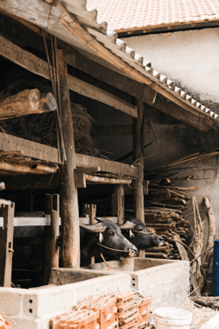
Beeld: © Pexels
Buffalo in traditional Vietnamese farm setting
On the other side of the world, Vietnam is also making progress in sustainable livestock waste management. As the country continues to expand its livestock industry, it faces challenges similar to those of the Netherlands. By 2030, Vietnam’s livestock population is expected to reach around 10 million cattle, 30 million pigs, and about 670 million poultry. The livestock industry emits around 18.5 million tons of CO₂ equivalent annually, accounting for 19% of agricultural emissions.
Today, livestock waste in Vietnam is seen as a valuable resource for biogas production, especially at the household level, where thousands of small-scale biogas systems can be installed for cooking purposes. The government and local farmers are increasingly recognizing that livestock waste can contribute to sustainable energy solutions and support both the economy and the environment. These efforts align with Vietnam’s commitment to achieving net-zero emissions by 2050 and its orientation toward circular agriculture and green growth.
Verdant Biogas: empowering rural communities
The Netherlands and Vietnam are working together, sharing a strong commitment to reducing the environmental footprint of agriculture, using land and water resources more efficiently, and promoting circular agricultural practices. In 2014, the two countries signed the Strategic Partnership Arrangement (SPA) on Sustainable Agriculture and Food Security. Since then, the SPA has served as a framework for bilateral collaboration, helping to promote innovation, applied research, and practical solutions for sustainable and resilient development.
This spirit was reflected in recent seminar on "Sustainable Development in Livestock Sector - Livestock Waste Management Solutions for Smallholder Farmers" hosted on May 23rd in Ben Tre province by the Department of Agriculture and Environment of Ben Tre Province and Dutch Verdant Biogas B.V.
Seminar on "Sustainable Development in Livestock Sector - Livestock Waste Management Solutions for Smallholder Farmers" in Ben Tre, Vietnam
Ms. Thao, Phu Trung shared that "This system helped me save a lot of money from gas for cooking. My house is clean and without smells."
The seminar showcased Dutch bio-digester technology from Verdant Biogas B.V., a social enterprise dedicated to converting livestock waste into renewable energy and organic fertilizer. Coming with different sizes to suit waste management needs of most small and medium scale farms, Verdant Biogas’ hybrid bio-digester has been used and tested by Vietnamese smallholders farmers, especially in Mekong Delta. This approach not only protects the environment but also empowers smallholder farmers by creating new economic opportunities and driving a circular, sustainable agricultural economy.
Beeld: © EKN Hanoi
Before and after testing Verdant Biogas’ hybrid bio-digester in a smallholder in Vietnam
Looking ahead
The ability to transform a problem into a resource is crucial for our agricultural and environmental future. Using livestock waste to produce biogas not only reduces environmental impact but also creates valuable economic opportunities for smallholder farmers. It is a step toward a more sustainable circular economy—one that strengthens local resources and promotes innovation in agriculture.
Contact
Do you have any questions for the Agriculture Department at the Netherlands Embassy in Vietnam? If so, please send an email to HAN-LVVN@minbuza.nl. For the latest updates, news, funding opportunities and more, follow our LinkedIn: Netherlands Agricultural Network in Vietnam.