
Mongolia is an emerging market, with opportunities in the Agri Food sector, in line with the ambition of the Ministry of Food, Agriculture and Light Industry. Opportunities can be found in food processing and improvement in storage facilities, animal husbandry, and greenhouses for vegetables.
Mongolia is a democracy between two central lead economies (China and Russia). It has a land size of 1.5 million square kilometers, about 38 times the Netherlands, with only 3.5 million inhabitants. About half the population lives in the capital Ulaanbaatar. The economy of Mongolia depends heavily on mining, as it represents 21.8% of its GDP and 80% of its exports. The GDP per capita equals 4.456 USD in 2023.
Agriculture
With 16.8% of the GDP, agriculture is the second industry in Mongolia. It is responsible for 6% of the exports of Mongolia. Around a quarter of the Mongolian workforce is working in agriculture.
Mongolia has the ambition to become more self-sufficient (see the overview below).
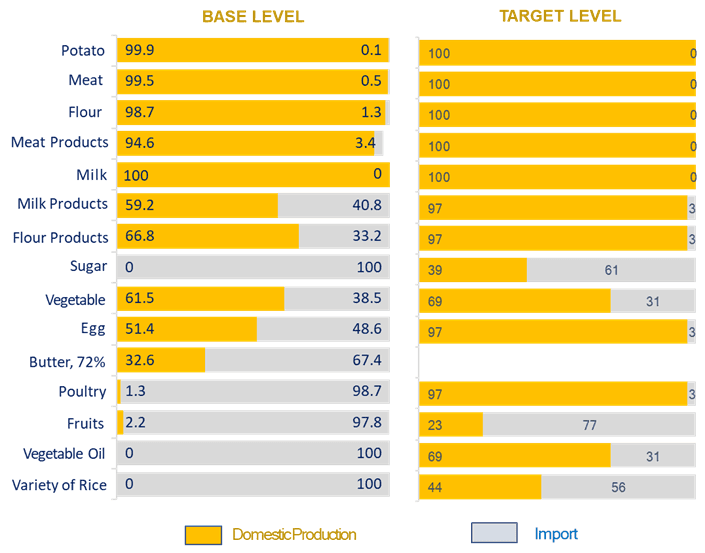
Beeld: © Mongolian Ministry of Food, Agriculture and Light industry
The most important agricultural sector is livestock. There are 24 million sheep, 23 million goats and 5 million cows, providing wool, cashmere, meat and dairy products. In meat and dairy, Mongolia is more or less self-sufficient, but it still imports about 40% of its dairy products, because of limited processing facilities. Only 15% of the milk is processed. The Asia Development Bank (ADB) identified 3 major bottlenecks:
- Seasonal raw milk supply,
- High cost of collection, because of the fragmented market with small farms
- Limited product development
Mongolia would like to become self-sufficient in eggs and poultry. Currently, they are 50% self-sufficient in eggs. Poultry on the other hand is hardly existing.
Also in vegetables, Mongolia wants to become more self-sufficient. There is an interest to develop so-called winter greenhouses to have more fresh vegetables. In 2019, there was 27.5 ha of winter greenhouses and 68.5 ha of summer greenhouses. Also in the storage of potatoes, carrots and onions, improvements can be made, as many of these products are directly sold after harvest at a low price, while later in winter these products need to be imported.
The Mongolian Ministry of Food, Agriculture and Light industry has a mid-term policy to improve domestic production, reduce import dependency and become more export oriented, as Mongolia wants to become less dependent on the export of minerals.
Most of the agri exports of Mongolia are only after primary processing, like wool, cashmere, animal skins and meat. Improving the processing industry, could create more added value and jobs. In meat processing, the slaughterhouses need upgrading to meet the export-worthy hygiene standards. Only 4.6% was slaughtered and processed in adequate facilities.
Mongolia is the second largest cashmere producer in the world, after China, but only 5% is further processed in Mongolia. The remaining is exported for further processing, mainly to China. This example illustrates the general situation in Mongolia. There is still a lack of long-term investments to upgrade the agrifood processing industry. The country exports raw materials and imports finished products.
Opportunities for Agrifood of the Netherlands
Mongolia is an emerging market, with some opportunities in the Agri Food sector, in line with the ambition of the Ministry of Food Agriculture and Light Industry.
Food processing
There is an interest to upgrade the food processing to become more self-sufficient and to add value, instead of exporting raw materials. This can be in meat, dairy, and vegetables and potatoes. Besides the processing there is also interest in improvements in agrologistics, including storage.
Animal husbandry
In Mongolia, there is interest to improve the genetics, and an interest in more professional livestock farming. This is especially in dairy, sheep and goats. This would also include the improvement of animal feed to guarantee better quality products. Also the I&R system should be improved for better herd management.
There is also interest to establish a poultry sector, to provide a different variety of meat, besides beef and mutton. At the moment there is hardly a poultry industry, therefore the whole supply chain needs to be developed.
Greenhouses
There is a limited area of greenhouses in Mongolia. The country has cold winters (below -30 degrees) and short summers. At the same time, there is a growing demand for fresh (greenhouse) vegetables, like bell pepper, tomato and lettuce. Mongolia is now mainly dependent on imports and wants to become more self-sufficient.
Both the EBRD (European Bank for Reconstruction and Development) and FMO (Dutch Entrepreneurial Development Bank) are offering financing solutions for investments in Mongolia.
Upcoming event
15 and 16 October, the Mongolia – EU Business & Investment Forum will be organized in Ulaanbaatar. This is your chance to connect with industry leaders, policymakers, and innovators driving the future of business and investment between Mongolia and the European Union.
You can register through here.
Alternatively, registration is also accessible via the official website.
Further information
If you want further information on agriculture in Mongolia, feel free to contact us at pek-lvvn@minbuza.nl.