
Despite efforts put in place by the government to contain CPI index, core inflation hits a new record. This is due to the quick rise in electricity prices and a “historic rise in food prices, of 16.7%”. In February, food prices were the highest they had ever been since 1994.
Expensive dish
Making a dish as typical as paella has never been so expensive in Spain. The rise in prices in February of several of its main ingredients has pushed the cost of paella to an all-time high: 19.1% more expensive than a year ago (Fig. 1). This is three times the 6% overall inflation rate in February.
Fig. 1. Evolution of the price of paella ingredients
The price of olive oil has risen the most, it is 33.5% more expensive than in February 2022. This growth seems far from being reversed as its production is particularly low in the current campaign. Vegetables have risen by 23.6% and rice, the most important ingredient, by 21.2%.
What about tortilla española?
Another traditional dish of Spanish cuisine, the potato omelet is 20% more expensive than a year ago. Eggs had a year-on-year increase of 28% and potatoes of 21% in February.
Food price has continued to rise even after the government subsidized taxes on the most basic products at the beginning of the year Spain: The government axes VAT of staple foods for six months | Nieuwsbericht | Agroberichten Buitenland. Higher costs faced by producers and retailers, poor harvests and long-standing problems in the primary sector are taking a heavy toll on consumers' wallets (Fig. 2).
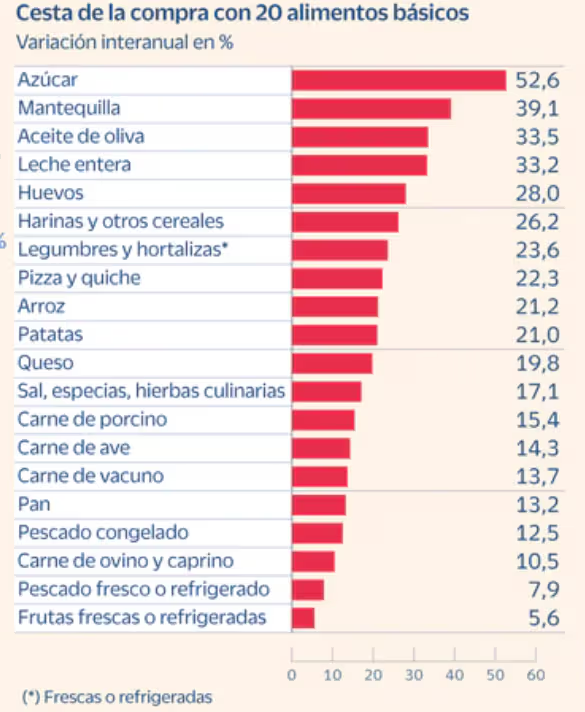
Fig. 2. YoY growth in the price of 20 food stuffs
Sharp fall in agri-food production
"Agricultural production in Spain plummets and threatens a further rise in food prices in the coming months", was the headline of the news item published by El Economista in mid-January this year. Droughts, higher commodity prices and rising temperatures have caused production to fall by 24.6% between December 2021 and December 2022, according to data from the Spanish Ministry of Agriculture (Fig. 3).
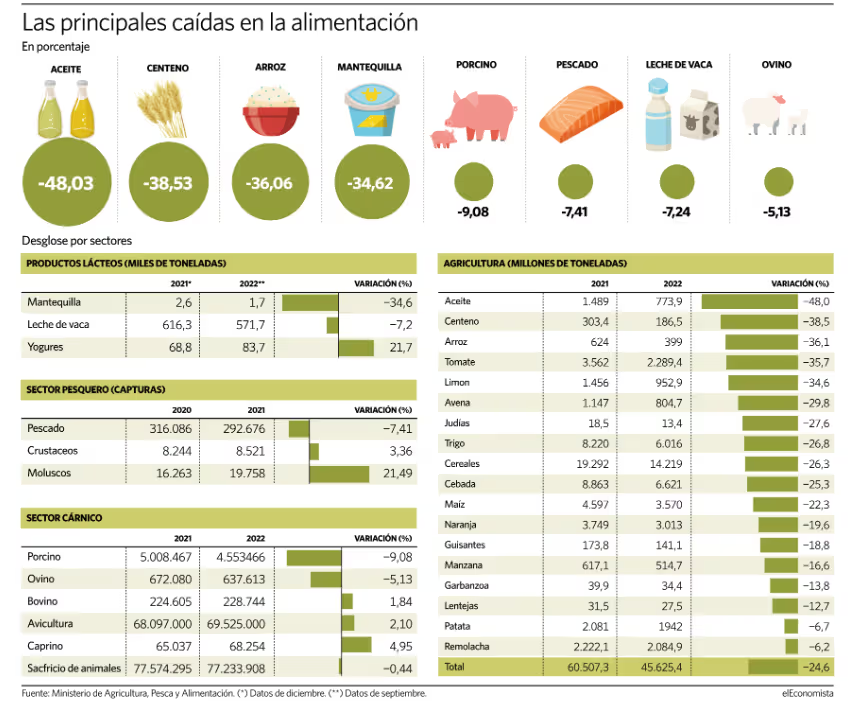
Fig. 3. Major declines in agri-food production in Spain
The main declines in agricultural products were in olive oil (-48.03%), rye (-38.53%), tomato (-35.6%), rice (-36.06%), lemon (-34.6%). In butter production there was also a significant decrease of 34.6%. In the fisheries sector, data for 2022 were not yet available, but the drop in activity of 5.77% in the previous year is significant.
Farmers get better prices than supermarkets
Good news for farmers is the difference between the prices charged by farmers and what consumers pay in supermarkets has fallen to the lowest in a decade. According to the farmers' organization Coag, this is "due to the increase in input costs but, at the same time, it would not have been possible if the industry and retailers had not adjusted their margins". This can be clearly seen in products such as oranges, milk and pork. Nevertheless, in Spain the debate now revolves around trade margins.
Is Mercadona making a killing?
On the one hand, supermarket chains insist that their profit margin has never exceeded 5% and, in many cases, is less than 2%. On the other hand, PM Sánchez has endorsed the trade unions' call for the creation of an observatory to monitor company margins. Meanwhile, the communist Podemos, the socialist party's coalition government partner, continues to claim on a cap on food prices. Such a measure has been adopted by the Croatian and Hungarian governments but has failed to halt rising inflation in those two countries.
According to the report prepared by PwC for the employers' organization AECOC, supermarkets in Spain operate with a "narrow profit margin and base their profitability on sales volume". Mercadona -the retailer with the largest market share (21.7%)- announced a few days ago that the impact of the increase in costs during 2022 had reduced the company's margin by 0.6 points, placing its profitability at one of the lowest in its historical series, at 0.025 euros of profit for every euro sold, compared to 0.027 euros in 2021.
Could a greater effort be made to narrow business margins", José M. Bonmatí, Director General of AECOC, wonders. "Reducing margins when it comes to price formation has little impact and could be ruining or mortgaging the future of most distributors. Another thing is the political debate," he concludes.
Loss of purchasing power
The general complaint of the Spanish population is that the shopping basket is becoming more and more expensive and wages seem to be constantly decreasing. Adecco Group has just published a study in which it calculates the deterioration of the purchasing power of Spanish workers. The real loss of purchasing power has been 14.2%, despite an average wage increase of 4.1%.
In this report, the Ministry of Agriculture itself acknowledges that in Spain 70% of the price of food is conditioned by the costs of energy, fertilizers and animal feed, which have not ceased to grow. The measures taken by the government have had no effect, and the parties that make up the governing coalition are expected to be severely punished in the next elections. The public does not understand whether Putin, meteorology or inflation is responsible for the current situation. What citizens do know that a year ago they were making ends meet and now their situation has worsened considerably.
More info: Spain: Capping the price of basic foodstuffs? | Nieuwsbericht | Agroberichten Buitenland